“Suspected bubonic plague in Russia” ... ‘This stock’ surges 15% as the KOSPI crumbles [Shareholder Club]
- Input
- 2026-10-14 07:50:58
- Updated
- 2026-10-14 07:50:58
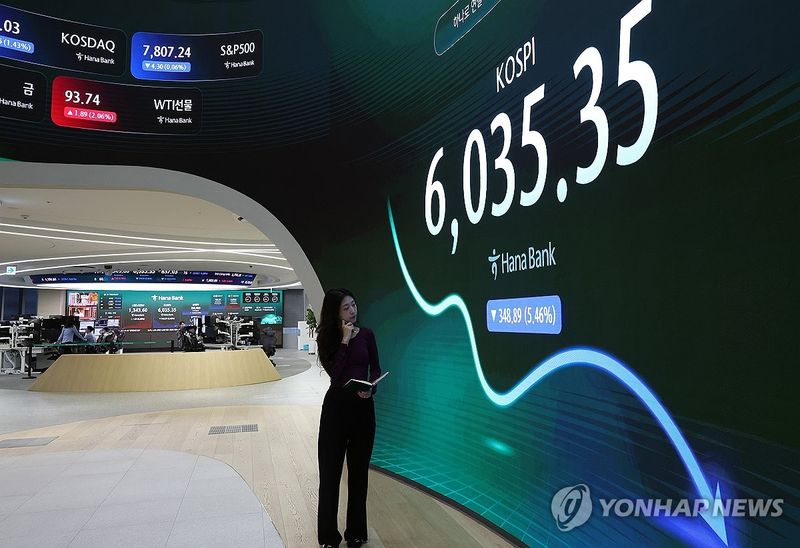
[Financial News] The KOSPI plunged to just above the 6,000 mark amid record foreign selling and external headwinds facing the semiconductor sector. After topping 7,000 in early October, the index fell more than 13% in just five trading days. Meanwhile, shipping, inter-Korean economic cooperation and vaccine-related stocks ended higher, prompting analysis that buying could shift to stocks responding to geopolitical and disease-control issues, away from headwinds in the semiconductor sector.
KOSPI briefly falls below 6,000 intraday ... Foreign investors dump 4.5 trillion won
According to the Korea Exchange, the KOSPI closed at 6,035.35 on the 13th, down 348.89 points (5.46%) from the previous trading day, while the KOSDAQ closed at 837.03, down 1.43%. At one point during the session, the KOSPI plunged more than 7% and fell to around 5,910, briefly breaking below 6,000 for the first time in 47 trading days since late July. A sell-sidecar was also triggered for the first time in two months since August 19.
Artificial intelligence (AI)-related headwinds had a major impact. In a report, Kang Jin-hyuk, a senior researcher at Shinhan Securities, said, “AI-related headwinds have weakened investor sentiment toward the associated value chain,” adding, “Doubts about the persistence of bottlenecks and whether the sector is cyclical—the key arguments for semiconductor strength—were stirred up, leading foreign investors to continue their sell-off.” Foreign investors were net sellers of 4.52 trillion won worth of shares that day alone, and their cumulative net selling in October has come close to 13 trillion won.
Vaccine stock Kukje Pharmaceutical surges ... Shipping stocks also hold up well
Some stocks rose despite the sharp market decline. First, concerns over supply-chain instability persisted amid clashes between Yemen’s Houthi rebels and Saudi Arabia, lifting shipping stocks HMM (1.2%) and Pan Ocean (1.6%). Codes Combine, an inter-Korean economic cooperation stock, also rose 0.6% after U.S. President Donald Trump said talks between North Korea and the United States could be possible while he was visiting Asia in November for the Asia-Pacific Economic Cooperation (APEC).
Vaccine stocks posted the biggest gains. After the World Health Organization (WHO) requested additional information on suspected bubonic plague cases in Russia, vaccine stock Kukje Pharmaceutical surged 15.4%. These stocks all have a relatively low dependence on semiconductors, and their gains appear to stem more from external developments than from improving earnings in their respective sectors.
Still, non-semiconductor rotation is clearly taking shape: secondary-battery stocks such as LG Energy Solution (3.0%) and materials, parts and equipment stocks such as PSK (6.5%) gained, while the KOSDAQ held up relatively well. Kang said, “Rather than actual damage to fundamentals, confidence in semiconductors has been shaken, with Samsung Electronics and SK hynix both hovering around their 200-day moving averages,” adding, “Non-semiconductor rotation could continue until doubts about semiconductors are resolved.”
[email protected] Kim Hee-seon Reporter