Kang Kyung-wha: “DMZ mine blast was no accident” ... Embassy in Washington scrambles to clarify
- Input
- 2026-10-14 07:24:27
- Updated
- 2026-10-14 07:24:27
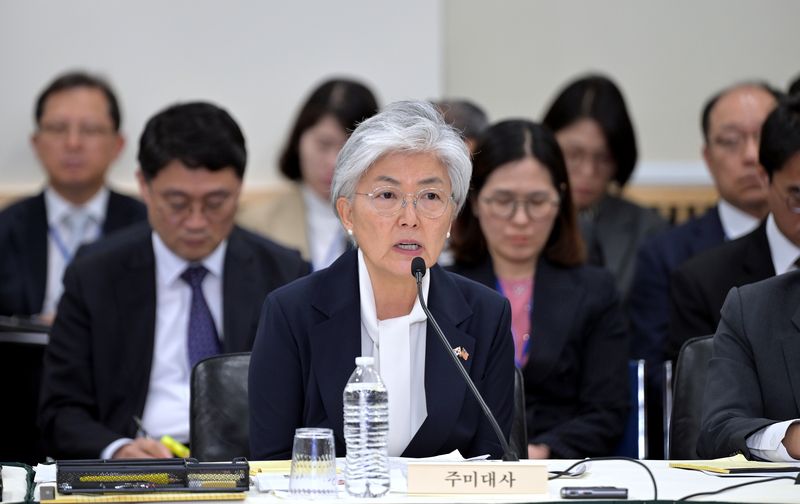
[Financial News] The South Korean Embassy in the United States said in a statement on the 13th (local time) that Ambassador Kang Kyung-wha’s remarks at a parliamentary audit about North Korean mines in the Demilitarized Zone (DMZ) were not intended to challenge the government’s existing position.
In a press backgrounder on the 13th (local time), the Embassy in Washington said of Ambassador Kang’s remarks the previous day, “They were in no way intended to address whether a particular expression previously used by our government was correct.” The previous day, during an audit by the National Assembly’s Foreign Affairs and Unification Committee, Kang was asked about her position on the mine explosion. She replied, “As a member of the public and as ambassador, I am deeply saddened by the harm suffered by our military,” but added, “Based on what the Joint Chiefs of Staff announced, these were mines laid by North Korea. In that case, they were laid deliberately, and in that sense, I don’t consider it an accidental incident.”
Earlier, President Lee Jae-myung described the incident as an “accident” in his Armed Forces Day address on the 1st. The Embassy in Washington explained that “the government’s use of that particular expression was intended to encourage and console the service members who were seriously injured in the mine explosion and their families. The ambassador also said, in that same spirit, that the harm suffered by our military was deeply saddening, both as a member of the public and as ambassador.”
The Embassy in Washington stressed that “the ambassador made the remarks in the course of emphasizing that, according to the Joint Chiefs of Staff’s final investigation findings on October 5, the explosion was caused by mines deliberately planted by North Korean forces south of the Military Demarcation Line (MDL), in violation of the Armistice Agreement.”
The Embassy in Washington also said, regarding controversy over limits to intelligence cooperation imposed by the U.S. side, “It is difficult for us to confirm the details of diplomatic communications between South Korea and the United States or of intelligence cooperation between the two countries.” It added, “We seek to continuously strengthen the U.S.-South Korean alliance as a pillar of our foreign policy, but differences between countries are inevitable, and we believe there is also a need to narrow and manage those differences.”
At the parliamentary audit the previous day, Kang said that at a meeting on the 18th of last month between Foreign Minister Cho Hyun and U.S. Secretary of State Marco Rubio, “there was talk that there were problems with intelligence cooperation,” adding, “I don’t think the problems have yet been sufficiently resolved to the extent the United States expects.”
At the audit on the 12th, Kang also said, “I acknowledge that there are limits to communication with the White House,” adding, “I often meet with the White House National Security Council (NSC) and key White House officials, but consultations at a senior level are not happening as much as I would like at this point, to the extent that even I find it frustrating.” In response, the Embassy in Washington said the remarks “were intended to convey that the ambassador was highly motivated to improve communication between South Korea and the United States and would make further efforts to meet that goal; they were in no way meant to suggest that there were difficulties with existing communication between the two countries.”
[email protected] Park Jong-won Reporter