“Borrowing to buy as stock prices fall”... Individual investors’ margin debt reaches 34.2886 trillion won
- Input
- 2026-10-14 06:59:31
- Updated
- 2026-10-14 06:59:31
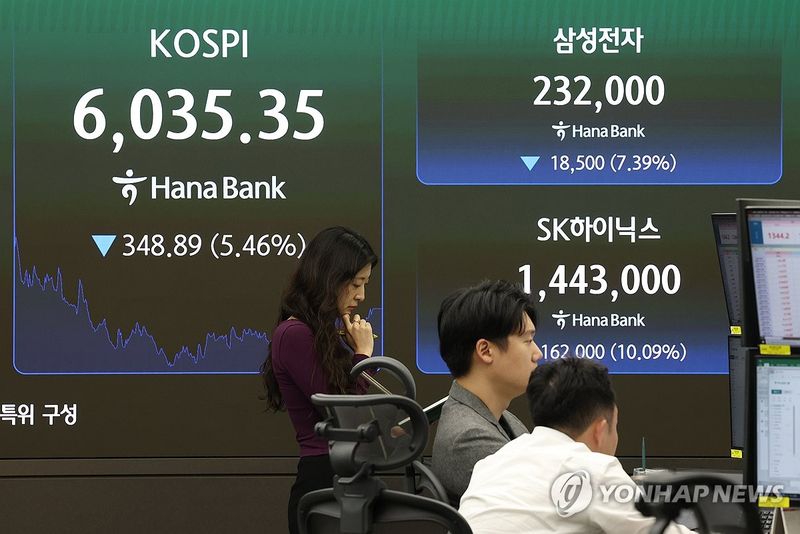
[Financial News] As the KOSPI fell to the 6,000 mark, the outstanding balance of margin-financing transactions—in which individual investors borrow money from securities firms to buy stocks—rose to its highest level in three months. Some investors appeared to be treating the sharp drop in stock prices as a chance to buy at lower prices, but forced liquidations also surged.
Investors are believed to have increasingly used loans to buy stocks as prices fell sharply. However, cases in which holdings were forcibly sold because investors could not repay outstanding balances also increased, raising the risk of investment losses.
According to the Korea Financial Investment Association on the 14th, the outstanding balance of margin-financing transactions stood at 34.2886 trillion won on the 12th, up 477.3 billion won from the previous day.
That was the highest level in about three months, since the balance reached 34.3701 trillion won on July 15.
The outstanding balance of margin-financing transactions, which had fallen to the 27-trillion-won range in early August, began rising again afterward. At the time, the stock market remained weak, and the amount borrowed to buy stocks had also declined.
After hovering around 33 trillion won, the balance rose into the 34-trillion-won range on the 12th, increasing by 477.3 billion won in a single day.
Alongside margin loans, unsettled trades—which require buyers to cover any shortfall in funds by the settlement date—also increased. In an unsettled trade, an investor buys stocks without paying the full amount to the securities firm and generally pays the shortfall within two business days.
Unpaid balances reached 1.0634 trillion won as of the 12th, surpassing 1 trillion won again after six trading days.
Forced sales, in which a securities firm sells shares held by an investor who failed to pay by the deadline, totaled 27 billion won.
The amount of forced selling, which stood at 6.3 billion won the previous day, increased by 20.7 billion won in a single day. Forced sales as a share of unpaid balances also rose from 0.7% to 2.7%.
The KOSPI’s sharp decline on the 12th is seen as a factor behind the surge in margin-financing balances. The index fell 3.65% from the previous trading day, and some individual investors are believed to have viewed the drop in stock prices as a buying opportunity.
Indeed, on the 12th, individual investors made net purchases worth 1.4674 trillion won in the securities market.
However, the KOSPI fell below the 6,000 mark during trading the next day, the 13th. As stock prices declined further, the risk of losses also increased for individual investors who had borrowed to buy shares.
In particular, if falling stock prices cause an investor to fail to meet the collateral maintenance ratio, the securities firm may forcibly sell the investor’s shares.
The burden of repaying loans used to buy stocks could also increase, so caution is advised when investing.
[email protected] Han Seung-gon Reporter