“What did you do in response to North Korea’s provocations?” Ambassador Cha Ji-hoon grilled at parliamentary audit
- Input
- 2026-10-14 04:31:21
- Updated
- 2026-10-14 04:31:21
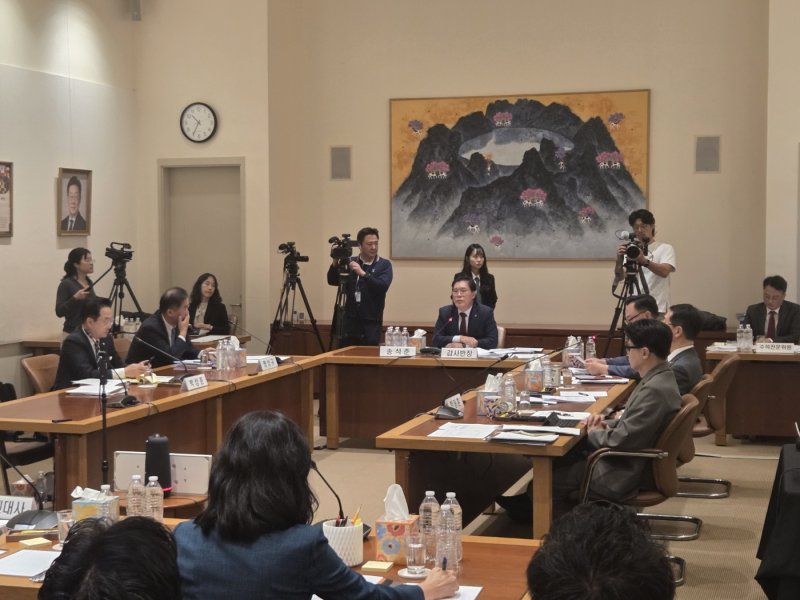
【Financial News, New York—Lee Byeong-cheol, correspondent】 Criticism was raised at a parliamentary audit that the South Korean government’s response at the UN to North Korea’s landmine provocation in the Demilitarized Zone (DMZ) had been inadequate. Opposition lawmakers grilled Cha Ji-hoon, South Korea’s ambassador to the United Nations, saying that despite South Korean service members being seriously injured by a North Korean landmine, no active diplomatic measures—such as convening a United Nations Security Council (UNSC) meeting—had been taken. Ambassador Cha said a response through the UN General Assembly was also meaningful, but debate continued over the need for action at the UNSC.
“Why wasn’t North Korea’s landmine provocation taken to the UNSC?”
At a parliamentary audit held in New York, United States, on the 13th (local time), Kim Geon of the People Power Party raised the North Korean DMZ landmine provocation that occurred on the 21st of last month and challenged the response by South Korea’s mission to the UN.
While acknowledging that the issue was raised at the UN General Assembly about two weeks after the incident, Kim said, “It was good to raise an international issue in remarks at the General Assembly, but that was not a more formal and forceful diplomatic response, such as referring it to the Security Council.”
He emphasized in particular that South Korea could raise an issue with the Security Council under the UN Charter even though it is not currently a council member.
Kim criticized the diplomatic efforts to convene a Security Council meeting as inadequate, saying, “It is the role of the UN ambassador to create a forum where the international community can discuss North Korea and to actively call for joint condemnation and measures to prevent a recurrence.”
Ambassador Cha acknowledged that the matter could be brought to the president of the Security Council for discussion, while maintaining that raising the issue through the UN General Assembly was also a form of diplomatic response.
“South Korea can respond at the Security Council, but the fact that it does not do so does not mean it need not respond at the General Assembly,” Ambassador Cha said, adding that “a response at the General Assembly is meaningful in its own way.”
Kim, however, argued that North Korea’s landmine provocation was a serious matter directly tied to the Korean Peninsula’s armistice regime and therefore needed to be formally addressed at the Security Council. He said that, beyond simply issuing a statement of condemnation, South Korea should directly contact ambassadors from major countries and secure international support.
Kim also stressed that a core role of South Korea’s ambassador to the UN was to consult in advance with Security Council members and determine whether a joint response to North Korean provocations was possible.
“Predecessor: 11 instances; Ambassador Cha: 2” — dispute over North Korea diplomacy record
Controversy also continued over Ambassador Cha’s diplomatic activities toward North Korea over the past year.
Han Dong-hoon of the People Power Party claimed that the predecessor ambassador had 11 activities and statements related to North Korean provocations over the course of a year, while Ambassador Cha had only two, including remarks to the UN General Assembly’s First Committee.
Han pressed him, asking, “You said you had been doing a lot of activities related to North Korea over the past year. Why is there such a difference?”
Ambassador Cha explained that the conditions for diplomatic activity differed between the period when South Korea served as a non-permanent member of the Security Council and the period after its term ended.
Earlier, People Power Party lawmaker Ko Dong-jin also noted that when Ambassador Cha took office in September last year, South Korea was both a non-permanent member of the Security Council and its presiding country.
Ko said South Korea had not actively pushed for Security Council meetings while North Korea continued developing nuclear weapons and missiles and launching ballistic missiles, and asked, “What measures did you take, Ambassador, while North Korea was openly violating resolutions?”
Ambassador Cha explained that he could request a Security Council meeting or propose an agenda item, but that the actual conduct of a meeting required consultation with other council members.
“An amateur with no diplomatic experience” — ambassador’s qualifications also questioned
At the audit that day, Ambassador Cha’s diplomatic expertise and the background to his appointment also came under scrutiny.
Han Dong-hoon cited Ambassador Cha’s past work as a lawyer for President Lee Jae-myung and criticized him, saying, “An amateur with no diplomatic experience at all has taken the post of South Korea’s ambassador to the UN.”
He went on to press Cha on why he had accepted the ambassadorship without diplomatic experience, asking, “Isn’t the post of UN ambassador one that should go only to the best of the best professionals?”
Ambassador Cha replied, “Whatever the profession, there is always a first time,” explaining that someone need not be a career diplomat to serve as an ambassador.
Ko Dong-jin pointed out that the Foreign Ministry had deemed Ambassador Cha qualified for a special appointment as head of mission, but had not prepared separate results for each assessment category, and called for the submission of the relevant review materials.
[email protected] Lee Byeong-cheol, correspondent Reporter