Brunson, U.S. Forces Korea commander: “Timing is also one of the conditions for OPCON transfer”
- Input
- 2026-10-14 03:44:04
- Updated
- 2026-10-14 03:44:04
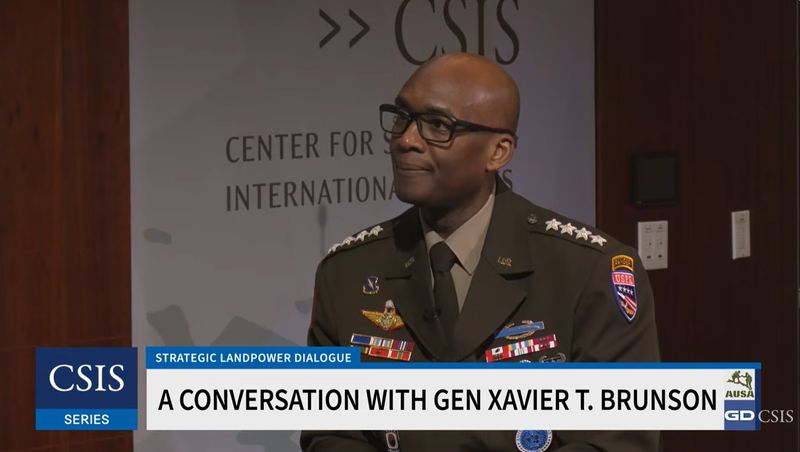
General Xavier T. Brunson, commander of U.S. Forces Korea, reaffirmed on the 13th (local time) his full support for a conditions-based transfer of wartime operational control (OPCON) between South Korea and the United States. He said, however, that timing is also one of the conditions.
He also stressed that the Multi-Domain Task Force (MDTF), whose deployment to the Korean Peninsula is being pursued, is focused on layered sensing of countries around the peninsula, including Russia and China. Concerns have grown that the Korean Peninsula could become a battlefield for major powers in a crisis.
OPCON transfer
At a discussion at the Center for Strategic and International Studies (CSIS) in Washington, D.C., that day, General Brunson said, “I fully support a conditions-based transfer of OPCON.” He was responding to a question about whether he agreed with setting a target year for the transfer at a future South Korea-U.S. summit. “That is what the agreement says,” he said, adding, “That’s all there is to it.”
Brunson stressed, “This is a conditions-based process,” adding, “My current mission is to defend the people of South Korea and the United States according to established standards. I cannot support anything that undermines our ability to defend them. What I support is a conditions-based transfer of OPCON.”
He added a caveat: “Timing is also one of the conditions. That is not for me to decide.”
Brunson added, “If the president or the Secretary of War (the Defense Secretary) told me to carry it out right now, I would say, ‘Yes,’ but I would report, ‘These are the risks of carrying it out without fully meeting the conditions.’”
Building layered sensing capabilities on the Korean Peninsula
Brunson also said the planned deployment of an MDTF to the Korean Peninsula is intended to enhance sensing capabilities.
The MDTF is a unit tasked with carrying out “multi-domain operations,” the U.S. Army’s operational concept spanning all domains, including land, sea, air, space, cyber and electronic warfare. According to The Wall Street Journal (WSJ), plans are underway to deploy the 2nd MDTF, one of three U.S. military MDTFs, from Germany to the Korean Peninsula. Signs have also been detected that some elements arrived ahead of the main force.
Brunson said, “The challenge facing the Korean Peninsula is not to reduce the 28,500 U.S. troops stationed there, but to add to them,” adding, “The MDTF is attractive in terms of deploying the right capabilities to the Korean Peninsula.”
He went on to stress that in future wars, “sensing capabilities, especially enhanced sensing capabilities, will be very important,” and that with the MDTF deployed, space, cyber and electronic warfare assets would help “us better understand not only the Korean Peninsula but also the broader surrounding environment.” His remarks suggested that the MDTF deployment was aimed not only at North Korea but also took China and Russia into account.
He added, “You can see the distance from Beijing to Seoul just by drawing a line on a map.” Given that he described South Korea last May as “a dagger at the heart of Asia that comes into view when China looks out from its eastern coast,” U.S. Forces Korea appears to continue serving as a means of countering China.
Building a regional logistics support hub
Brunson said the MDTF could operate high-altitude balloons alongside manned and unmanned aircraft at various altitudes through a layered sensing system, and suggested that such balloons could be flown near the Demilitarized Zone (DMZ).
He said South Korea, the United States and Japan, along with countries participating in the United Nations Command, should respond jointly to the threat posed by hypersonic vehicles North Korea is seeking to develop.
He also stressed that a logistics support hub should be established in South Korea.
He said U.S. Forces Korea equipment could be repaired within the region rather than on the U.S. mainland, and noted that South Korea’s strong industrial capabilities could be used to carry out maintenance, repair and overhaul (MRO) across all operational domains. He said it was particularly necessary to establish a regional hub that could provide these logistics capabilities not only within South Korea but also to other regions.
[email protected] Song Kyung-jae Reporter