Japan and Taiwan Also Rattled by Semiconductor Jitters—Korean Stocks Hit Harder [Why the Stock Market?]
- Input
- 2026-10-14 06:00:00
- Updated
- 2026-10-14 06:00:00
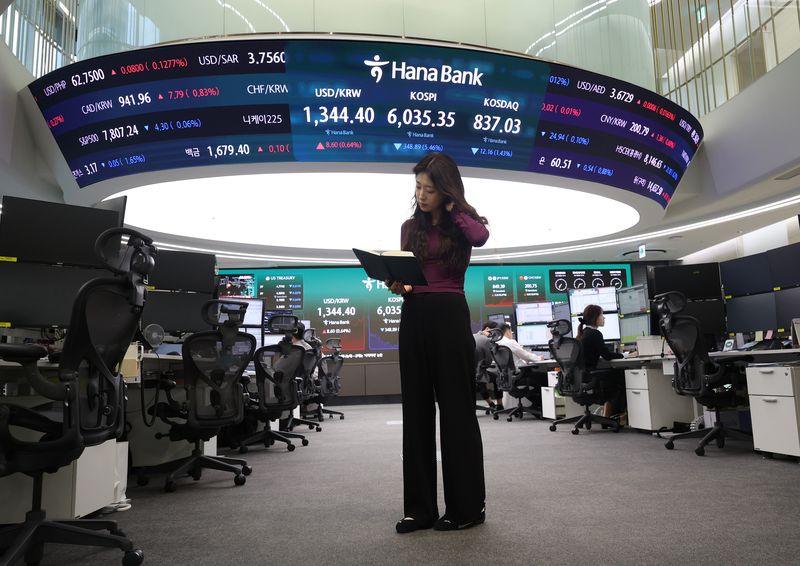
[Financial News] Major Asian stock markets fell in tandem amid concerns about the profitability of artificial intelligence (AI) investments and competition from Chinese semiconductor companies. The decline in the Korean stock market was more than twice as steep as those in Japan and Taiwan. With Samsung Electronics and SK hynix plunging, foreign investors were net sellers of more than 4.5 trillion won in a single day. Analysts said the losses deepened as concerns about semiconductor competition coincided with domestic interest-rate pressures and selling concentrated in particular sectors.
Large-cap semiconductor stocks plunge...KOSPI down 13.83% in five trading days
According to the Korea Exchange on the 14th, the KOSPI closed at 6,035.35 on the 13th, down 348.89 points (5.46%) from the previous trading day. Japan’s Nikkei 225 fell 1.82%, while Taiwan’s TAIEX fell 1.95%. The KOSPI’s decline was about three times Japan’s and about 2.8 times Taiwan’s.The KOSPI opened lower at 6,186.08 that day and fell as far as 5,911.11 during trading. Its intraday decline widened to 7.41%. The Korea Exchange triggered a sell-sidecar in the securities market at 9:47 a.m. The KOSPI, which had closed at 7,003.74 on the 2nd, fell 968.39 points (13.83%) in five trading days.
Large-cap semiconductor stocks fell more sharply than the index. Samsung Electronics closed at 234,000 won, down 6.59%, while SK hynix closed at 1,456,000 won, down 9.28%. The large-cap index consequently fell 5.90%. The mid-cap and small-cap indexes declined 0.64% and 0.79%, respectively.
Lee Sang-jun, an analyst at NH Investment & Securities, said, “There are limits to interpreting the day’s sharp stock-price drop solely as a CXMT issue,” adding, “What sets Korea apart from Taiwan is the pace of policy rate hikes in Korea and concerns that further rate hikes could accelerate.”
He added, “While CXMT’s technological progress may be a concern over the long term, it would be difficult in practice for it to close the technology gap with the three memory makers and resolve the current memory supply shortage in the short term,” stressing that “it is an overstatement to view this issue as damage to semiconductor fundamentals.”
Foreign selling concentrated 95% in electrical and electronic stocks...Supply-demand imbalance deepens losses
According to the securities industry, of the approximately 4.5 trillion won in net sales by foreign investors in the securities market on the 13th, about 4.3 trillion won came from the electrical and electronic sector. That accounted for about 95% of the total. Analysts said the standout trend was a reduction in holdings of large-cap semiconductor stocks, rather than selling across the domestic stock market as a whole.In the KOSPI 200 futures market, foreign investors were net buyers for two consecutive trading days. They bought a net 3,009 contracts on the 12th and 1,670 contracts on the 13th.
Stock performance also diverged. While large-cap memory stocks plunged, some semiconductor equipment makers, including PSK Holdings and Jusung Engineering, rose. LG Energy Solution and EcoPro also gained. The explanation was that selective buying flowed into semiconductor equipment stocks, where expectations for increased capital investment and improved earnings remained intact, as well as stocks expected to benefit from rising North American demand for energy storage systems (ESS).
Yuanta Securities cited selling concentrated in particular sectors as a factor behind the sharp drop in the Korean stock market. It said the KOSPI fell more than 3 percentage points further than Japan’s and Taiwan’s even as falling U.S. Treasury yields and international oil prices eased market pressure. The firm also said the KOSPI’s move below its 200-day moving average intensified selling and widened the losses.
Lee Jae-won, an analyst at Yuanta Securities, said, “What matters is not the motivation behind foreign investors’ selling, but how the intensity of that selling changes going forward and whether earnings estimates for 2027–2028 hold up,” adding, “There is insufficient basis to interpret the current decline as damage to industry fundamentals, while oversold RSI (Relative Strength Index) readings and reduced valuation pressure are factors that could support a technical rebound.”
[email protected] Choi Doo-sun Reporter