Market propped up by share buybacks comes crashing down; Samsung Electronics and SK Hynix buybacks also near completion
- Input
- 2026-10-14 08:01:50
- Updated
- 2026-10-14 08:01:50
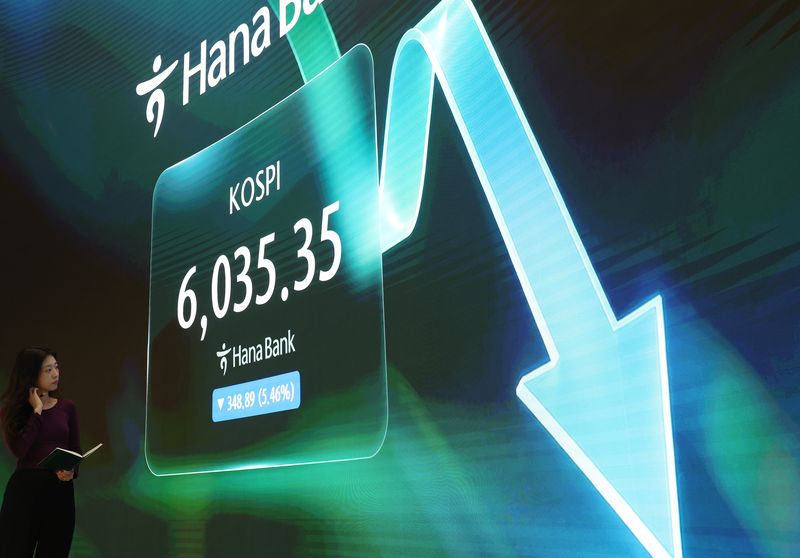
[Financial News] As large-scale share buybacks by Samsung Electronics and SK Hynix near completion, concerns over supply-demand imbalances in South Korea’s stock market are mounting. Individual investors have turned net buyers this month, but selling by foreign investors and institutions continues.
According to the Korea Exchange on the 14th, the KOSPI closed the previous day at 6,035.35, down 348.89 points (5.46%) from the previous trading day. It fell as low as 5,911.11 during the session, dropping below the 6,000 mark. The large-cap index fell 5.90%, while the mid-cap and small-cap indexes declined 0.64% and 0.79%, respectively, concentrating the losses in large-cap stocks.
Samsung Electronics closed at 234,000 won, down 6.59% from the previous trading day, while SK Hynix ended at 1,456,000 won, down 9.28%. Both stocks have fallen for five consecutive trading sessions since the 6th.
Until recently, South Korea’s stock market had seen a pattern in which major investor groups sold shares and companies bought them up. From Aug. 31 through Oct. 2, other corporations were net buyers of 35.4255 trillion won worth of shares on the KOSPI market. Over the same period, foreign investors net sold 22.1453 trillion won and individual investors 17.5434 trillion won. Institutions as a whole were net buyers of 4.3408 trillion won, but excluding net purchases of 6.4386 trillion won by financial investment firms, they were net sellers of 2.0978 trillion won. In effect, major investors reduced their holdings while Samsung Electronics and SK Hynix carried out large-scale share buybacks.
Since the start of October, individual investors have turned buyers, but foreign investors and institutions have continued to be net sellers. So far this month, foreign investors have net sold 11.5077 trillion won worth of KOSPI shares, and institutions 881.5 billion won. By contrast, individual investors were net buyers of 6.4484 trillion won and other corporations of 5.9202 trillion won.
Meanwhile, the two companies’ combined share buybacks, valued at 55 trillion won, are nearing completion. Samsung Electronics had completed the purchase of its planned number of shares as of the 6th. Since SK Hynix announced its share buyback policy, other corporations’ cumulative net purchases have totaled about 34.7 trillion won, equivalent to about 86.8% of the planned 40 trillion won buyback. Cho Joon-gi, an analyst at SK Securities Co., Ltd., said he expects that “given the trend in average daily net purchases, SK Hynix’s share buyback is also likely to be completed as this week draws to a close.”
Once corporate buying subsides, the key will be whether individual investors continue buying and whether demand from foreign investors and institutions recovers. Some, however, believe the end of the buybacks will not immediately lead to further declines, since existing investors reduced their holdings during the buyback period, potentially easing selling pressure afterward.
Foreign ownership stakes in Samsung Electronics and SK Hynix stand at 46.18% and 49.12%, respectively, both at 52-week lows. Each is about 6 percentage points below its 52-week high. The decline in foreign ownership does not guarantee a shift to net buying, but it could be an indicator to watch for future changes in supply and demand.
A securities industry source said, “If the outlook for future earnings and additional shareholder returns becomes clearer with the release of finalized third-quarter results and subsequent investor communications, there may be room for funds to flow back into large-cap semiconductor stocks.” The source added, “Conversely, if foreign investors and institutions continue selling and individual investors’ buying also weakens, pressure from supply and demand could increase.”
[email protected] Choi Doo-sun Reporter