Samsung Electronics and SK hynix tumble ... Securities industry warns: “Don’t rush to buy the dip just because stocks are falling”
- Input
- 2026-10-14 04:40:00
- Updated
- 2026-10-14 04:40:00
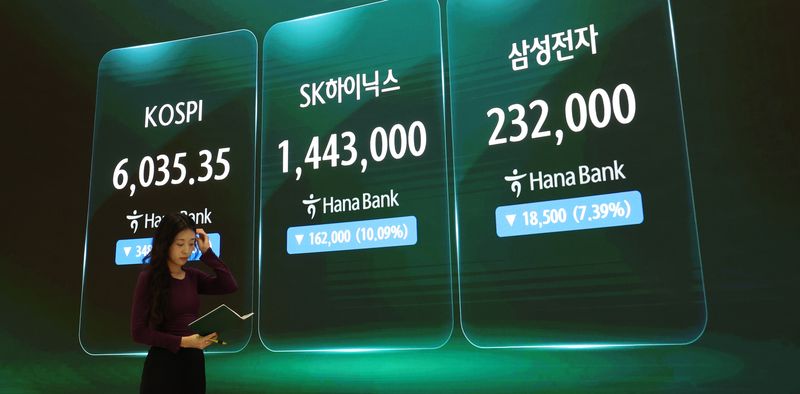
[Financial News] South Korea’s stock market has plunged day after day amid a record-breaking wave of selling by foreign investors and external headwinds facing the semiconductor sector, leaving even the 6,000 level in jeopardy. The KOSPI, which broke above 7,000 in early October, has slumped more than 13% in just five trading days, while panic selling is spreading across the market, with a sidecar—a temporary halt on program sell orders—triggered during trading.
Korean stocks caught in a foreign selling onslaught
According to the Korea Exchange, the KOSPI closed at 6,035.35 on the 13th, down 348.89 points (5.46%) from the previous trading day. At one point during the session, it plunged 7% or more and fell to the 5,910 level, briefly dropping below 6,000 for the first time in 47 trading days since late July. The index has also fallen below its 200-day moving average, weakening its technical trend line.
The biggest trigger for the latest sell-off is the indiscriminate wave of selling by foreign investors and a fragile market structure unable to absorb it. Foreign investors were net sellers of shares worth 4.52 trillion won that day alone. Their cumulative net sales in October are nearing 13 trillion won. Individual investors and institutions stepped in to absorb more than 2 trillion won and 1 trillion won, respectively, but their efforts were not enough to withstand the intense downward pressure on the index.
The decline was concentrated in large-cap semiconductor stocks, which account for an overwhelming share of market capitalization. In just one day, foreign investors pulled 3.72 trillion won from only two stocks: SK hynix (2.3601 trillion won) and Samsung Electronics (1.3599 trillion won). That amounts to 82% of total net selling by foreign investors.
Concerns about oversupply from China and doubts that earnings have peaked are behind the sharp cooling in sentiment toward semiconductor investments. Anxiety about domestic memory makers’ medium- to long-term market share and competition over supply came to the fore after China’s CMXT announced plans to develop next-generation DDR5. Selling was also fueled by a more demanding global market outlook on the sustainability and monetization of investment in artificial intelligence (AI) infrastructure.
Even the “pillar” that had been supporting the index has disappeared. Samsung Electronics’ 15 trillion won share-buyback program ended on the 6th, and SK hynix’s buyback is also nearing completion, making the resulting supply-demand gap a reality. Shares have continued to fall even after Samsung Electronics reported record-level operating profit for the third quarter, underscoring a severe valuation-multiple discount in which strong earnings are not reflected in stock prices.
The external macroeconomic environment is also weighing on the stock market. As high interest rates persist, with the U.S. 10-year Treasury yield in the 5.2% range, escalating geopolitical risks in the Middle East and Ukraine have added to pressure from high oil prices, with West Texas Intermediate (WTI) crude rising above the $90 level. Concerns that the Federal Reserve (Fed) will keep monetary policy tight for longer have consequently spread, fueling global aversion to risk assets.
Calls for risk management over hasty dip-buying
Securities industry experts describe the current market as “a phase driven more by a supply-demand gap and deteriorating investor sentiment than by damage to fundamentals,” and are calling for risk management rather than hasty dip-buying.
Jo Ain, a researcher at Samsung Securities, said, “It is difficult to predict how geopolitical risks will unfold, and volatility could rise further ahead of major political events such as the United States midterm elections.” Jo advised, “At this point, a strategy of responding gradually while monitoring how key external events unfold is more appropriate than aggressively increasing exposure.”
Some also say a staggered buying approach may be worth considering, as valuations could become more attractive if the KOSPI enters the 5,000s. Experts expect the first turning point for a rebound in South Korea’s stock market to be whether the U.S. Consumer Price Index (CPI) and Producer Price Index (PPI), due to be released on the 14th and 15th, and earnings reports from ASML and TSMC reaffirm the resilience of global AI demand.
[email protected] Moon Young-jin Reporter