“My person vs. your person”: Legal community voices blunt criticism over Supreme Court justice appointment dispute ... “Secretive nomination process must be reformed”
- Input
- 2026-10-13 22:05:38
- Updated
- 2026-10-13 22:05:38
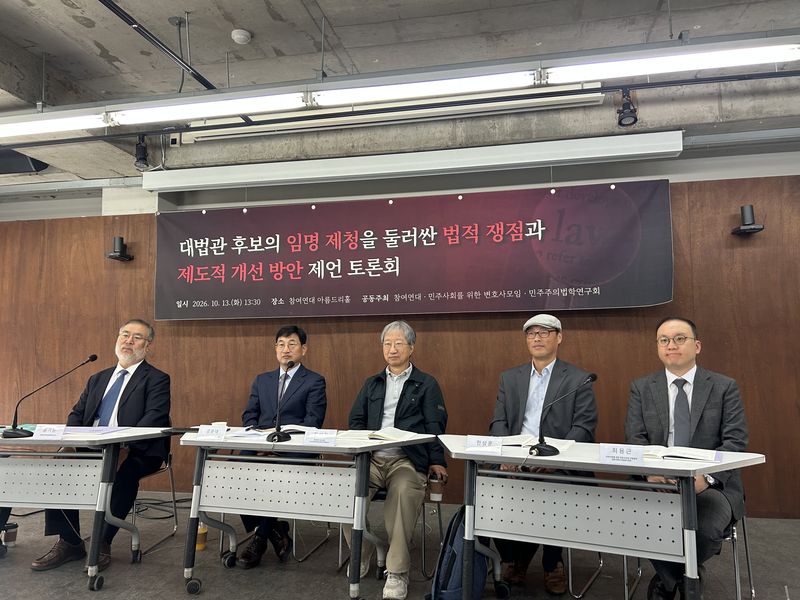
[Financial News] As vacancies on the Supreme Court drag on amid a dispute between President Lee Jae-myung and Chief Justice Cho Hee-dae over the nomination of Supreme Court justice candidates, voices from civil society and academia have called for fundamental reform of the current appointment process.
People’s Solidarity for Participatory Democracy, Lawyers for a Democratic Society (Minbyun), the Research Society for Democratic Law and others held a forum on the 13th at the former’s offices in Jongno District, Seoul, on “Legal Issues and Measures to Improve the Nomination of Supreme Court Justice Candidates.” Experts at the forum described the current situation as a shallow “power struggle,” not a defense of judicial independence, and delivered scathing criticism.
Han Sang-hee, a professor at Konkuk University School of Law and co-chair of People’s Solidarity for Participatory Democracy, who delivered the opening presentation, sharply criticized the conflict, saying, “The recent dispute is nothing but a do-or-die power struggle between the chief justice and the president, who are fighting solely over whether someone is ‘my person or your person.’” He added, “The practice of ‘prior consultation’ between the presidential office and the Supreme Court was also a backroom process for sharing the spoils of power.”
There was some disagreement over the constitutional interpretation of the unprecedented “refusal to nominate a candidate for appointment.” Song Ki-chun, a professor at Jeonbuk National University School of Law, said, “Returning a nomination simply because there was no agreement, without giving grounds for finding the candidate unsuitable, and demanding another specific candidate exceeds the president’s constitutional authority.” Han Sang-hoon, a professor at Yonsei University School of Law, also cautioned against abuse of appointment powers, saying, “If a nomination can be made only by agreement, that would amount to a ‘joint nomination’ and run counter to the purpose of guaranteeing judicial independence.”
By contrast, Professor Han Sang-hee viewed the chief justice’s nomination authority as part of the power to designate candidates. He noted, “The president’s refusal to appoint, in itself, is not unconstitutional. But it is problematic for the presidential office to step in and demand that one of the candidates already recommended be nominated again.”
They identified the “imperial chief justice” system and an opaque nomination process as the root causes of recurring conflicts and called for sweeping institutional reforms. They agreed that, in the short term, the composition of the Committee of Recommendation of Supreme Court Justice Candidates should be democratized to increase the participation of civil society and representatives of rank-and-file judges, and that its meeting procedures should be fully disclosed. Lawyer Choi Yong-geun of Minbyun proposed excluding the head of the National Court Administration from the committee and requiring the chief justice, barring special circumstances, to nominate one of the candidates recommended by the committee, to prevent arbitrary exercise of authority.
Long-term alternatives involving constitutional amendments were also proposed. The experts stressed that democratic legitimacy should be secured by abolishing the chief justice’s exclusive nomination authority and replacing it with such options as selection by a Judicial Administration Council in which ordinary citizens make up a majority, or election by a judges’ assembly. They also noted that the short terms served by Supreme Court justices undermine legal stability and political neutrality, and some argued that terms should be extended to 15 years or guaranteed through the retirement age of 70.
[email protected] Park Ji-hyun Reporter