KOSPI Tumbles as Samsung Electronics Plunges 7% and SK hynix 10%; 800 Trillion Won in Market Value Wiped Out
- Input
- 2026-10-13 16:50:33
- Updated
- 2026-10-13 16:50:33
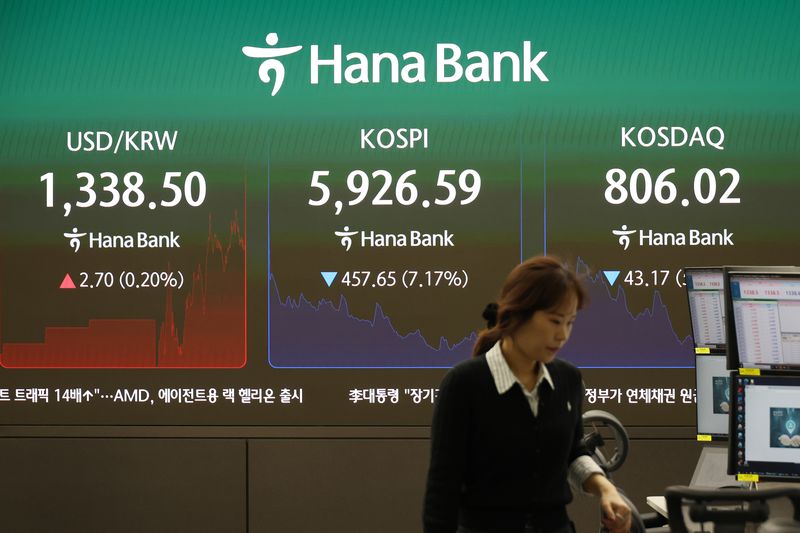
[Financial News] The KOSPI’s sharp drop has erased nearly 800 trillion won in market capitalization over the past five trading sessions. The index, which had been above 7,000, fell below 6,000 intraday. Analysts say the recent decline has been excessive given the earnings outlook. However, with interest rates and geopolitical uncertainty still in play, some continue to warn of the possibility of further losses.
According to KOSCOM CHECK, the KOSPI’s market capitalization stood at 4,978.833 trillion won at the close on the 13th. It fell by 795.878 trillion won (13.78%) in five trading sessions from 5,774.711 trillion won on the 2nd. That amounts to about 14% of the market’s total capitalization being wiped out.
The KOSPI closed at 6,035.35 that day, down 348.89 points (5.46%) from the previous session. Compared with its close of 7,003.74 on the 2nd, it fell 968.39 points (13.83%). The index dropped for five consecutive trading sessions, losing around 1,000 points.
In just the two trading sessions on the 12th and 13th, market capitalization fell by 488.419 trillion won, slipping below 5,000 trillion won. The KOSPI fell 3.65% on the 12th and then another 5.46% that day, dropping below the 6,000 level intraday.
Samsung Electronics, the leading semiconductor stock, closed down 7.39% at 232,000 won, while SK hynix plunged 10.09% to 1,443,000 won.
Analysts say concerns about a supply-demand vacuum ahead of the end of share buybacks by Samsung Electronics and SK hynix are fueling selling. Seokmo Yoon, head of the Research Center at Samsung Securities, said, "The concern itself that a supply-demand vacuum will emerge after the buybacks end is prompting selling before they end," adding, "The end of the buybacks will not be a reason for further share-price declines."
Uncertainty surrounding US interest rates and the artificial intelligence (AI) industry outlook is cited as a risk that could trigger further declines. Lee Kyung-min, a researcher at Daishin Securities, noted, "The most dangerous scenario would be if concerns about a renewed sharp rise in US interest rates and doubts about AI profitability and the memory cycle all worsened at the same time." He put the KOSPI’s first support level at 5,800.
Some analysts also say share prices have fallen too far relative to the corporate earnings outlook. Lee said, "We are in a phase where next year’s earnings forecasts are being revised upward and 12-month forward earnings per share (EPS) is rising," adding, "The forward price-to-earnings ratio (PER) is below 5, placing share prices in an area of extreme undervaluation relative to earnings."
Yoon also said, "Despite a decline in semiconductor export unit prices in September, export value rose as volumes increased," adding, "With final demand for semiconductors holding firm, it is difficult to say that earnings momentum has been significantly damaged."
Analysts say the market’s future direction will depend on easing interest-rate pressures and the confirmation of corporate earnings. Lee said, "The US consumer price index (CPI) and TSMC’s earnings results are important inflection points," adding, "We expect sentiment to reverse and valuations to normalize from the point when the peak in interest rates is confirmed."
Yoon predicted, "Share prices are likely to stabilize as we approach the end of October," adding, "After Samsung Electronics and SK hynix end their share buybacks, foreign investors may return as net buyers if the KOSPI is at or below 6,500."
[email protected] Lee Jeong-hwa Reporter