Samsung Electronics, with 100 trillion won in sales: If you’ve changed the people, overhaul the evaluation rules too [Kim Moon-kyung’s Leadership Tech] (30)
- Input
- 2026-10-25 09:00:00
- Updated
- 2026-10-25 09:00:00
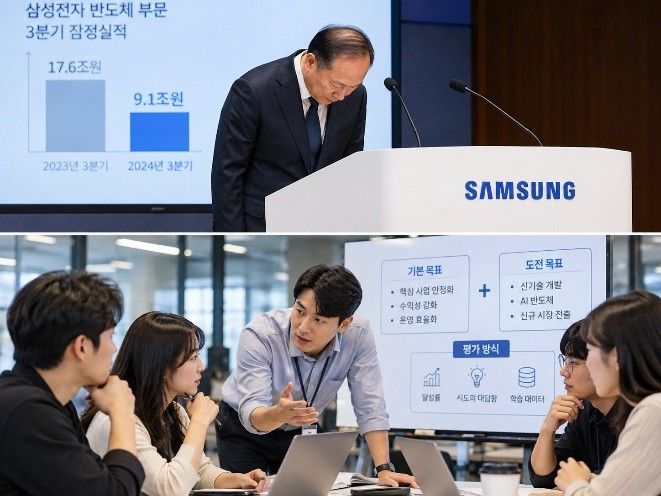
Then, exactly two years later, this October, Samsung Electronics surpassed the 100 trillion won mark in quarterly operating profit, making new history for a Korean company. In effect, after the painful apology, it moved beyond the crisis of playing defense and once again laid the groundwork for a leap forward.
In the meantime, the organization’s lineup also changed significantly. A major executive reshuffle brought in young blood from the 30s and 40s age group, while technical talent in artificial intelligence and semiconductors was moved to the forefront. It was a powerful message of renewal: prioritize performance over seniority, and the demanding realities on the front line over comfortable management. But changing people at the forefront of management is only half a renewal. Unless what the newly appointed leaders are evaluated on changes fundamentally, they too will end up working like the leaders of the past.
At most companies, leader evaluations remain trapped in outdated frameworks from an earlier era of stable growth. The criteria for identifying top leaders are how accurately they meet the key performance indicators set at the start of the year and how perfectly they control risks and mistakes. In other words, the system gives higher ratings to those who cause no problems and submit flawless scorecards than to those who take on challenges and break new ground. Under these rules, a leader’s choices are obvious. Innovative attempts that might fail are ruled out at the planning stage, leaving only safe, modest targets guaranteed to be met 100% by year-end. A leader’s conservative, defensive mindset is not a matter of personal disposition; it is the inevitable result cultivated by the company’s evaluation scorecard.
American management scholar Steven Kerr directly addressed this painful contradiction in his 1975 classic, ‘On the Folly of Rewarding A While Hoping for B.’ Organizations talk up innovation, yet their evaluation systems reward flawlessness and the status quo. Employees inevitably follow not the company’s grand slogans but the reward metrics that determine their salaries. Because organizations fixate on objective numbers that are easy to measure, immediate achievement rates are recorded neatly, while bold attempts at innovation and the valuable learning gained through failure are not captured in numbers and are the first things erased from evaluation scorecards.
Here, we need to overturn an outdated assumption. It is commonly believed that evaluation rules should be overhauled when a company faces a serious crisis. In reality, the opposite is true. When survival is at stake in a crisis, immediate results become urgent, leaving no psychological or financial room to tolerate failure. Conversely, when the market is booming, it is difficult to tell whether strong results reflect a leader’s true ability or simply good fortune from riding the market. When the memory chip cycle is on an upswing, achievement rates are high no matter who leads the organization. The moment of record results, when there is the most to protect, is precisely when a defensive mindset is most likely to return—and, at the same time, the perfect golden opportunity to overturn the evaluation rules.
Of course, there are also counterarguments. One objection is that Silicon Valley big tech companies, including Microsoft, have recently tightened the reins on evaluations by stepping up efforts to weed out low performers. This objection is valid. Tolerating failure must not come to mean turning a blind eye to poor performance. The key is to distinguish rigorously between different kinds of failure. Missing an easy target through laziness is not at all the same as failing after boldly pursuing a challenging, innovative goal. The former calls for serious accountability, while the latter should be recognized as learning that becomes an asset to the organization. The heart of the problem is a one-dimensional scorecard that treats both kinds of failure as the same deduction.
With year-end evaluations and next year’s goal-setting approaching, what management needs to do is clear.
First, strictly separate next year’s goals into essential baseline targets that must be met and stretch targets for innovation. Evaluate baseline targets by their achievement rate, but assess stretch targets by the speed and boldness of the attempts and the learning data generated along the way.
Second, separate the market effects of industry conditions from each leader’s independent contribution to this year’s results. Only by clearing away the bubbles created by the tide can we see the difference a leader truly made.
Third, explicitly include leading collaboration across departments among the key evaluation criteria, rather than excluding it because it is difficult to measure. If it is not in the metrics, the organization will never act on its own initiative.
We cannot hand the new field commanders, selected to slog through the mud of crisis, outdated evaluation maps and then push them to explore a new continent. The painful reflection from two years ago—that the company would abandon defense and choose challenge—will be complete only when it is written into the evaluation scorecard, not shouted as a slogan in an auditorium.
Whether the enormous achievement of 100 trillion won in quarterly operating profit will become an excuse to defend the past or the resources for bold challenges toward the future—the answer lies in the evaluation scorecard you are holding right now.
/Kim Moon-kyung (Adjunct Professor at Kookmin University and Vice President of the Korean Leadership Society)
[email protected] Jung Myung-jin, Medical Correspondent Reporter