“The time for a rebound has come” ... Yen deposits swell as the yen weakens
- Input
- 2026-10-15 16:47:16
- Updated
- 2026-10-15 16:47:16
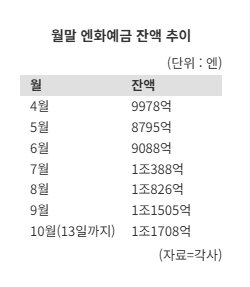
[Financial News] Yen deposits at major banks are rising as the yen continues to weaken. Demand from those who see the decline in the won-yen exchange rate as an opportunity to buy at a low price, as well as companies’ tendency to delay converting yen received as export proceeds into won, are also seen as factors behind the increase in deposits. However, if the won continues to strengthen, the won-yen rate could fall further, so concerns over when to convert currencies are expected to persist.
According to financial industry sources on the 15th, the combined balance of yen deposits at the five major banks—KB Kookmin, Shinhan, Hana, Woori and NH Nonghyup—stood at 1.1708 trillion yen as of the 13th. That was up 291.3 billion yen (33.1%) from 879.5 billion yen at the end of May. Yen deposit balances rebounded to the 900-billion-yen range in June and topped 1 trillion yen in July. They then exceeded 1.1 trillion yen last month, marking four consecutive months of growth. With balances also rising this month, a fifth straight monthly increase is likely.
Demand for bargain buying prompted by the decline in the won-yen exchange rate is cited as a reason for the increase in yen deposits. Because the same amount of won can now buy more yen, people have greater incentive to seek foreign-exchange gains from a future rebound or to secure travel and payment funds in advance.
According to the Bank of Korea, the benchmark won-yen exchange rate stood at 842.30 won per 100 yen on the 13th, its lowest level in 18 years and nine months since Jan. 2, 2008, when it was 838.20 won. Compared with March 3, 2009, when it had risen to 1,620.76 won per 100 yen, the yen has lost nearly half its value against the won.
For domestic companies that do business with Japanese firms, the weak yen is also a reason to delay converting yen into won. The lower the won-yen exchange rate falls, the less won a company receiving export proceeds in yen can get by converting the same proceeds. If it does not need won immediately, it can deposit the yen and wait for the exchange rate to recover.
Companies that will need yen to pay for imports or repay borrowings in the future can also hold on to the yen they receive and use it to make those payments.
However, it has been pointed out that individuals and companies accumulating yen in hopes of foreign-exchange gains or a recovery in the exchange rate may have to wait longer as the won-yen rate could fall further. If the yen remains weak for an extended period, the burden of managing funds while delaying currency conversion will grow.
Im Hwan-yeol, an analyst at Woori Bank, explained, “The yen has remained weak as the Bank of Japan has maintained relatively low interest rates compared with other countries,” adding, “The effects of BOJ rate hikes are limited, as the United States and Europe, among others, are maintaining high policy rates and further rate hikes by the U.S. Federal Reserve are also expected.” He added, “Given the OECD’s upward revision to its growth forecast for South Korea and strong exports, a further rate hike by the Bank of Korea is expected, so the possibility that the won will strengthen further cannot be ruled out.”
[email protected] Ye Byeong-jeong Reporter