[Han Dong-ha’s Materia Medica] For boils, internal treatment is just as important as external treatment.
- Input
- 2026-10-17 06:00:00
- Updated
- 2026-10-17 06:00:00
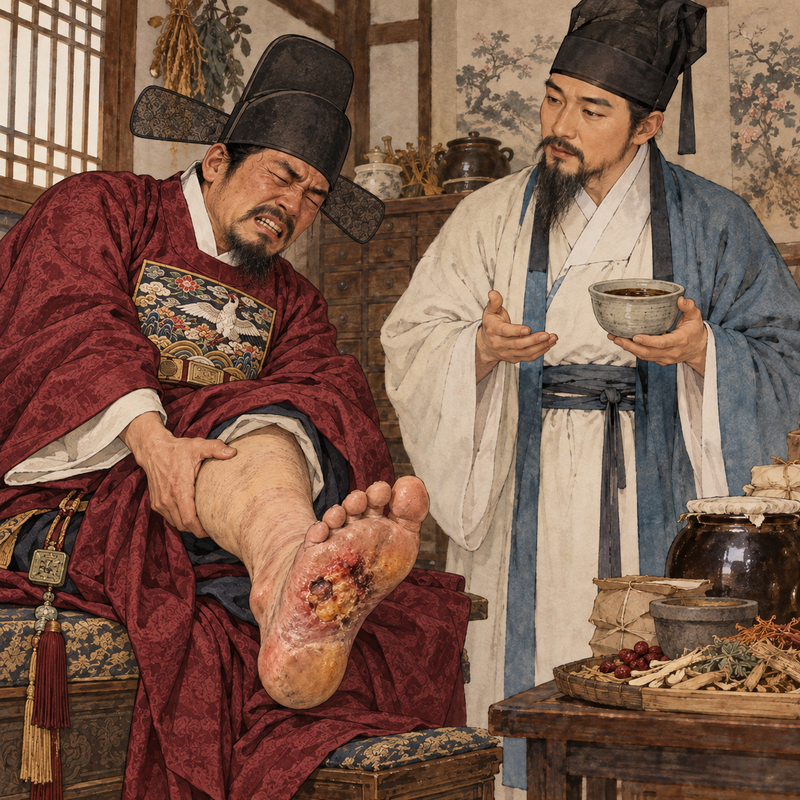
During the Ming Dynasty, there was a physician named Wang Daguo in Nanchang, Jiangxi Province. Wang Daguo had originally suffered from a chronic phlegm disease, but one day he met an extraordinary man with exceptional medical skills who cured his illness. Impressed by this, Wang Daguo took him as his teacher and began to learn medicine.
The master taught Wang Daeguk medical texts such as the *Huangdi Neijing* and *Suwen*, and even passed down his own secret remedies. Wang Daeguk studied medicine day and night. One day, when the master asked about the medical skills he had learned, Wang Daeguk answered without hesitation, and his response accurately pinpointed the core of the illness.
The master spoke with great surprise, saying, "I have traveled throughout the world, but I have never seen anyone as intelligent and outstanding as you. Strive even harder. Before long, you will be known to the world as the Sage of Medicine."
Afterwards, Wangdaeguk began treating patients in earnest.
Mr. Du, who lived in the same village, had a young son. For a long time, the child had been suffering from scrofula, a chronic condition affecting the lymph nodes around the neck that caused lumps to form. They visited many doctors and gave him medicine, but he did not get better easily. The lumps did not shrink, and his parents' worry grew day by day.
Wang Daeguk examined the child and made pills using seaweed, kelp, Hagocho, Fritillaria, and Scrophularia. These are medicinal ingredients that dissolve phlegm and break down hard lumps. He then gave two pills to the parents.
Feed this.
Du was skeptical that a long-standing illness could be cured with just two pills. However, having no other choice, he gave the medicine to the child. Surprisingly, according to records, the child recovered that very day. Witnessing this, the villagers praised Wang Daeguk’s medical skills as having reached a divine level.
Around the time when the fame of the Great Kingdom of Wang was becoming widely known, Hu Shensan, a local official working in Nanchang in charge of criminal cases and trials, suffered from a severe boil.
The boil on Hosinsam's left foot grew deeper and deeper, eventually threatening to pierce through the sole. Pus oozed from the boil, and the pain was unbearable. He had already received treatment from several different doctors, but the condition worsened day by day. The doctors applied various poultices to the affected area and treated the wound. However, his foot showed little sign of healing.
Finally, Hosinsam summoned Wangdaeguk for an examination. Wangdaeguk examined the condition of the boil and said something unexpected.
Please remove all the medication you are currently applying.
Hosinsam was puzzled. "You tell me to remove the medicine applied to the boil? Then what do you intend to use to treat it?"
From now on, please drink only this herbal medicine.
Wang Daeguk prescribed a prescription containing honeysuckle, *Gagoja* seeds, *Dangguimi* seeds, *Hwanggi*, peony, frankincense, myrrh, *Cheonhwabun*, fritillary, *Baekji*, and dried tangerine peel. Hosinsam found this even more incomprehensible. The boil was on the foot, and the wound was deeply gouged; how could it be treated with oral medicine alone?
"How can taking herbal medicine heal a boil and make new skin grow on a wound?" Wang Daeguk did not back down. "Please give me just fifteen days. I will make sure you recover."
Hosinsam was skeptical, but decided to follow Wang Daeguk's advice. Eventually, he removed the poultice and began taking only the herbal medicine prescribed by him. However, after three days and then four, a surprising change occurred. The wound, which had been difficult to heal, began to shrink little by little.
Hosinsam was overjoyed. "It is truly amazing! Are you saying that boils can heal with medicine taken orally?"
Treatment continued, and about twenty days after it began, flesh filled in the deep wound, and it had almost completely healed. Although it took a few days longer than the fifteen days Wang Daeguk had initially promised, the boil, which many physicians had been unable to treat for a long time, was finally cured.
Hosinsam admired Wang Daeguk's medical skills and made a plaque inscribed with four characters: 'Skills Beyond the Prescription.' It meant that his medical skills had surpassed ordinary methods and conventional wisdom.
In Korean traditional medicine, when treating boils or sores, not only external treatment, which involves applying medicine directly to the wound, but also internal treatment, which involves taking medicine to address the cause of the disease from within the body, was considered important.
In internal treatment methods, when treating boils or abscesses, the methods of dispersal, excretion, and tonification were distinguished according to the stage of disease progression. Dispersal is a method of dispersing and eliminating boils, excretion is a method of expelling accumulated toxins and pus from the body, and tonification is a method of replenishing depleted qi and blood to help wounds heal.
Specifically, when a boil first appeared, emphasis was placed on dissolving lumps and reducing swelling (消腫散結) and cooling and detoxifying heat (淸熱解毒). Once pus had formed, the techniques of expelling retained toxins (托毒外出) and facilitating the rupture and drainage of pus (透膿排膿) were utilized. Even after the boil burst, if the wound did not heal properly, replenishing Qi and blood (補益氣血) and promoting tissue regeneration and wound healing (生肌斂瘡) were considered important.
Today's Herbal Medicine Anecdotes Source
<History of famous medical doctors>Ming. Great country. 按《Jiang西通志》: King Daegu, Liaoguo, Nanjing people. 嘗患痰疾, foreign people's desire, teacher's affair. 《素問》ᆞ《內經》 study book, 及秘藏諸方, non-injurious mind-examination. One day, a study between foreigners and foreigners, no separation between human beings, a study between foreigners. As for the meeting, it is said: "It is a good thing. A person in the world of medicine, a holy name in the world. A person in the world. A person in the world." The same Lidong family has children, many years of illness, no cancer, no medicine. The nation's foundation, the two rulers, the northern Japan's peace, the God of seeing and seeing. Namchang University Medical Center, left leg disease, left leg disease, medical science, daily life, one day of cancer. A country's body, a life-saving medicine, a healthy liquid. The author said: "Whether it's a liquid drinker?" 國曰: "Half the moon, full moon." 服至三four days, 瘡口漸合, 司理大喜. 才2十日, 肌肉已滿, 如其所言, 技技超方外外字匾旌之. 國仁心神術, 一以濟人利物爲念, hand-centered life, 何啻萬人? 子開能world 其學. (Ming Dynasty. Wang Daguo. According to the *Jiangxi Tongzhi*, it is as follows: Wang Daguo, whose courtesy name was Yijiao, was from Nanchang. He had suffered from a phlegm-related illness in his youth, but after meeting Yi Ren and recovering, he took him as his teacher. He received instruction in medical texts such as the *Suwen* and *Neijing*, as well as various secret prescriptions, and there was nothing he did not study with his whole heart. One day, Yi Ren assessed his learning, and was astonished because there was nothing he failed to accurately grasp the essence of. When they parted ways and he left, Yi Ren said, "Strive diligently. Before long, you will be renowned in the world as a sage physician. I have traveled throughout the world, but I have never seen anyone with such exceptional intelligence as you." In the same village, a man named Du had a young son who had been suffering from scrofula for a long time, and taking medicine had no effect. Wang Daguo came and administered two pills, and the son was completely cured that very day; those who witnessed it were astonished and regarded him as a god. Hoshinsam, a relic of Nanchang, had a knot on his left foot that pierced straight through to the sole; although he had already changed doctors several times... The condition worsened day by day, and the pain was so severe that he was on the verge of death. Wang Daeguk arrived and urgently ordered that the medicinal herbs be removed, instructing him to take only the decoction. When Sari asked, "How can a decoction make new flesh grow?" Wang Daeguk replied, "If you give me just fifteen days, I will fully recover." After three or four days of taking the medicine, the ruptured wounds began to heal, and Sari was overjoyed. Since the flesh had already filled in after only twenty days—just as he had predicted—he presented a plaque bearing the four characters 'Gichobangoe,' meaning "technique transcends conventional wisdom," as a token of his honor. Wang Daeguk devoted his heart solely to saving lives and benefiting others with his benevolent heart and miraculous medical skills; how could the number of people he saved with his own hands have been merely ten thousand? His son, Gae, successfully inherited his medical legacy./ Han Dong-ha, Director of Han Dong-ha Korean Medicine Clinic
[email protected] Jeong Myeong-jin, Medical Specialist Reporter