Ruling camp infighting continues even as approval ratings fall in tandem; opposition fans flames of feud rumors
- Input
- 2026-10-13 15:59:40
- Updated
- 2026-10-13 15:59:40
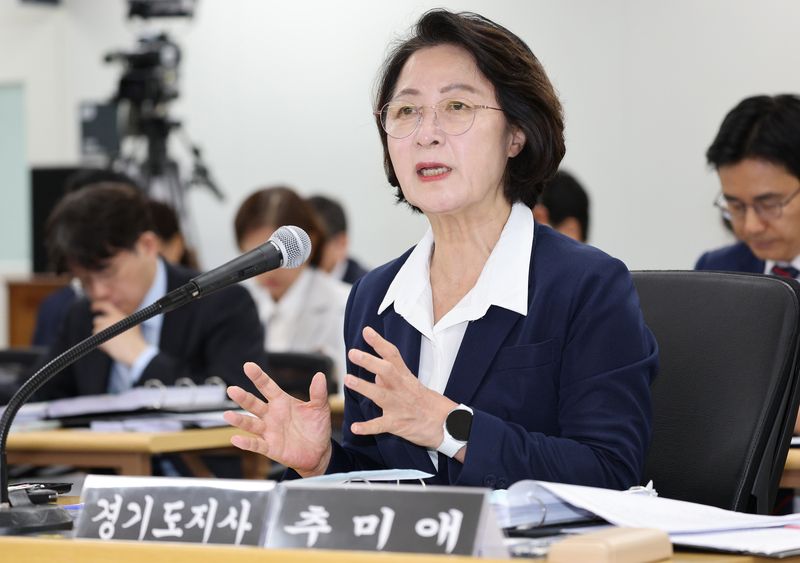
At the National Assembly Public Administration and Security Committee's audit of Gyeonggi Province on the 13th, an unusual scene unfolded: ruling-party lawmakers, who typically defend provincial governors from their own party, instead openly rebuked Governor Choo's administration. DPK lawmaker Chae Hyun-il criticized Choo for declaring a fiscal emergency and launching a budget restructuring immediately after taking office, citing accumulated debt under the previous administration. He said, “It put the ruling DPK in a rather awkward position.” Lawmaker Lee Gwang-hee took issue with the notification of cuts to provincial funding without sufficient consultation with cities and counties, while Lee Hae-sik raised concerns including delays in senior-level appointments.
The successive rebukes by ruling-party lawmakers are drawing attention amid unease among lawmakers aligned with Lee Jae Myung over Choo's independent political moves. Choo's declaration of a fiscal emergency, after taking issue with the previous administration's fiscal management, could be seen as targeting the fiscal policies of President Lee, who previously served as Gyeonggi governor. Choo has also called for the withdrawal of Kim's nomination, citing his past opposition to prosecutorial reform, while the pro-Lee faction maintains that the president's appointment powers should be respected. Within the ruling camp, the successive disagreements over Choo's provincial administration and prosecutorial reform are seen as reflecting wariness toward the independent moves of Choo, a heavyweight politician.
The People Power Party made use of the unease within the ruling camp as ammunition for its attacks. Lawmaker Park Sang-ung took issue with Choo's frequent references to national political issues, including Kim's nomination, on social media since taking office, criticizing her: “Haven't these been 100 days of abandoning the running of Gyeonggi Province, entrusted to you by 14 million residents, to hover around the national political scene?” He also highlighted the rift between the two, asking whether she regretted having played a major role in getting President Lee elected. Lawmaker Joo Ho-young also pressed Choo on whether President Lee's social media messages were aimed at her: one on the 5th criticizing interference in appointments and another on the 11th rebuking cuts to the welfare budget. Lawmaker Kang Myung-gu argued that the expansionary fiscal policy Lee pursued as Gyeonggi governor had caused the province's fiscal difficulties, and claimed that the Future Response Fund being pursued by the current government could also become a fiscal burden in the future.
Choo, however, appeared wary of being seen as entering into an all-out political confrontation with President Lee. She defended Lee's expansionary fiscal spending during his time as Gyeonggi governor, calling it “an unavoidable measure to respond to COVID-19.” Choo also drew a line on the president's social media message, saying, “I don't think it was aimed at me.”
The conflict within the ruling camp is expected to become more prominent at Kim's appointment hearing on the 14th. This is because hard-line advocates of prosecutorial reform across the broader ruling bloc are calling for the withdrawal of Kim's nomination and have promised “stringent vetting.” The launch of an inspection into Lim Eun-jung, head of the Gwangju Regional Serious Crime Investigation Agency, has added to the dispute, as disagreements over the direction of prosecutorial reform appear to be turning into a struggle for control of the reform agenda.
The problem is that internal divisions are not subsiding even as approval ratings for the president and the ruling party fall side by side. In a poll released by Realmeter on the 12th, President Lee's positive job performance rating stood at 35.2%, down 2.2 percentage points from the previous week. Support for the DPK also fell 7.0 percentage points to 35.5%, while the People Power Party rose 2.9 points to 41.3%. There are concerns that if the ruling camp's infighting drags on, it will not only give the opposition ammunition for its attacks but also weaken the government's ability to govern.
The cited poll was conducted by Realmeter at the request of Asia Economy. The survey on the president's job performance was conducted from the 6th to the 8th among 1,504 voters aged 18 or older nationwide. The margin of error was ±2.5 percentage points at a 95% confidence level, and the response rate was 2.8%. The party approval survey was conducted from the 7th to the 8th among 1,004 voters aged 18 or older nationwide. The margin of error was ±3.1 percentage points at a 95% confidence level, and the response rate was 2.6%. Both surveys used automated responses via wireless phones. For details, see the website of the Central Election Poll Deliberation Commission.
[email protected] Song Ji-won, Kim Gyeong-min, Kim Gyeong-su Reporter