KAIST develops 'beetle robot' that walks on artificial muscles and senses through touch
- Input
- 2026-10-13 14:34:24
- Updated
- 2026-10-13 14:34:24
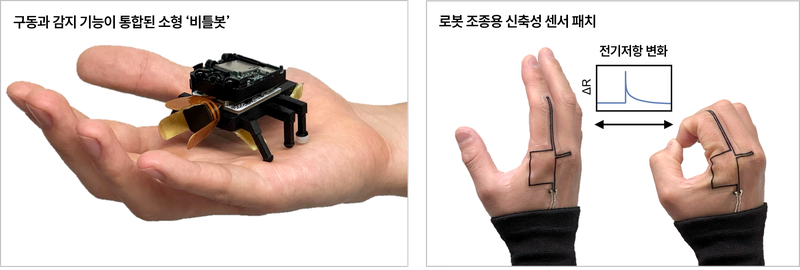
[Financial News] A technology has been developed that lets users move a small robot by bending and straightening a finger, then pick up and move objects while checking video and contact information sent by the robot. The technology combines artificial muscles, a camera and tactile sensors in a small soft robot modeled on a beetle. It is expected to be useful in remote tasks such as inspecting narrow spaces that are difficult for people to access or retrieving small objects.
Korea Advanced Institute of Science and Technology (KAIST) said on the 13th that a research team led by Professor Sang-Wook Kim of its Department of Materials Science and Engineering had jointly developed a small soft robot, BeetleBot, with teams led by Professor Wei Gao of the California Institute of Technology (Caltech) in the United States and Professor Hirotaka Sato of Nanyang Technological University (NTU) in Singapore.
The joint research team designed the robot to walk and grasp objects using artificial muscles that contract like biological muscles. They also integrated a camera, pressure sensors and a stretchable sensor patch attached to a finger, enabling users to control the robot while checking its surroundings and information about contact with objects.
The team first analyzed the relationship between the leg muscles and joint movements of beetles, then applied the findings to the arrangement of BeetleBot’s artificial muscles and its leg structure. They 3D-printed a liquid crystal elastomer (LCE), a polymer material that contracts when heated, to make the artificial muscles, and combined them with an actuator module that generates heat using electricity. By moving the artificial muscles in different parts independently and adjusting the sequence in which they operated, the team enabled the robot to move forward and change direction.
Inspired by the beetle’s pincer-shaped mandibles, which it uses to grasp food, the team created a soft robotic gripper. Artificial muscles and pressure sensors were integrated into it so it could grasp objects and detect contact. When the artificial muscles contract, the gripper moves to grasp an object, while the pressure sensors detect the pressure applied when it touches the object. Contact is detected based on changes in the distance between the internal electrodes and in electrical properties when an object presses on the sensor.
The team used a stretchable sensor patch whose electrical resistance changes with finger movement to control the robot. When a user bends a finger and stretches the patch, the conductive pathways of the carbon nanotubes (CNTs) inside it change, altering the resistance signal. The team classified the signal into four commands—move forward, turn left, turn right and grasp an object—and sent them to BeetleBot via Bluetooth so it could perform the corresponding actions.
Users can view their surroundings through the small camera mounted on the robot and monitor contact with objects using information sent by the gripper’s pressure sensors. Based on this information, they decide on the next action and send a command through finger movements. This implements “two-way feedback”: the user’s commands are sent to the robot, and information detected by the robot is relayed back to the user.
Using this control method, the research team demonstrated BeetleBot avoiding obstacles to approach a target object, then grasping and carrying it. By connecting artificial-muscle-based walking and grasping, visual and tactile sensing, and user control in a single system, the team showed the potential of small soft robots to perform tasks.
Professor Sang-Wook Kim said, “This research is an achievement that has broadened the potential applications of soft robots by connecting artificial-muscle movement, sensing and user control in a single system. We expect that, building on joint research with Caltech and others, it will contribute to the development of soft robots capable of working even in spaces that are difficult for people to access.”
The findings were published on August 19 in the international journal Science Advances.
[email protected] Ji-an Yeon Reporter