Defense Acquisition Program Administration (DAPA) Chief Says Hanwha’s Bid to Acquire Korea Aerospace Industries (KAI) Will Be Closely Examined in Terms of National Security and the National Interest
- Input
- 2026-10-13 14:41:39
- Updated
- 2026-10-13 14:41:39
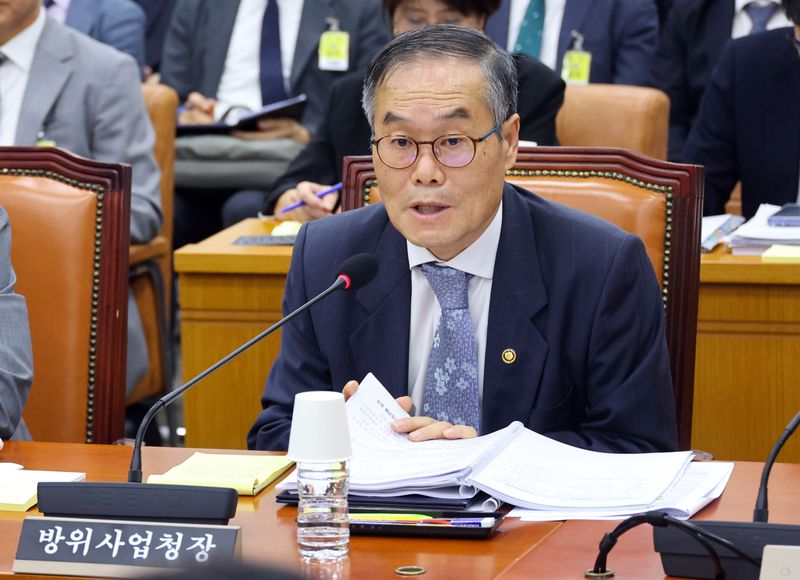
[Financial News] The Defense Acquisition Program Administration (DAPA) said it would closely examine Hanwha Group’s bid to acquire Korea Aerospace Industries (KAI) from the perspective of national security and the national interest.
DAPA chief Lee Yong-cheol said at a National Defense Committee audit of the National Assembly on the 13th, referring to Hanwha Group’s bid to acquire KAI, “It is true that market share is quite concentrated within a single country.”
Lee was responding to concerns about monopolization raised by Rep. Cheon Ha-ram of the New Reform Party, who said, “If Hanwha Group and KAI are combined, they will account for 40–50% of our defense industry by revenue, and as much as 60–70% among the four major companies in particular,” and asked, “Have you ever seen a case in which one company in a country is overwhelmingly No. 1 across land, sea and air, and even in space?”
The Korea Fair Trade Commission (KFTC) recently approved Hanwha Group’s increase of its stake in KAI to 15.89%. The simplified business combination review has been completed, and industry observers speculate that Hanwha Group’s acquisition could also lead to KAI’s privatization.
Rep. Cheon noted in particular that, as KAI enters mass production of the KAI KF-21 Boramae, South Korea’s homegrown supersonic fighter, its research and development (R&D) investments over the years are beginning to generate returns. He argued, “The timing of the sale and monopoly concerns must be considered from the standpoint of the national interest.”
Lee said he agreed “that there are various factors that need to be considered in terms of the national interest,” adding that DAPA would actively offer its views if a KFTC business combination review were conducted, for example, if Hanwha Group further increased its stake or joined KAI’s board.
The KFTC had earlier conveyed to this publication, through Democratic Party lawmaker Han Min-su, its position of keeping its distance from KAI’s privatization. It said the simplified business combination review merely verified the facts of the reported stake increase and that it had not conducted an assessment of the impact on competition.
The ruling Democratic Party of Korea also called for a thorough review. When Rep. Chun Jun-ho urged that “we must examine and draw up a mid- to long-term plan for how the future direction of KAI’s corporate governance could affect our defense industry,” Lee replied, “I 100% agree that this must be closely examined in terms of national security and the national interest.”
However, some have argued that Hanwha Group’s acquisition of KAI could advance the defense industry through economies of scale.
Lee said, “Economies of scale could also enhance international competitiveness,” adding, “There are both pros and cons, so it would be premature to make a decision now.”
[email protected] Kim Yun-ho Reporter