Debate Over ‘Renomination’ of Supreme Court Justice Candidate Also Surfaces at Constitutional Court Audit; Views Differ on Seven-Month Record of Constitutional Complaints Against Court Rulings
- Input
- 2026-10-13 14:10:27
- Updated
- 2026-10-13 14:10:27
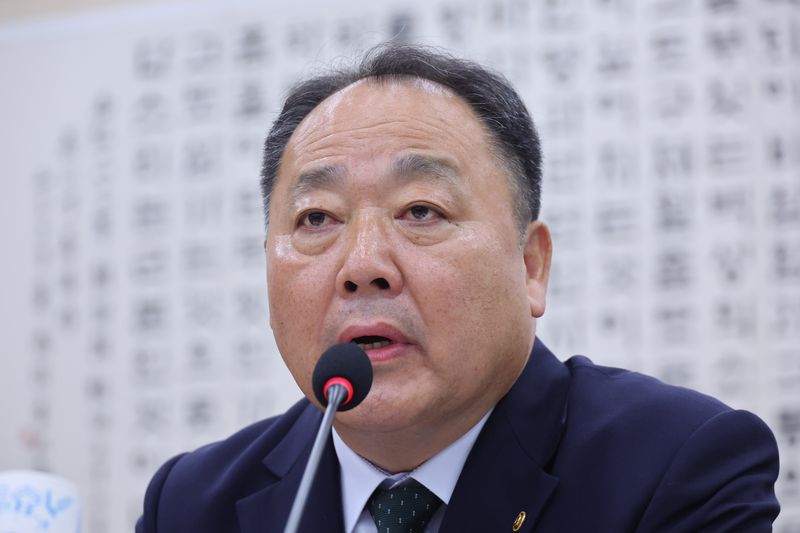
[Financial News] The dispute between the presidential office and the Supreme Court over a new nomination for a Supreme Court justice candidate also emerged as a major issue at the Constitutional Court’s parliamentary audit. Views were divided between the ruling and opposition parties over whether constitutional complaints against court rulings, introduced last March and now seven months into operation, effectively function as a “fourth-instance system.”
The National Assembly’s Legislation and Judiciary Committee held a parliamentary audit of the Constitutional Court on the 13th.
The constitutional powers at issue in Chief Justice Cho Hee-dae’s nomination of a candidate for Supreme Court justice and the presidential office’s request for a new nomination came under scrutiny first. Cho had nominated Judge Son Bong-gi as a candidate for Supreme Court justice, but the presidential office requested a new nomination. Cho rejected the request, saying it was difficult to find a constitutional basis for it.
Since People Power Party lawmakers had filed a petition for adjudication of a jurisdictional dispute, arguing that the president’s failure to appoint a Supreme Court justice infringed the National Assembly’s power to consent to appointments, the Constitutional Court refrained from stating a specific position.
When Democratic Party lawmaker Park Gyun-taek asked for a view on the relationship between the president’s appointment power and the chief justice’s nomination power, Son In-hyeok, secretary-general of the Constitutional Court, replied that it was “a matter of interpreting Article 104, Paragraph 2 of the Constitution,” adding, “With a petition for adjudication of a jurisdictional dispute pending, it would not be appropriate to state my personal view before the court panel has expressed its opinion.”
By contrast, when People Power Party lawmaker Park Hyeong-su asked whether the Constitution explicitly allows the presidential office to request a new nomination for Supreme Court justice, Son said, “There is no such provision in the text.” He added, however, that “the matter could certainly be resolved if the powers of nomination, consent and appointment are exercised with mutual respect and cooperation,” stating a general position.
Lawmakers also asked whether the jurisdictional dispute petition filed by People Power Party lawmakers would proceed to a ruling on the merits. When Democratic Party lawmaker Kim Han-gyu cited past precedents and asked whether the case could be dismissed over the petitioners’ standing, Son said, “Past precedents suggest that such a ruling is possible,” adding, “But each case has its differences, and we are taking those into account.”
Constitutional complaints against court rulings, now seven months into operation, also came under close scrutiny. Park Eun-jeong of the Rebuilding Korea Party argued that although the Supreme Court initially expected around 15,000 cases to be filed annually, only 2,310 had actually been filed as of the end of August, and 25 cases were being heard by the full bench after preliminary review. She said, in effect, that “the feared fourth-instance system has not emerged.”
By contrast, People Power Party lawmaker Kwak Gyu-taek noted that most complaints against court rulings (91.2%) were being dismissed, asking, “Isn’t this effectively operating as a fourth-instance system and putting the public through the agony of false hope?”
Son said the rate of cases referred to the full bench was low, at just over 1%, and that the number of cases was also lower than expected. “These statistics could also be seen as evidence that the Constitutional Court is working to function as a constitutional court rather than as a fourth-instance court,” he explained.
In his overall response, Constitutional Court President Kim Sang-hwan also said, “The system of constitutional complaints against court rulings may be somewhat unfamiliar, but its purpose—to protect people’s fundamental rights from the exercise of state power—is unchanged.” He added, “We will work even harder to ensure it takes root stably with the public’s trust.”
[email protected] Choi Eun-sol Reporter