“71.5 billion won in dividends despite a 233.8 billion won loss”... PEF-owned environmental firms flash financial-health warning [fnMarketWatch]
- Input
- 2026-10-13 14:48:39
- Updated
- 2026-10-13 14:48:39
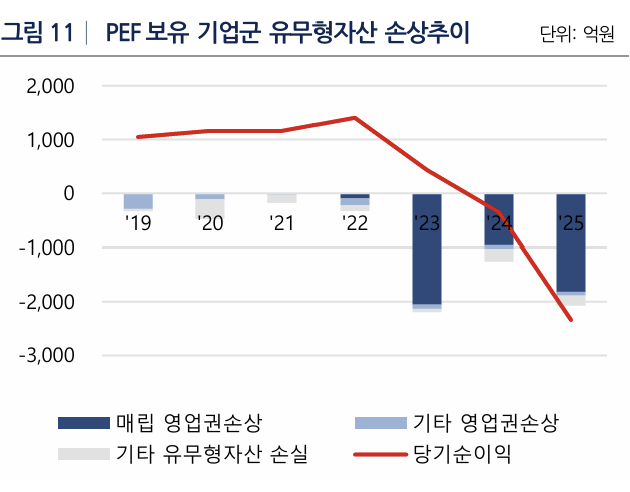
According to a report released on the 13th by NICE Investors Service, titled “The Shadow of Expansion in the Environmental Industry: A Growing Financial Burden and Outlook,” six environmental companies affiliated with PEFs posted combined net losses of 233.8 billion won last year. Their dividend payments over the same period totaled 71.5 billion won. This contrasted with 18 other environmental companies, which recorded net profits of 97.4 billion won and paid out 10.1 billion won in dividends.
PEF-owned environmental firms have continued paying dividends despite losses for a second consecutive year. In 2024, they also posted net losses of 35.3 billion won, but dividend payments reached 220.4 billion won. However, that figure included a one-off special dividend of 105.9 billion won paid by EcoBit to TY Holdings. NICE Investors Service said that even excluding this payment, the dividends paid by PEF-affiliated environmental companies remained substantial.
The gap in financial stability is also evident in financing costs. Last year, the average interest burden rate for six PEF-owned environmental firms was 5.1%, 1.9 percentage points higher than the 3.2% for 18 other environmental firms. The average interest burden rate is calculated by comparing financing costs with total borrowings. The difference reflects the expansion of acquisition financing as PEFs grew environmental companies through bolt-on M&A, as well as higher borrowing rates following changes in controlling shareholders and refinancing.
Goodwill impairment at environmental companies acquired at high prices in the past is also weighing on them. At the end of last year, intangible assets at PEF-owned environmental firms totaled about 1.3 trillion won, accounting for 39% of their total assets—far above the 2% share at other environmental firms. Since 2022, profitability has worsened amid falling landfill fees and environmental issues at some sites, leading to large impairment losses on goodwill created through past M&A. This resulted in net losses and a decline in equity, further weakening financial stability.
The report cited EcoBit and Renewus as prominent examples.
EcoBit posted a net loss of 173.6 billion won last year due to asset impairments stemming from the suspension of operations at major landfills and declining profitability, among other factors. To shore up its finances, it issued about 225 billion won in hybrid capital securities in 2025–2026 and recognized 68.7 billion won in land revaluation surplus. However, as of the end of June this year, total borrowings stood at 764.4 billion won, with short-term borrowings accounting for 36.5%. The company also resumed this year the dividend payments it had withheld last year.
Renewus also posted a net loss of 101.3 billion won last year. The company bolstered its capital by about 249.5 billion won through a debt-to-equity conversion by its controlling shareholder and a paid-in capital increase. However, its borrowing rate rose by about 2 percentage points as it refinanced existing acquisition financing with secured loans. Including borrowings assumed through its merger with RenewOne this year, total borrowings were estimated at about 800 billion won.
Yook Seong-hun, a senior researcher at NICE Investors Service, said, “We believe it will be structurally difficult to suspend dividends entirely for an extended period or to use all operating cash flow to reduce borrowings.” Given that PEFs must recover their investments within a fixed fund life, this means that returning capital through dividends could take priority over reducing companies’ borrowings and securing funds for investment.
He added, “Excessive capital outflows, such as a high-dividend policy aimed at enabling PEFs to recover their investments early or paid-in capital reductions, could undermine not only a company’s financial stability but also the continuity of its business.”
[email protected] Kim Hyun-jung Reporter