Financial Services Commission to move to Sejong City next year... Justice, Foreign Affairs and Defense ministries to follow
- Input
- 2026-10-13 14:06:02
- Updated
- 2026-10-13 14:06:02
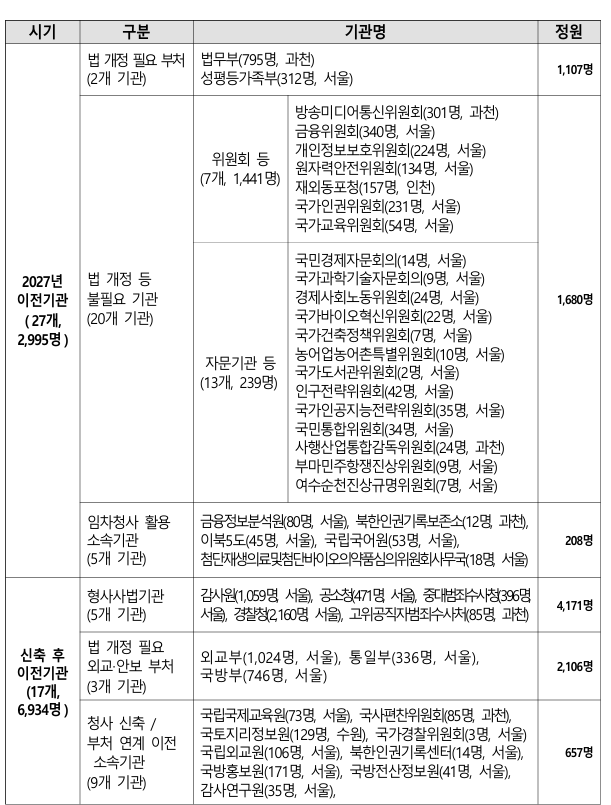
[Financial News] Yoon Ho-jung, minister of the interior and safety, said on the 13th, “We will relocate central administrative agencies currently in the Seoul metropolitan area—including the Financial Services Commission, the Broadcast Media and Communications Commission, the Personal Information Protection Commission, the Ministry of Foreign Affairs, the Ministry of National Defense and the Korean National Police Agency—to Sejong City in phases from 2027 to 2031.” He added, “A total of 44 agencies are included in this relocation, with 9,929 employees based on authorized civil-service positions.”
At a briefing on the second relocation plan for central administrative agencies, held that day at the Government Complex Seoul, Minister Yoon explained, “After reviewing a total of 142 administrative agencies currently in the Seoul metropolitan area, we decided that all central government ministries would move to Sejong City to improve the efficiency of government operations, while affiliated agencies that provide direct services to the public would be excluded from the relocation.”
The plan aims to move central government ministries remaining in the Seoul metropolitan area to Sejong City, strengthen cooperation among ministries and establish a system of government administration centered on Sejong City.
Minister Yoon stressed, “Relocating central administrative agencies is not simply a matter of moving government offices. It is a spatial strategy to overcome the Seoul-centric system and make balanced use of the national territory, as well as a growth strategy to lead the Republic of Korea toward a sustainable future and a new leap forward.”
The relocations will proceed in phases, taking into account each agency’s work and the availability of office buildings.
The 27 agencies that can use leased offices will pursue relocation during the coming year. In the first half of the year, six agencies will move first: the Broadcast Media and Communications Commission, the Personal Information Protection Commission, the Nuclear Safety and Security Commission, the National Human Rights Commission, the National Education Commission and the Overseas Koreans Agency.
In the second half of the year, 19 agencies, including the Financial Services Commission, ministry-affiliated agencies and advisory committees, will move to Sejong City. The relocation dates for the Ministry of Justice and the Ministry of Gender Equality and Family will be set in line with the timing of amendments to the Special Act on the Construction of Administrative City.
Seventeen agencies, including the Ministry of Foreign Affairs, the Ministry of Unification, the Ministry of National Defense, the Board of Audit and Inspection, the Korean National Police Agency, the Prosecution Agency, the Serious Crime Investigation Agency and the Corruption Investigation Office for High-ranking Officials (CIO), will relocate after separate office buildings are newly constructed. The 6,934 people covered by this relocation account for about 70% of the total.
Minister Yoon said, “If we start construction of the office buildings next year, we expect the relocation to be possible around 2031,” adding, “We will provide optimal facilities suited to the nature of the work, including investigations and security.”
The relocation of presidential offices and related agencies, including the Presidential Secretariat and the National Security Office, will be considered separately, taking into account factors such as when the presidential office will be fully relocated.
The government will also pursue the legal amendments and secure the budget needed for the agencies’ relocation. It plans to consult with the National Assembly on amending the Special Act on the Construction of Administrative City to remove five ministries—the ministries of foreign affairs, unification, national defense, justice, and gender equality and family—from the list of agencies excluded from relocation to Sejong City. After consultations with relevant agencies and public hearings, the government will revise and announce the relocation plan and begin securing office buildings for each agency.
The government will also draw up housing and transportation support measures for relocating civil servants and their families. Minister Yoon said, “Since relocating agencies brings major changes to the lives of civil servants and their families, we will maintain close communication and work to ease the difficulties arising from the move.”
After consultations with relevant agencies and public hearings, the government will revise and announce the relocation plan for central administrative agencies, then begin securing office buildings for each agency and preparing for the move.
Minister Yoon also mentioned the plan to complete the National Assembly Sejong building in 2033. He said, “Once the National Assembly Sejong building is completed in 2033, Sejong City will truly take shape as the center of government administration,” adding, “We will minimize inconvenience to the public while pursuing agency relocations alongside improvements to working methods, thereby strengthening Sejong City’s role as the administrative capital.”
[email protected] Lee Bo-mi Reporter