Revised Grain Management Act faces its first test: Government avoids mandatory rice purchases as surplus production stands at 1.9%
- Input
- 2026-10-13 13:49:10
- Updated
- 2026-10-13 13:49:10
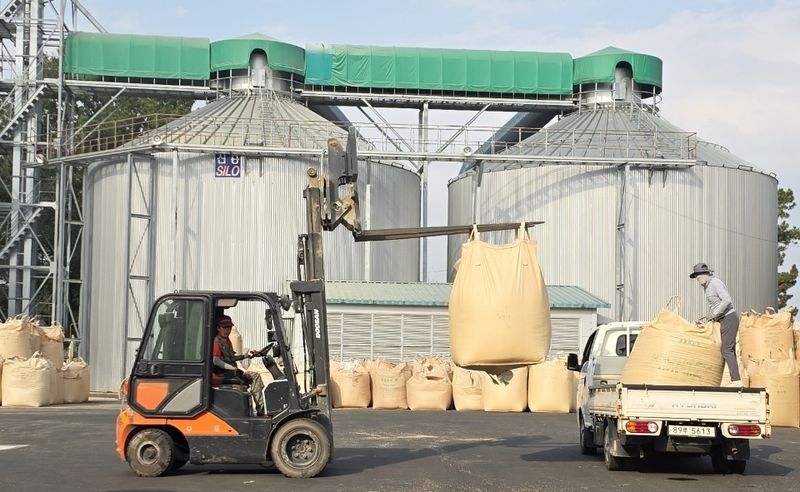
[Financial News] With this year’s surplus rice production amounting to just 1.9% of total production, the government has avoided mandatory rice purchases. That is because the revised Grain Management Act’s mandatory-purchase clause applies when the surplus reaches 3% or more. The government plans to take the surplus off the market through the return of loaned government grain and purchases for public reserves. It is expected to keep rice prices around 58,803 won per 20 kg, the price at the start of this year’s harvest season in production areas as of the 5th.
On the 13th, the Ministry of Agriculture, Food and Rural Affairs said it had drawn up a “Rice Supply and Demand Stabilization Plan for the 2026 Crop” following deliberations by the Rice Supply and Demand Management Committee on the 12th. Rice production this year is forecast at about 3.46 million tonnes. Taking demand into account, the surplus is projected at 66,000 tonnes, or 1.9% of total production. In August, the committee, a statutory deliberative body, set the criteria for requiring the government to implement supply-and-demand measures, including purchases: either surplus production of at least 3% of total production, or a drop of at least 5% in prices during the preceding off-season (July–September) compared with the average year.
To manage the surplus from the 2026 rice crop, the ministry will pursue a three-stage supply stabilization system: rice grown for supply-and-demand adjustment, loans of government grain, and purchases for public reserves followed by the return of loaned grain. The ministry plans to regulate the supply of rice for table use by restricting the rice to processing uses in line with the crop’s growth. The steps will include cutting production in advance, lending government-held rice to private parties if inventories run short, and recovering loaned grain during the harvest season (October–December), along with other measures to take rice off the market and reduce price volatility throughout the year.
The government loaned 155,000 tonnes of government grain last year and this year. Some of it has been returned, leaving about 120,000 tonnes of loaned grain from the 2026 crop for the government to recover. That is more than the 66,000-tonne surplus projected for the 2026 crop. A Ministry of Agriculture, Food and Rural Affairs official said, “We will maintain the plan to recover 120,000 tonnes, but review the amount and timing of returns in light of the final production figure to be announced on November 13. The remaining 120,000 tonnes of loaned grain can take the entire 66,000-tonne surplus off the market.”
The ministry will purchase 400,000 tonnes of rice from the 2026 crop for public reserves by this year’s harvest. The government uses its budget to buy newly harvested rice from the current year at market prices and store it at reserve facilities. This year, it also introduced for the first time a system for rice grown for supply-and-demand adjustment. The budget proposal for next year includes 20,000 hectares, equivalent to 100,000 tonnes of rice. This has the same effect as reducing the area under cultivation and taking 100,000 tonnes off the market in advance. Farmers participating in the program will receive a strategic-crop direct payment of 5 million won per hectare.
According to the National Data Agency, the first farmgate rice price of this year’s harvest season was 58,803 won per 20 kg as of the 5th. That was down 5.1% from 61,988 won for the 2025 crop, but up 12.7% from the typical-year price of 52,164 won. This first farmgate price is the first indicator released after the rice-price benchmark shifts from the 2025 crop to newly harvested rice from the 2026 crop. Rice prices typically trend downward after peaking on October 5.
[email protected] Choi Yong-jun, agriculture specialist Reporter