If You Bleed During Colon Polyp Removal, Check for Blood in Your Stool for 30 Days Afterward [Health Check]
- Input
- 2026-10-13 14:45:40
- Updated
- 2026-10-13 14:45:40
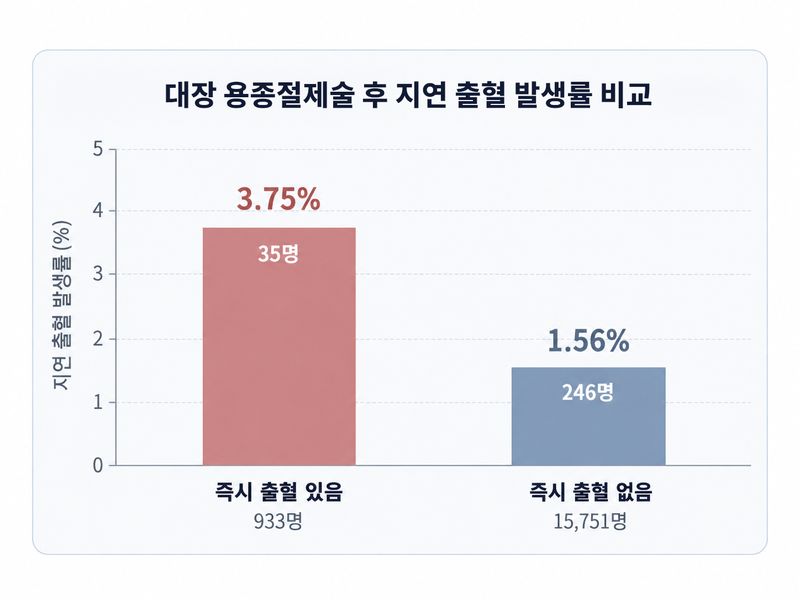
[Financial News] Patients who experience bleeding during colon polypectomy are at least twice as likely to bleed again after the procedure, a study has found. The analysis suggests that “immediate bleeding” during the procedure may be a signal of subsequent “delayed bleeding.”
A research team led by Professor Heo Cheol-ung of the Department of Gastroenterology at Yongin Severance Hospital recently published these findings in the international journal in gastroenterology and hepatology, World Journal of Gastroenterology. Professors Hwang Jin-ho and Hyeon Hye-gyeong, also from the department, were co-first authors, while Professor Heo and Professor Son Nak-hun of Keimyung University’s Department of Statistics were co-corresponding authors.
Colon polypectomy is an important treatment that reduces the risk of colorectal cancer and death, but bleeding can occur afterward. Post-polypectomy bleeding (PPB) is classified by when it occurs as immediate post-polypectomy bleeding (IPPB) or delayed post-polypectomy bleeding (DPPB). Immediate bleeding occurs right after a polyp is removed and can usually be controlled with endoscopic hemostasis. Delayed bleeding, by contrast, occurs within 30 days of the procedure and may require an emergency room visit, hospitalization, repeat endoscopy or a blood transfusion.
The research team analyzed medical records for 16,684 patients who underwent colon polypectomy at Severance Hospital and Yongin Severance Hospital between November 2005 and June 2022, involving 41,279 polyps. Immediate bleeding was defined as bleeding that continued for 1–5 minutes despite irrigation after polyp removal. Delayed bleeding was defined as bloody stool within 30 days of the procedure that required emergency treatment (such as endoscopic hemostasis), hospitalization or another procedure.
The analysis found immediate bleeding in 933 patients, or 5.59% of the total; 35 of them (3.75%) later experienced delayed bleeding. By comparison, 246 of the 15,751 patients who had no immediate bleeding (1.56%) developed delayed bleeding.
Statistical analysis also confirmed a significant association between immediate and delayed bleeding (matched odds ratio, 3.65; P<0.001). Sensitivity analyses using different methods showed the same trend.
The team also analyzed factors associated with delayed bleeding among patients who had immediate bleeding. In a multivariable logistic regression analysis that took into account patient characteristics, polyp size and number, and procedure time, having the procedure performed by a trainee was the only independent risk factor significantly associated with delayed bleeding.
Professor Heo Cheol-ung said, “Our large cohort analysis confirmed that immediate bleeding during polypectomy is an important signal for assessing the risk of subsequent delayed bleeding.” He added, “More careful monitoring of patients who experience immediate bleeding, and ensuring adequate supervision and appropriate hemostasis, particularly when a trainee performs the procedure, could help improve patient safety.”
[email protected] Medical correspondent Jeong Myeong-jin Reporter