Supreme Court Chief Justice Cho Hee-dae Faces Complaint Over 'Business Promotion Expense' Controversy Following 'Supreme Court Justice Recommendation' Controversy
- Input
- 2026-10-13 14:11:54
- Updated
- 2026-10-13 14:11:54
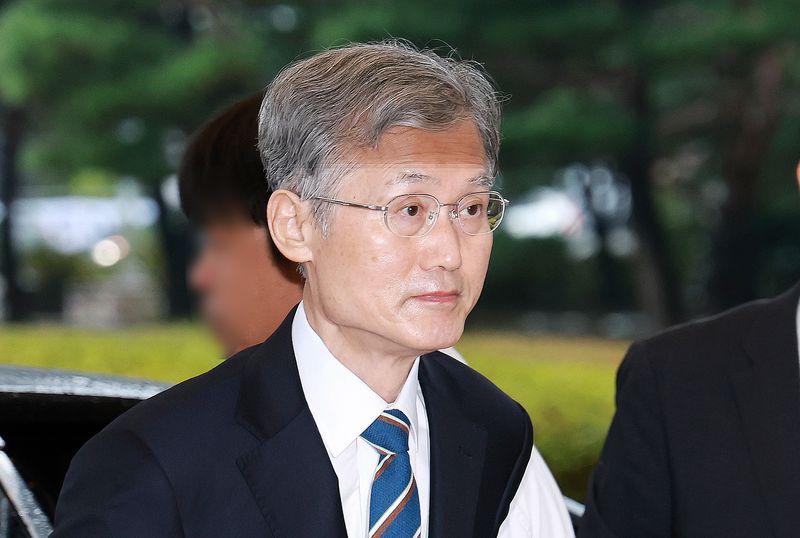
[Financial News] Cho Hee-dae, chief justice of the Supreme Court of Korea, who was recently the subject of a complaint alleging abuse of authority and obstruction of the exercise of rights in connection with the 'Supreme Court justice nomination controversy,' has also been the subject of a complaint over allegations that he improperly used business promotion funds and submitted false materials to the National Assembly.
The Rebuilding Korea Party (RKP) said on the 13th that it had filed a complaint with the Corruption Investigation Office for High-ranking Officials (CIO) over the latest allegations concerning Chief Justice Cho, saying, "We could no longer stand by."
RKP lawmakers held a news conference at the National Assembly Communication Center that day and filed a complaint against Chief Justice Cho on six charges, including embezzlement under the Act on the Aggravated Punishment of Specific Economic Crimes, occupational embezzlement, preparing and using false official documents, obstruction of official duties by deceptive means, causing loss to the state treasury, etc., under the Act on the Aggravated Punishment of Specific Crimes, and violating the Improper Solicitation and Graft Act.
The RKP alleged that Chief Justice Cho regularly paid Supreme Court justices money as an encouragement and improperly used business promotion funds.
They said, "He used taxpayers' money for cash handouts. That's the kind of thing only a party leader in the authoritarian era would have done," and criticized him, saying, "He used money meant for official business to enjoy lavish feasts that would cost an ordinary person a full day's or two days' wages."
They added, "The Supreme Court itself knew this was a problem and padded the number of attendees to make it fit," and said, "It submitted a response to the National Assembly containing this false information." They also criticized him, saying, "When this was discovered, Chief Justice Cho tried to pass the blame to his subordinates."
They sharpened their criticism, saying, "It is common sense that judges who pass judgment on other people's lives and punish them should be scrupulously restrained themselves. The chief justice, as head of the highest court, must be held to ethical standards far stricter than those applied to the average citizen of South Korea," and added, "Because he failed to meet them, the RKP will hold him to the same standards applied to ordinary citizens."
Meanwhile, the CIO assigned the case to Investigation Division 1, headed by Chief Prosecutor Na Chang-su, and began investigating the case for which the civic group Citizens' Action for Establishing Judicial Justice (Sasehaeng) had filed a complaint against Chief Justice Cho last August on charges of abuse of authority and dereliction of duty.
Sasehaeng had filed a complaint with the CIO, alleging that Chief Justice Cho disregarded convention and unilaterally submitted a written recommendation of Supreme Court justice nominee Son Bong-gi, thereby obstructing the president's exercise of appointment authority.
Sasehaeng also charged him with dereliction of duty, saying, "Without a legitimate reason, Chief Justice Cho failed for more than seven months to recommend a successor to former Supreme Court Justice Rho Tae-ak to the president, deliberately neglecting his duties."
[email protected] Yu Seon-jun Reporter