Japanese stocks plunge amid concerns over recouping AI investments; Nikkei down 2.52%
- Input
- 2026-10-13 13:00:50
- Updated
- 2026-10-13 13:00:50
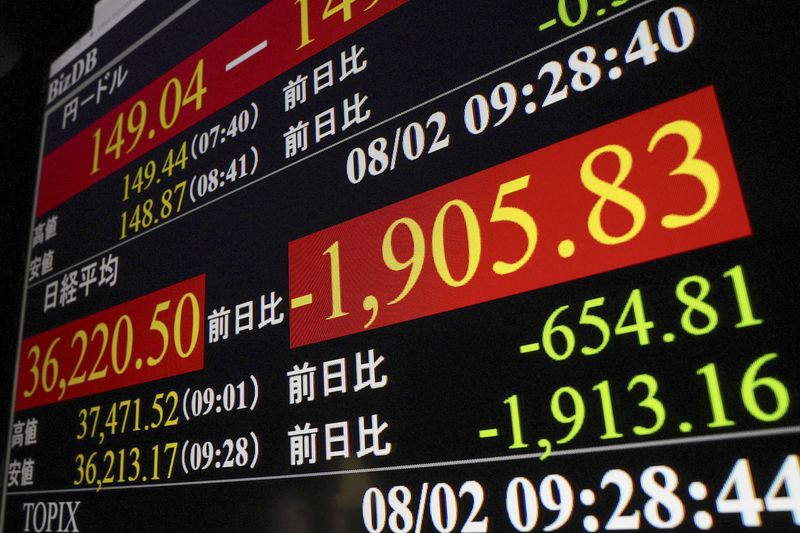
【Financial News, Tokyo — Correspondent Seo Hye-jin】 Japan’s Nikkei 225 Stock Average (Nikkei index) plunged 2.52% in the morning on the 13th. Selling was concentrated in AI and semiconductor-related stocks amid concerns over recouping investment in AI infrastructure and mounting competition from Chinese memory chipmakers. Fears of high oil prices amid instability in the Middle East also dampened investor sentiment.
According to the Nihon Keizai Shimbun, the Nikkei index ended the morning session at 67,292.39, down 2.52% (1,738.53 points) from the previous trading day, the 9th. Its intraday loss briefly exceeded 2.75% (1,900 points). SoftBank Group fell 8.03%, while semiconductor testing equipment maker Advantest dropped 5.38%, weighing on the index.
Expanded AI investment: financing costs and payback timing in focus
Comments by semiconductor industry executives on AI investment weighed on the market. Intel CEO Lip-Bu Tan cited securing funding, financing costs and return on investment (ROI) as challenges for investment in AI infrastructure at an event in Singapore on the 12th. Broadcom CEO Hock Tan also noted that capital could become the biggest constraint.
Major cloud providers are raising vast sums, including through corporate bond offerings, to build data centers and secure semiconductors. But an increase in bond issuance can push up interest rates and raise companies’ interest costs. There are concerns that even if demand for AI grows, companies may struggle to cover investment and financing costs if it takes longer to generate revenue.
Kazuyuki Muramatsu, head of investment management at Wa Capital, explained, “Demand is stronger than expected, making it difficult for companies to stop investing, but investors are worried that it may take longer to recoup their investments.” Japanese companies with strengths in semiconductor manufacturing equipment are among those set to benefit from increased investment, but analysts said they were swept up in the broad sector sell-off on the day.
Competition from Chinese companies added to the pressure on the memory sector. News that Chinese DRAM maker ChangXin Memory Technologies (CMXT) had made progress in developing new products with higher storage capacity fueled concerns about rising supply and intensifying competition. The previous day, U.S. chipmaker Micron Technology fell 3.88%, while the Philadelphia Semiconductor Index (SOX) dropped more than 2%. In South Korea’s market on the day, Samsung Electronics fell more than 8% and SK hynix dropped more than 9%.
Japan’s Kioxia Holdings also plunged 12.42%, hitting its lowest level since a stock split. Kioxia, whose main product is NAND flash memory, is not directly affected by CMXT’s DRAM development, but it could not escape the sell-off across the memory sector.
Margin-trading positions were also cited as a factor that deepened the losses. As of the 8th, Kioxia’s outstanding margin purchases totaled 885 billion yen, about 10% of the market-wide total, and were 23 times its outstanding margin sales. Analysts said the decline may have accelerated as investors who bought shares with borrowed funds sold their holdings in response to negative news.
Selling focused on semiconductors, not the broader market... Earnings reports in focus
Despite the sharp drop in the Nikkei index, the market as a whole did not fall across the board. On the Tokyo Stock Exchange Prime Market, 1,066 stocks rose, more than twice the 457 that fell. Toyota and Fast Retailing, the operator of Uniqlo, were among the gainers, while the TOPIX ended the morning session at 4,085.91, down 0.46%. The steep losses in AI and semiconductor stocks, which carry significant weight in the Nikkei index, amplified the index’s decline.
Share prices diverged among semiconductor-related stocks depending on their earnings outlook. Yaskawa Electric, which makes servomotors and robots for semiconductor manufacturing equipment, rose as much as 4.91% intraday. On the 9th, the company forecast that net profit for the fiscal year ending in February 2027 would reach 47.5 billion yen, up 35% from the previous year, citing strong orders in the AI and semiconductor sectors.
Instability in the Middle East added further pressure to the market. Concerns about disruptions to oil supplies and logistics mounted after the Houthis, an Iran-aligned armed group in Yemen, attacked the international airport in Riyadh, Saudi Arabia, on the 10th and 11th. November West Texas Intermediate crude oil (WTI) futures hit a two-week high of $94.36 a barrel overnight.
However, crude prices fell in Asian trading on the day as investors took profits, somewhat easing inflation concerns in foreign exchange and bond markets. As the U.S. 10-year Treasury yield declined to the 5.19% range, buying of the yen came in on expectations that the U.S.-Japan interest rate gap would narrow. At noon, the dollar traded at 158.23–158.24 yen, down 0.10 yen from 5 p.m. on the 9th.
Japan’s 10-year government bond yield also fell 0.01 percentage point to 3.000%, its lowest level since the 18th of last month.
The next factor likely to determine the direction of semiconductor stocks is earnings. ASML of the Netherlands is due to report results on the 14th of this month, followed by Taiwan’s TSMC on the 15th. With concerns about recouping investment mounting, the market is focused on how much AI demand is translating into actual orders and profit growth.
[email protected] Seo Hye-jin Reporter