DAPA: “First and second U.S. MASGA vessels to be built in Korea” ... National security on high alert over cyberattacks
- Input
- 2026-10-13 12:59:51
- Updated
- 2026-10-13 12:59:51
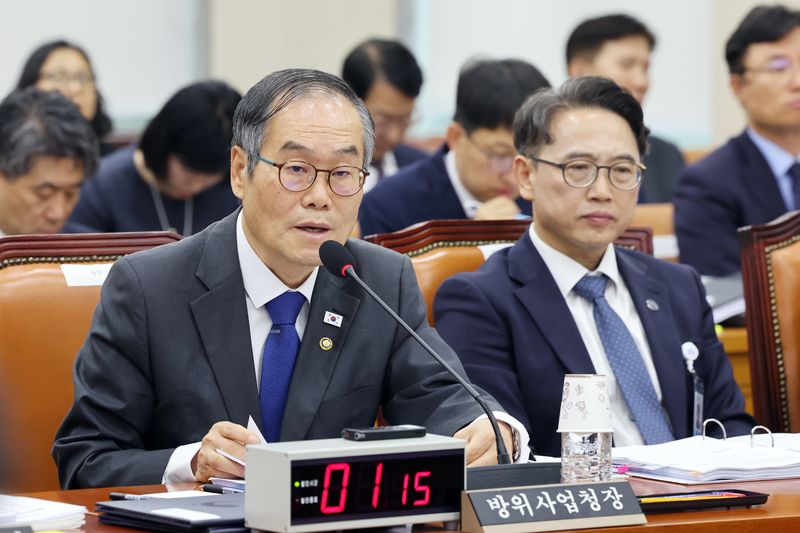
Under the plan, the first vessel (Hull No. 1) and the second vessel in the MASGA Project, a symbol of cooperation between the two countries, will be built at shipyards in South Korea. From the third vessel onward, however, the hulls will be built in the United States. Responding to Min’s concern that domestic defense-industry companies could be left out when production of subsequent vessels shifts to the United States, Lee acknowledged that “there are indeed real concerns about the domestic industry being sidelined from the third vessel onward.” He added, “We will actively seek ways for Korean companies to enter U.S. supply chains at the parts, components and modules level, large and small, going beyond simple hull construction, to minimize the impact.”
On the maintenance, repair and overhaul (MRO) business for naval vessels, Lee said, “We have entered the working-level stage, closely discussing specific implementation plans with the shipbuilding cooperation center and MRO center to be established there,” adding, “We are driving forward shipbuilding cooperation as a whole on the basis of an executive order by U.S. President Donald Trump.” He also acknowledged some friction caused by shifts in the political climate in the United States. “There are differences over details between the U.S. president’s executive-order policy and congressional leaders responsible for enacting the National Defense Authorization Act (NDAA), so progress on the project has been somewhat slower than initially expected,” Lee said.■ Admits shortcomings in whole-of-government control tower, seeks breakthrough through G2G cooperation among foreign affairs and finance ministriesSharp criticism was also voiced that, despite the growing scale of shipbuilding cooperation with the United States, there was no visible focal point at the government level. When Min pointed out the absence of a clearly designated control tower to oversee the South Korea-U.S. shipbuilding cooperation project, Lee candidly acknowledged the limits of the government’s response.
Lee replied, “It is certainly true that the dedicated control-tower organization needed to ensure coordinated action across the government is currently somewhat inadequate.” He added that, apart from establishing a new organization, the ministries were maintaining close coordination to prevent gaps in practical work. “We are continuously operating closely knit government-to-government (G2G) cooperation channels among relevant agencies, including the Ministry of Foreign Affairs, the finance ministries responsible for export financing, and the Ministry of Trade, Industry and Energy, and are opening up practical avenues for progress,” Lee said.■ Defense-industry hacking shakes national security; 74% of 63 leaks since 2021 occurred in recent yearsIn stark contrast to the green light for exports to the United States, a shocking tally showed that global cyber espionage targeting South Korean defense technology had breached defenses with devastating effect. According to a comprehensive review of security incidents submitted by DAPA to Yoo Yong-won, a People Power Party lawmaker on the National Assembly’s National Defense Committee, a cumulative 63 cases of defense data leaks have occurred at domestic defense companies and non-defense partner companies since 2021.
The number of leak incidents remained in the single digits by year—eight in 2021, three in 2022 and five in 2023—before surging to 17 in 2024. There were also 16 cases last year, and 14 leaks have already been confirmed this year as of the first of this month. Overall, 47 cases, or 74% of the cumulative total of 63, occurred since 2024.
In particular, the attacks were found to have been carried out by external actors. According to the statistics, 16 of the 17 cases in 2024, 14 of the 16 cases last year and 11 of the 14 cases this year resulted from external cyberattacks, rather than unauthorized removal of data by personnel.
A traceback of the IP addresses and distinctive attack methods used in the attempted leaks found that three cases in total—two in 2024 and one last year—were suspected to have been carried out by hacking groups linked to North Korea. In two of those cases, it was confirmed that internal confidential files had been transferred to North Korea. An even larger security gap is that 15 “untraceable” cases have gone unresolved since 2021, with authorities unable to determine whether hacking had occurred even after receiving reports of leaks. DAPA told Yoo’s office, “In some cases, companies failed to properly retain and manage logs related to cyberattacks, making it physically impossible to trace them.” Yoo called for a sweeping overhaul of DAPA’s security, saying, “Protecting the country’s core technologies is directly linked to the lifeline of national security,” and urging it to “abandon reactive, after-the-fact investigations and implement effective, extraordinary safeguards that can prevent technology leaks at the source.”
■ Hanwha-KAI acquisition speculation ... DAPA chief Lee: “We will carefully weigh factors such as monopolies, with national interests at the center”On the possibility of Hanwha Group acquiring Korea Aerospace Industries (KAI), Lee said it was too early for the government to adopt a definitive position at this stage. He added that if an actual acquisition or merger process gets underway, the government would closely examine the impact on national security and the national interest.
National Defense Committee lawmakers noted that Hanwha had increased its stake in KAI and shifted its objective toward participating in management. They voiced particular concern that if control of a key asset involved in the mass production of the KF-21 Korean fighter jet were transferred to private hands, it could create an overwhelming monopoly, pose supply-chain risks and undermine the health of the defense-industry ecosystem.
Lee said he fully understood the lawmakers’ concerns and the need to examine the relevant factors, while noting that economies of scale could also improve international competitiveness. Cautioning that it would be premature to decide in advance which way to go, he said that once a formal process for gathering opinions begins, the government would carefully weigh the pros and cons in light of the national interest before making a judgment.
[email protected] Lee Jong-yun Reporter