North Korea fired two missiles the previous day, traveling “900 km” and “220 km” ... Blasts heard near the front off Ganghwa Island point to ongoing fortification work
- Input
- 2026-10-13 15:17:07
- Updated
- 2026-10-13 15:17:07
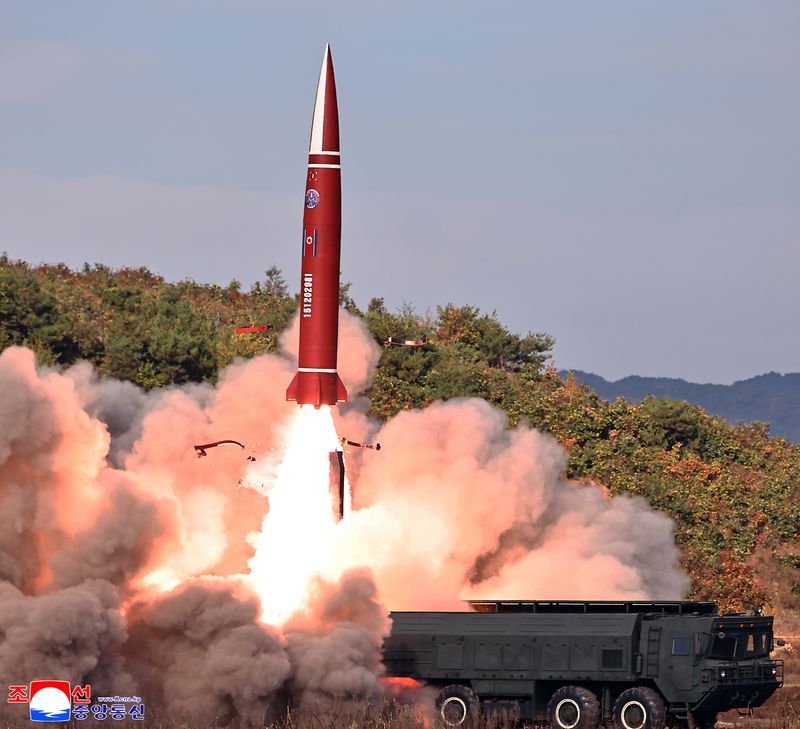
North Korea’s latest missile launch is seen as a calculated deceptive provocation. The South Korean Joint Chiefs of Staff said that North Korea had fired “several” ballistic missiles from the Pyongyang area toward the East Sea the previous day, some of which flew approximately 900 km or more. By contrast, the U.S. Pacific Command and Japan’s Ministry of Defense assessed that North Korea had fired “two” missiles, reflecting a discrepancy in the number detected. Japan’s defense ministry specifically confirmed that missiles with flight distances of approximately 220 km and at least 910 km had been launched simultaneously. The U.S. Pacific Command added in a statement that, based on its current technical assessment, the incident did not pose an immediate threat to U.S. territory or its allies.
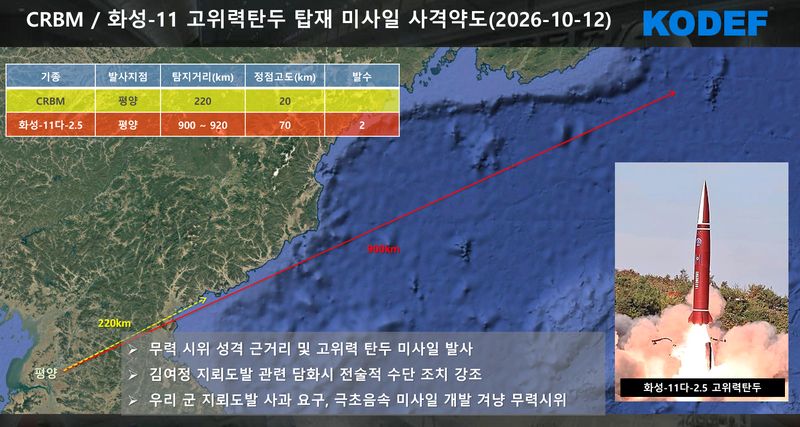
Security experts believe that an upgraded variant from the KN-23 (Hwasong-11) family, North Korea’s signature short-range ballistic missile (SRBM), was used. North Korea has persistently pursued upgrades to high-yield warheads to strike strategic facilities across the Korean Peninsula, including cluster munitions packed with numerous submunitions in a single warhead, mine warheads that scatter large numbers of mines, and carbon-fiber bombs designed to disable power grids.■ KODEF: “High-yield Hwasong-11Da-2.5 deployed ... intended to disrupt precise South Korea-U.S. analysis”The Korea Defense & Security Forum (KODEF), a defense and security think tank, pointed to the propaganda effort behind the messages North Korea has put out through its media. Shin Jong-woo, KODEF secretary-general, assessed that the provocation involved alternating launches of a Close-Range Ballistic Missile (CRBM) with a flight range of about 220 km and an apogee of around 20 km, and a “Hwasong-11Da-2.5” missile carrying a high-yield warhead, with a flight range of about 900–920 km and an apogee of about 70 km.
Shin said North Korea intended to widely publicize footage of the high-yield missile that flew roughly 900 km while concealing the launch of the CRBM, which traveled a much shorter distance. He described it as “a deliberate act of technical interference, mixing guided missiles with completely different ranges to confuse the detection radars of South Korea-U.S. combined assets and hinder precise post-launch analysis.”
On the cause of the provocation, he assessed that “this show of force was a retaliatory response to our military’s demand for an apology over a violation of the Armistice Agreement following the recent landmine explosion involving mines laid by North Korean troops in the western-front Demilitarized Zone (DMZ), and to the sudden disclosure on the 8th of the successful first test launch of a domestically developed hypersonic glide vehicle (HGV), which sent a strong warning.” It is viewed as a counter-show of force carried out immediately after Kim Yo Jong, vice department director of the Workers’ Party of Korea, vowed to activate tactical measures against South Korea.■ Blasts ring out daily at Ganghwa Island’s northern tip as fortification work continues to entrench the “hostile two states” stanceAlongside the missile deception in the skies, North Korea’s fortification activity, which has continued for months on the ground in the western-front border area, was also observed. Jang Do-young, public affairs director of the Republic of Korea Joint Chiefs of Staff, said at a briefing on the 13th that “powerful explosions have been heard continuously in recent days in North Korean coastal areas north of the neutral waters of the Han River estuary, facing Ganghwa Island,” adding, “We assess that the North Korean military is reinforcing its coastal guard facilities on the northern side and are monitoring developments.”
The blasts are believed to be part of North Korea’s efforts, pushed continuously since April 2024, to seal off the border and build a barrier to block access to South Korea. Japan’s NHK reported that it had captured a large-scale series of blasting operations in which North Korea was breaking up a rocky mountain along a river near Kaesong. North Korea is entrenching the barrier against South Korea by erecting barbed-wire fences along rocky terrain shaped by blasting and laying anti-personnel mines.
A resident, 63, whose family has lived for generations at the frontline on the northern tip of Ganghwa Island, described the tension on the ground: “I’d heard blasting sounds from far away for a long time, but things changed when the work zone gradually moved in from east to west along the river and the blasts began booming every day in the border area near our village. Now that they’ve come so close, there are loud booms every day that shake the whole house. It’s a fear I’ve never experienced in my life.”
The JCS emphasized that the country was fully prepared, saying of the provocation, “It is at a level that can be sufficiently detected in advance and intercepted with current South Korea-U.S. combined defense assets and detection radars.” North Korea is assessed to be strengthening frontline fortifications and surprise-strike capabilities at the same time in order to carry out the physical severance outlined in Kim Yo Jong’s statement. Experts advised that, to prepare for the possibility of accidental clashes in border areas, the rules of engagement (ROE) should be revised so field commanders can activate them immediately in the event of a North Korean provocation. They also said that, under Article 51 of the UN Charter (the right to self-defense), a rigorous peacetime posture with no blind spots should be maintained to enable the immediate exercise of the right to self-defense on the ground.
[email protected] Lee Jong-yun Reporter