Exports of K-Consumer Goods, Including Ramen and Cosmetics, Surge 4.2-Fold in 10 Years, Expanding from China to the U.S. and Europe
- Input
- 2026-10-13 12:00:00
- Updated
- 2026-10-13 12:00:00
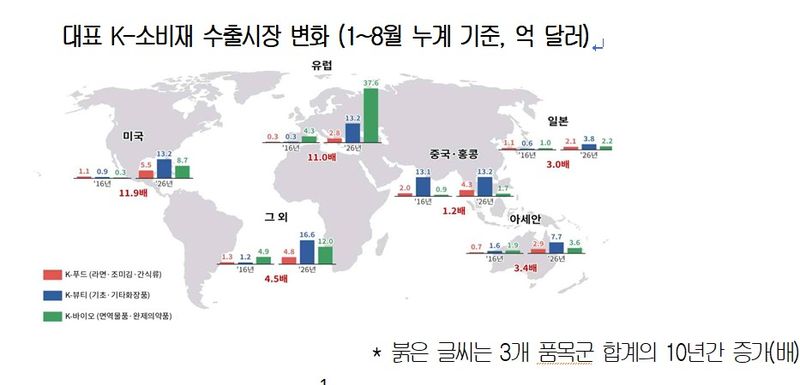
[Financial News] Exports of major Korean food, cosmetics and biotech products have at least quadrupled in 10 years. Cosmetics exports, once concentrated in China, have spread to the U.S. and Europe, while food and biotech have also grown primarily in the U.S. and Europe, respectively.
Amid assessments that the base of SMEs and mid-sized companies driving exports has broadened, observers say region-specific support is needed to sustain this growth.
According to the Korea Chamber of Commerce and Industry's report, “A 10-Year Trend Analysis of K-Consumer Goods Exports,” released on the 13th, exports of seven product categories—including ramen, seasoned seaweed and snack foods; basic and other cosmetics; and immunological products and finished pharmaceuticals—totaled $15.59 billion from January to August this year.
That was 4.2 times the $3.74 billion recorded in the same period in 2016, far exceeding the 2.2-fold increase in South Korea's total exports.
The U.S. and Europe were the markets that drove growth. Exports to the U.S. increased 11.9-fold, from $230 million to $2.74 billion over the period, while exports to Europe rose 11-fold, from $490 million to $5.36 billion. Exports to ASEAN and Japan grew 3.4-fold and threefold, respectively, while those to China and Hong Kong rose just 1.2-fold.
Cosmetics saw the most pronounced change in markets. In 2016, 74.2% of exports were concentrated in China and Hong Kong, but exports to the U.S. and Europe subsequently grew 15.3-fold and 43.9-fold, respectively. This year, the shares going to China and Hong Kong, the U.S. and Europe have become similar, at around 20% each.
The U.S. has established itself as a key market for food. Based on combined exports of ramen, seasoned seaweed and snack foods, the U.S. overtook China to become the largest export destination in 2020 and has held that position since. This year, the U.S. accounted for 40.4% of seasoned seaweed exports, 28.1% of snack food exports and 17.6% of ramen exports. In biotech, Europe's share rose from 32.3% to 57.1%, driven by expanded supplies of biosimilars.
The companies driving exports varied by sector. This year, SMEs and mid-sized companies accounted for 93.1% of food exports and 91.3% of cosmetics exports. In contrast, large companies accounted for 72.8% of biotech exports, where investment in large-scale production facilities and overseas regulatory approvals are important—up 20.8 percentage points from 10 years ago.
Growth among mid-sized companies was particularly notable. Their cosmetics exports increased 20.8-fold over the decade, and their share of exports rose from 3.5% to 19.1%. In food, growth among mid-sized manufacturers leading ramen exports helped expand mid-sized companies' share from 40.1% to 61.8%.
The number of companies entering export markets also increased. The number of SMEs exporting basic cosmetics rose from 2,808 in 2016 to 6,019 last year. The spread of the Korean Wave and the expansion of online distribution networks were found to have broadened their reach to overseas consumers.
Professor Jeong Jae-wook of Sogang University's Graduate School of International Studies said, “Growth paths differ by product, but the common denominator is non-price competitiveness, not price,” adding, “The quality and brands of Korean products are being recognized in the U.S. and European markets.”
The KCCI therefore called for support that takes into account each country's certification and labeling requirements and distribution networks. It said support for market access and logistics should be strengthened for new exporters, and that a “growth ladder” is needed to ensure continued support as companies grow into mid-sized businesses.
Lee Si-wook, who heads economic research at the KCCI, emphasized, “We need to turn the export base built by thousands of SMEs and mid-sized companies into a lasting engine of growth through tailored strategies that take regional and company-specific characteristics into account,” adding, “We should also analyze the causes of slowing exports to China and pursue measures to reinvigorate them.”
[email protected] Kim Hak-jae Reporter