From 7,000 to a break below 6,000 in just five trading sessions ... KOSPI slides to 5,950 intraday
- Input
- 2026-10-13 11:29:18
- Updated
- 2026-10-13 11:29:18
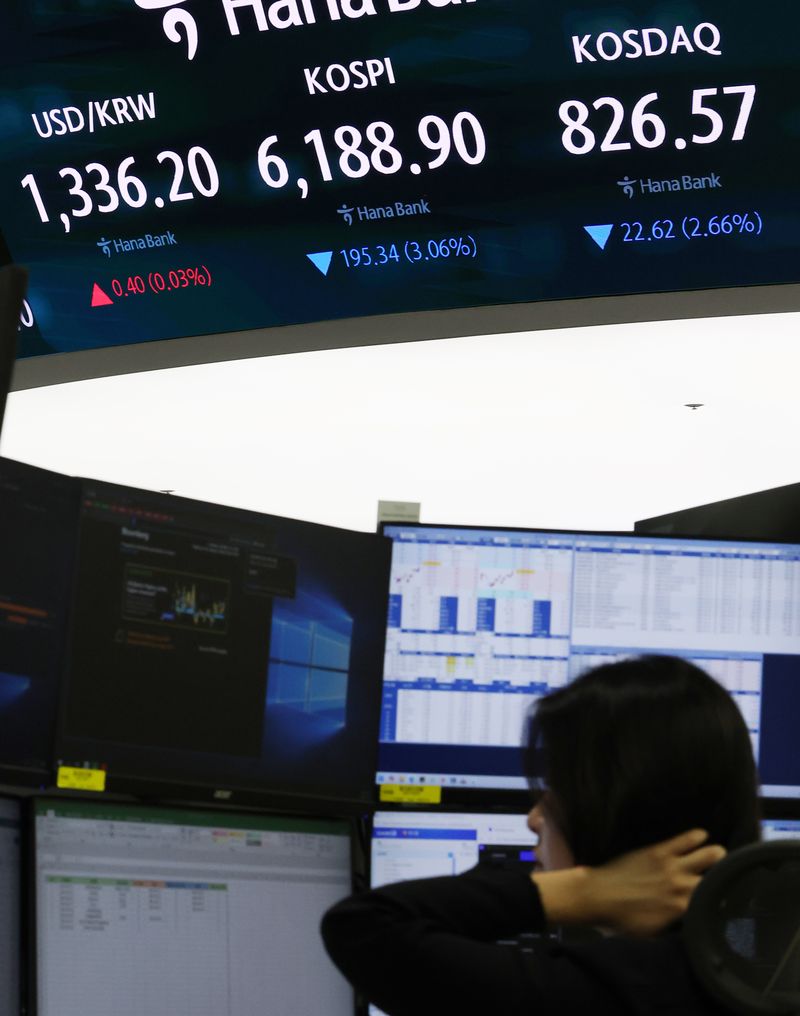
[Financial News] The KOSPI, which had been above 7,000, plunged below 6,000 in just five trading sessions. After closing at 7,003.74 on the 2nd, the index fell every trading session thereafter, shedding more than 1,000 points. As selling continued, led by large-cap semiconductor stocks, the intraday decline exceeded 6% on the 13th.
As of 11:26 a.m. that day, the KOSPI was down 404.18 points (6.33%) from the previous trading session at 5,980.06. Compared with its close of 7,003.74 on the 2nd, it had fallen 1,023.68 points, or 14.62%, in just five trading sessions. Intraday, it slid as low as 5,950.00, bringing its decline from the 2nd to 15.05%.
It took just five trading sessions for the index to fall from above 7,000 to below 6,000. After rising 0.46% on the 2nd, the KOSPI fell to 6,941.39 on the next trading day, the 6th. It then closed at 6,803.90 on the 7th, 6,625.93 on the 8th and 6,384.24 on the 12th. That day, it gave up the 6,100 level and then the 6,000 level.
The pace of the decline also accelerated. The drop widened from 0.89% on the 6th to 1.98% on the 7th, 2.62% on the 8th and 3.65% on the 12th. Intraday that day, the index fell as much as 6.80%. With losses continuing without a rebound, the declines grew larger with each trading session.
At 9:47 a.m. that day, the Korea Exchange triggered a sell-sidecar in the securities market. It was the 50th such measure in the KOSPI market this year and the 26th in the sell direction. The index extended its losses even after the measure, which suspends the effectiveness of program sell orders for five minutes.
The downturn spread across the broader market. At that time, 836 stocks on the securities market were declining, about 13 times the 65 that were rising. The large-cap index fell 6.28%, while the mid-cap and small-cap indexes dropped 2.86% and 2.24%, respectively.
Large-cap semiconductor stocks also plunged. Intraday, Samsung Electronics traded at 233,000 won, down 6.99% from the previous session, while SK Hynix fell 9.03% to 1.46 million won. Both stocks had declined for five consecutive trading sessions since the 6th.
Shinhan Securities cited concerns about returns on AI investment and Chinese memory makers catching up as factors behind the steep drop that day. Kang Jin-hyuk, a senior researcher at Shinhan Securities, said, “Individual issues in the semiconductor industry, rather than macroeconomic factors, are shaking the market.” He explained, “Sentiment has cooled amid controversy over OpenAI’s revenue, as well as warnings from the CEOs of Broadcom and Intel about constraints on financing AI investment and pressure on returns.” He added that “the possibility of China’s CMXT launching next-generation DDR5 for servers within the year is also stoking concerns about intensifying competition and the profit outlook for 2027–2028.”
The weakening of the buying base was also cited as a headwind. Kang said, “Samsung Electronics’ share buyback ended on the 6th, and SK Hynix is also expected to wrap up its buyback this week.” With individual investors’ buying insufficient to provide support and share buybacks also nearing an end, the market’s supply-demand dynamics have become vulnerable to panic selling, according to the analysis.
[email protected] Choi Doo-sun Reporter