China's domestic car sales fall 28.0% ... while exports surge 73.7%
- Input
- 2026-10-13 11:23:37
- Updated
- 2026-10-13 11:23:37
[Financial News] Last month, China's passenger-car exports rose by more than 73%, while its domestic market for passenger cars showed marked weakness.
According to Maeil Business Newspaper and other outlets on the 13th, the China Automobile Dealers Association's Automobile Market Research Branch (the branch) announced the previous day that domestic retail sales of passenger cars in China fell 28.0% year on year to just 1,618,000 units last month.
China's domestic passenger-car retail sales continued their year-on-year decline for 12 consecutive months, and the September drop was the largest of the year. Although September is considered peak season for China's auto market, retail sales rose just 5.0% from the previous month.
Cumulative passenger-car retail sales from January to September totaled about 13.33 million units, down 21.7% year on year.
With new-energy passenger cars, including electric vehicles and plug-in hybrids, holding up relatively well, their share of domestic passenger-car retail sales in September rose to a record 67.0%.
Domestic retail sales of new-energy passenger cars in China fell 16.7% year on year to 1,084,000 units in September, while retail sales of passenger cars powered solely by internal-combustion engines plunged 49% year on year.
The branch said the weakness during September's peak season was marked by “an unusually pronounced decline in sales.” It attributed the downturn not only to the Mid-Autumn Festival (Chuseok) holiday and base effects, but also to factors including high oil prices and delays in new-car launches due to rising memory-chip prices.
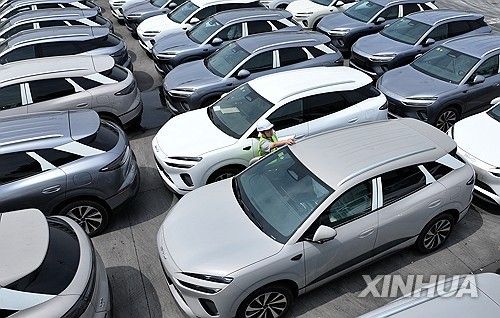
By contrast, passenger-car exports in September, including finished vehicles and completely knocked-down (CKD) kits, surged 73.7% year on year to 917,000 units. That was equivalent to 36% of passenger-car manufacturers' sales in September.
China's new-energy vehicle exports in September rose 163.5% year on year to 558,000 units, accounting for 60.8% of total passenger-car exports.
The branch said exports are becoming a key growth engine, with some companies exporting more vehicles than they sell domestically.
The September sales figures for China's passenger-car market were released as China and the European Union (EU) reached an agreement last week after a dispute over Chinese-made new-energy vehicle exports to the EU.
Bloomberg News reported that, under the agreement, the EU would limit imports of Chinese-made hybrid cars to 350,000 next year and then increase the quota by 6% annually. A senior EU official had said that imports of Chinese-made hybrid cars were expected to reach as many as 800,000 units this year.
China's Ministry of Commerce said exports of Chinese-made hybrid cars to the EU totaled around 302,000 units last year and that negotiations had “secured export opportunities for Chinese companies.”
A branch official said the agreement was mutually beneficial overall, since the sides had reached a negotiated deal instead of resorting to tariffs, but added, “Exports next year may face greater pressure in the short term. In the long term, rather than simply exporting finished vehicles, companies need to accelerate localization in the EU.”
China's Ministry of Finance and State Taxation Administration announced the previous day that they plan to lower the VAT rebate rate on new-energy vehicle exports from 13% to 9%, effective next April.
An industry source said that reducing the VAT rebate rate would raise companies' export costs and could therefore lead to higher export prices.
Caixin added that Chinese industry circles are also discussing the possibility that VAT rebates on new-energy vehicle exports could be eliminated entirely over the next two to three years.
[email protected] Lee Seok-woo, international affairs correspondent Reporter