Core Businesses Recover, AI Infrastructure Adds Lift ... Combined Operating Profit at Korea’s Three Telcos Nears 5 Trillion Won
- Input
- 2026-10-14 15:37:43
- Updated
- 2026-10-14 15:37:43
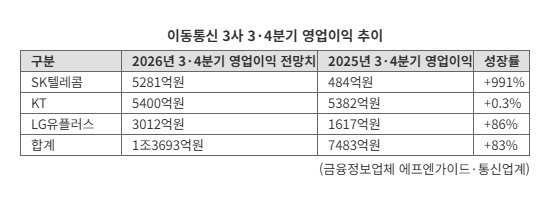
[Financial News] Expectations are growing that combined Q3 operating profit at Korea’s three mobile carriers will approach 1.4 trillion won, ushering in an era of 5 trillion won in annual combined operating profit. The base effect is beginning to take hold as one-off costs related to compensation for subscribers affected by last year’s hacking incident and voluntary retirement fade. Meanwhile, AI infrastructure businesses, including artificial intelligence data centers (AIDCs), are establishing themselves as new growth drivers.■ One-off costs out of the way, operating profit at the three telcos set to surge 83%According to financial data provider FnGuide on the 14th, the three telcos—SK Telecom Co., Ltd. (SKT), KT and LG Uplus—are forecast to post combined Q3 revenue of 15.3393 trillion won and operating profit of 1.3693 trillion won. That would be an 83% increase from 748.3 billion won in the same period last year.
The biggest factor behind the earnings rebound is the base effect from one-off costs incurred last year. SKT’s profitability deteriorated after last year’s hacking incident amid customer compensation, subscriber churn and SIM replacement costs, while LG Uplus also recognized costs related to voluntary retirement in its results.
Among the three companies, SKT is expected to see the biggest improvement in earnings. Its Q3 operating profit is forecast at 528.1 billion won, at least 10 times the level in the same period last year. KT is expected to see wireless revenue decline as subscribers left during the penalty-waiver period in the first half of this year following last year’s hacking incident. But with marketing costs stabilizing and new businesses such as AIDCs growing, KT is expected to post operating profit of 540 billion won in Q3, the highest of the three. LG Uplus is also forecast to post Q3 operating profit of 301.2 billion won, up about 86% year on year.■ AI infrastructure growing rapidly, emerging as a new growth engine for the three telcosThe rapid growth of AI infrastructure businesses is also contributing to improved results. Analysts say telecom companies are expanding their business scope by meeting surging demand for AI infrastructure, drawing on their existing networks and experience operating data centers (DCs).
In the second quarter, all three telcos recorded double-digit growth in AIDC-related revenue. SKT’s AIDC revenue rose 93% year on year to 136.2 billion won. SKT is accelerating its expansion in the business through its dedicated AIDC companies, SK Horizon and SK Hyper. SK Horizon is responsible for operating and expanding existing DCs, while SK Hyper handles the development of new hyperscale AIDCs. The company plans to secure a total of 15 GW of infrastructure by 2035.
KT does not disclose AIDC revenue separately, but KT Cloud, which includes its DC and cloud businesses, posted second-quarter revenue of 265.4 billion won, up 20% year on year. KT plans to invest about 5 trillion won over the next five years to secure 1 GW of AIDC capacity. It also aims to meet corporate customers’ demand for AI transformation (AX) by linking central AIDCs with edge infrastructure near industrial sites.
LG Uplus’s AIDC revenue also rose 29% year on year to 124.1 billion won in the second quarter. The company is bringing together LG Group’s power, cooling and facility technologies for a 200-MW-class AIDC currently under construction in Paju. It aims to secure cumulative AIDC orders worth 5 trillion won by 2030.
With the core telecom business recovering and AIDC operations growing, combined annual operating profit at the three telcos is expected to reach 5.2114 trillion won. An industry official said, “As the telecom market enters maturity, it is difficult to grow through subscriber increases alone,” adding, “We are accelerating efforts to develop AI infrastructure businesses such as AIDCs into new sources of revenue.”
[email protected] Choi Hye-rim Reporter