Seoul Students Can Now Join the Rural Study Program in South Gyeongsang, Too
- Input
- 2026-10-13 12:00:00
- Updated
- 2026-10-13 12:00:00
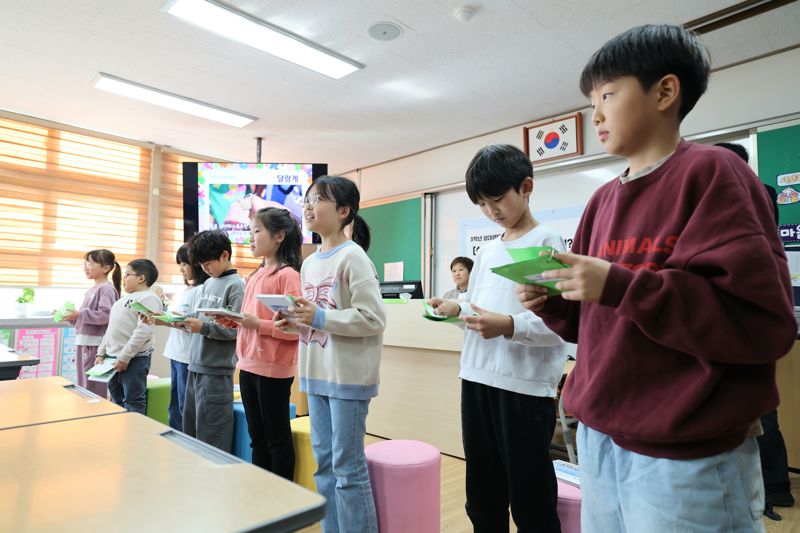
The Seoul Metropolitan Office of Education said on the 13th that it will sign an MOU with the South Gyeongsang Provincial Office of Education on the 16th to promote the rural study program and establish a framework for mutual cooperation.
Under the agreement, the Seoul Metropolitan Office of Education plans to recruit participants for the rural study program in South Gyeongsang starting in November for the first semester of the 2027 school year. The two education offices will discuss selecting participating schools, developing educational programs, and measures to support student safety and daily life, among other matters, and draw up detailed operating plans.
The Seoul Metropolitan Office of Education will recruit Seoul students to participate in the rural study program in South Gyeongsang and provide administrative and financial support to ensure their education and daily lives are stable. The South Gyeongsang Provincial Office of Education will recruit schools to operate the program and support the development of specialized programs at each school and the securing of accommodation.
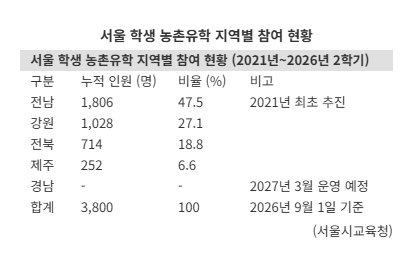
The rural study program began in South Jeolla in 2021 and later expanded to North Jeolla, Gangwon and Jeju, among other regions. According to the Seoul Metropolitan Office of Education’s regional participation figures, as of September 1 this year, South Jeolla accounted for 1,806 of the 3,800 cumulative participants, or 47.5%. Gangwon had 1,028 participants (27.1%), North Jeolla 714 (18.8%), and Jeju 252 (6.6%).
By type of accommodation, the family-stay model accounted for 3,388 participants, or 89.2% of the total. The study-center model had 351 participants (9.2%), while the homestay model had 61 (1.6%).
The Seoul Metropolitan Office of Education expects the agreement to broaden opportunities for Seoul students to take part in educational programs that draw on South Gyeongsang’s natural environment and cultural resources. In South Gyeongsang, the program is expected to improve educational conditions at small schools through educational exchanges between urban and rural areas.
Geun-sik Chung, superintendent of the Seoul Metropolitan Office of Education, said, “I expect that cooperation with the South Gyeongsang Provincial Office of Education will further expand opportunities for Seoul students to learn and grow alongside nature in a new region.”
[email protected] Kim Man-gi Reporter