U.S. stocks notch four straight years of bull-market gains on AI... Will it end next year?
- Input
- 2026-10-13 14:04:35
- Updated
- 2026-10-13 14:04:35

[Financial News] The U.S. stock market, buoyed by the popularity of artificial intelligence (AI), logged four consecutive years in a bull market as of the 12th (local time). Experts forecast that the trend would last at least through next year, but were divided on what would follow.
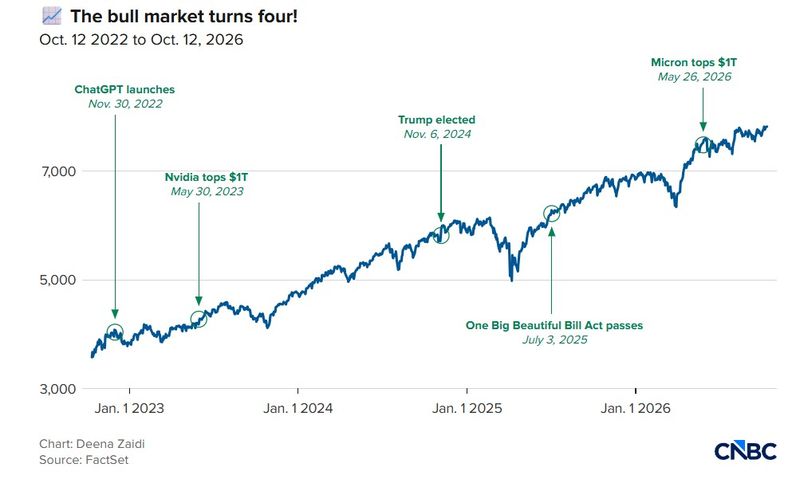
According to U.S. business news outlet CNBC, the S&P 500 closed at 7,807.2 that day, extending its bull market. In stock markets, a bull market generally refers to a market that has risen at least 20% from its previous low. The S&P 500 hit a low of 3,577.03 on October 12, 2022, four years ago, and has since remained in a bull market for four consecutive years, rising 118.3%.
The tech-heavy Nasdaq Composite also climbed 161.5% over the same period, from 10,417.1 to 27,245.9. The Dow Jones Industrial Average (Dow 30), which includes many large-cap stocks, rose about 77.5%, from 29,210.85 to 51,850.55.
CNBC emphasized that AI stocks have driven the bull market. Technology stocks now make up about 40% of the S&P 500. Nvidia, which makes AI semiconductors, has seen its market capitalization grow about 19.5-fold in four years, reaching $5.464 trillion (about 7.422 quadrillion won). Rival Micron Technology, Inc. also topped $1 trillion in market capitalization for the first time last May, and has since grown to $1.119 trillion (about 1.52 quadrillion won). In addition, seven semiconductor companies—including Broadcom Inc., TSMC, Samsung Electronics Co., Ltd., SK hynix and AMD—have crossed the $1 trillion market-cap mark for the first time. Meta, Tesla and Amazon.com, Inc. have also regained market capitalizations above $1 trillion. CNBC said investors had poured money into stocks across the AI sector since the launch of ChatGPT in November 2022, adding that stocks tied to building AI infrastructure had surged in particular.
Investors are now most focused on when the bull market will end. Ari Wald, a senior analyst at U.S. investment bank Oppenheimer, said the bull market of the past four years is the sixth-longest among the 24 bull markets observed in U.S. stocks since 1932. Based on the median of past observations, he forecast that the current bull market would peak in about 13 months. CNBC, for its part, noted that recent gains have been concentrated in a small number of large-cap stocks. Last month, 75% of S&P 500 stocks declined.
Experts cited U.S. interest-rate hikes and the resulting decline in bond prices as reasons the bull market could end. Jordan Rizzuto, chief investment officer (CIO) at U.S. asset manager GammaRoad Capital, noted in comments to MarketWatch that rising interest rates drag down stock prices. Higher benchmark rates ultimately raise companies’ interest expenses and reduce their net income. In addition, the higher the benchmark rate, the higher the risk-free rate used to discount companies’ future cash flows to present value, reducing that value. AI-related stocks, which have gained popularity because of their high growth rates, may struggle to sustain their share prices if the present value of future cash flows falls.
Rizzuto also noted that falling bond prices could prompt money to flow out of the stock market. Early this month, prices of U.S. 10-year and 30-year Treasury bonds hit their lowest levels in 24 and 19 years, respectively. “If bonds offer similar returns with much lower volatility, pension funds and others have a greater incentive to move money from stocks into bonds,” Rizzuto said.
There are also positive outlooks. Wald said the median return in the fifth year of a bull market is about 21%, noting that investors may still be able to make money before the bull market ends. Ryan Detrick, chief strategist at U.S. investment advisory firm Carson Group, said, “A bull market has ended in its fifth year only once, about 50 years ago,” and argued, “This bull market is off to the third-best start on record for a fourth year.”
[email protected] Jongwon Park Reporter