“Just say, ‘Order bottled water’”—Kakao Corp. unveils strategy to bring AI to the masses
- Input
- 2026-10-13 11:00:00
- Updated
- 2026-10-13 11:00:00
[Financial News] Say, “Order bottled water,” to a smartphone screen, and it suggests, “I’ll order two packs of 12 bottles. Talk Deal Chun-sik bottled water is the cheapest at 14,400 won with no delivery fee. Would you like me to order that?”
Kanana Space is a new AI assistant feature Kakao Corp. is introducing so it can be used directly within KaTalk. Swipe across the KaTalk screen with two fingers, and the AI agent Ryan appears, able to send messages, manage schedules and search the web, as well as place orders and make payments. Kakao Corp. plans to advance KaTalk into an AI service for everyday life, going beyond asking AI questions and getting answers to let users entrust it with tasks they actually need done, drawing on personal experiences and a range of situational contexts.
From a single voice command to completing orders and payments
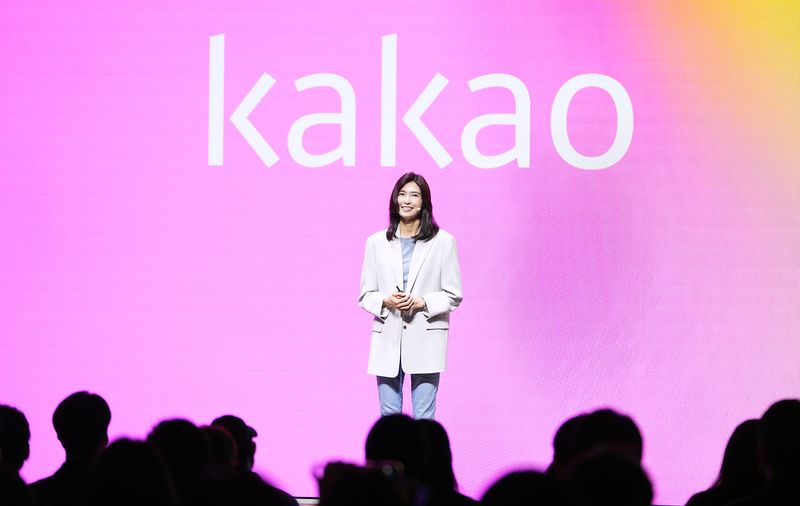
Shina Chung, CEO of Kakao Corp., unveiled a strategy for building an AI ecosystem that includes these features on the 13th at the annual developer conference ‘If Kakao 2026,’ held at Kakao AI Campus in Yongin, Gyeonggi Province, under the theme ‘Intelligence in Every Connection.’Kakao Corp. gave the first preview of Kanana Space, an AI assistant that users can easily call up anywhere in KaTalk to request tasks. Swipe the KaTalk screen, and the AI assistant, represented by the Ryan character, can take requests by voice or text to send messages, manage schedules, search the web and change KaTalk settings. Users can also have everyday conversations with Ryan. Kakao Corp. plans to enhance Kanana Space in the future to handle orders, gifts, reservations and money transfers with a single voice command.
The service is designed to let users call up AI and easily request what they need within the familiar KaTalk app, without having to learn a separate way to use it or find a new app. In particular, the plan is to expand the ecosystem by using the familiar Ryan character to narrow the psychological distance between users and AI. Kakao Corp. plans to select people who apply in advance and conduct a closed beta test (CBT) starting in December.
Kim Dae-nyeon, a performance leader overseeing design at Kakao Corp., said, “I hope the familiarity and friendliness we’ve built over the past 10 years will help people feel more comfortable starting this new experience with AI,” adding, “We plan to introduce a range of IPs, starting with Ryan.”
Users to create their own AI agents
Kakao Corp. also unveiled Canvas, where users can create and run their own AI agents. On a PC, users describe the kind of agent they want, and the system connects relevant tools and skills to assemble the functions needed to run it. While Kanana Space focuses on making it easy to call up AI in everyday life, Canvas helps users combine the functions they need to create their own AI. Instead of overseeing every step themselves, users can handle repetitive work and everyday tasks by checking in at key stages. Agents perform tasks within the limits users authorize. Kakao Corp. is also preparing a feature that lets users share agents they have created. The company aims to build a user-centered ecosystem where, when useful agents are shared, others can use them or develop the ideas further. Kakao Corp. plans to conduct a CBT for Canvas with a small group of users as early as this year.Kakao Corp. is also working to build an integrated environment that connects multiple agents. To that end, it plans to create a new space in KaTalk in the first half of next year where teams of agents can be connected for users. It will support the use of agents built with other frameworks, as well as those created with Canvas, through a familiar interface. The aim is to create an environment where users can connect the agents they need to achieve a goal, rather than logging into each AI separately and issuing commands.
Building Kakao’s AI ecosystem for everyday life
Kakao Corp. is advancing Kanana as an AI model that helps users in their daily lives, going beyond strong performance alone. It outlined three strategies to achieve this: full-stack optimization, multimodality and agentic AI. Full-stack optimization makes the entire operation of AI services more efficient, from model compression to computation and serving. Kakao Corp. is working to handle requests that can be processed on a smartphone with on-device models, while connecting more complex tasks to larger models. In this process, an AI conductor understands users’ requests and selects and coordinates suitable models, tools and execution sequences. Rather than routing every request to a large model, it selects resources suited to each task to reduce inference costs. Kakao Corp.’s in-house tokenizer also supports efficient processing.In the field of multimodality, Kakao Corp. introduced Kanana-o, an omni-language model that understands text, images and speech together and responds by voice. Kakao Corp. developed in-house the various encoders and decoders that make up Kanana-o and plans to release them as open source for use in AI ecosystems in Korea and abroad. It also presented development results for Kanana Live, a full-duplex technology that listens and speaks at the same time.
Kakao Corp. is also pursuing Project Mosaic to deliver personalized AI experiences. The key is to connect users’ memories and experiences in meaningful contexts and ensure that each agent safely receives only the information it needs for its task, within authorized limits. The goal is for agents with different roles to collaborate while understanding a shared context, enabling users to get the results they want without repeating the same explanations. For example, when handling a request that involves multiple steps, each agent would share only the information needed for its assigned task while working toward the overall goal.
Kakao Corp. is also establishing safeguards to reduce risks that may arise as AI carries out actions. Through systematic data governance and multiple layers of safety checks, the company plans to ensure that agents’ action plans and execution remain within the scope users have agreed to. It will also strengthen the infrastructure needed to provide AI services reliably to large numbers of users.
Chung said, “Connection for everyone is a promise Kakao Corp. has upheld and an unwavering standard it will carry forward in the AI era. By adding intelligence that understands each person and works according to their individual needs to connection for everyone, we will make it possible for anyone to experience AI in the familiar routines of everyday life.”
[email protected] Jang Min-gwon Reporter