All 9 Secondary Payload Satellites Successfully Establish Communications After Nuri (KSLV-II)’s Fifth Launch
- Input
- 2026-10-13 10:02:30
- Updated
- 2026-10-13 10:02:30
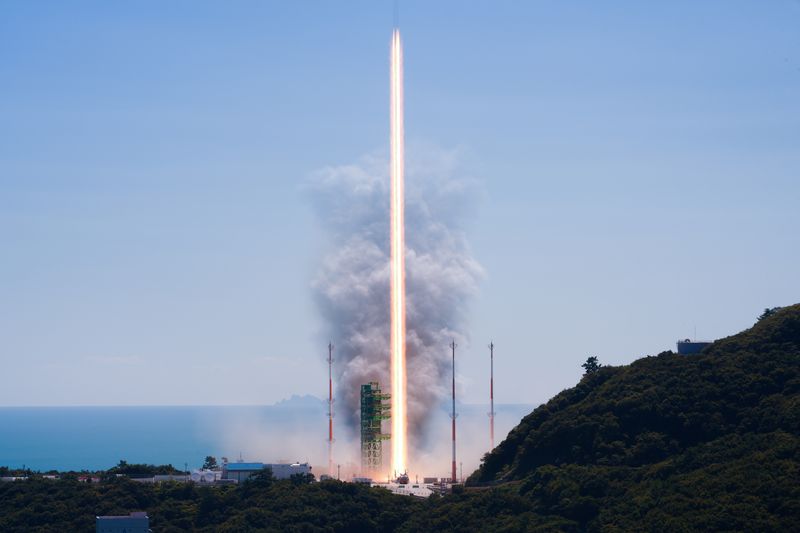
[Financial News] All nine secondary payload satellites ejected during the fifth launch of the Korean launch vehicle Nuri (KSLV-II) successfully established communications.
The Korea AeroSpace Administration and the Korea Aerospace Research Institute announced on the 13th the results of communications with the nine secondary payload satellites launched aboard Nuri (KSLV-II) No. 5 at 12:25 on the 7th.
Of the 10 secondary payload satellites aboard Nuri (KSLV-II) No. 5, nine were ejected. All nine, which separated normally, have now successfully established communications and are undergoing checks in preparation for their missions.
By satellite, Jibisat (KAIST) first received a beacon signal during its first communications attempt at around 1 p.m. on the 7th, and successfully received data (downlink) at around 11 p.m. that day. A ground station is now attempting to uplink data to the satellite to establish two-way communications.
Next, B-1012 (Space Lintec) established two-way communications during its first attempt at around 2 p.m. the same day and is checking the satellite in preparation for its primary mission. Ulysses (Unmanned Exploration Research Institute) also established two-way communications during its first attempt at around the same time and, after checking the satellite, confirmed that its payload was in good condition.
SD1Sat (Space & Bean) also established two-way communications during its first attempt at around the same time and received data, including GPS log data. The Space Optical Communication Orbit Verification Satellite (Chosun University) also received a beacon signal during its first communications attempt at around 2 p.m. on the 7th. At around 11 p.m. that day, it established two-way communications, obtained satellite status and operational data, and received image data. Jack-007 (CosmoWorks) also received a beacon signal during its first attempt at around 2 p.m. and later successfully received data (downlink), confirming that the satellite was in good condition.
Next, at around 2:30 p.m. the same day, the Domestic Components and Parts Space Verification Platform No. 2 (KARI) established two-way communications during its first attempt. It has completed checks of the satellite bus and is now checking its payload. Later, at around 10 p.m. that day, Sledge (O&V Space) received a beacon signal for the first time and successfully received data (downlink) on the 9th, confirming that the solar panels and antenna had deployed properly. A ground station is now attempting to uplink data to the satellite to establish two-way communications.
The following day, the 8th, DaejeonSat-1 (Daejeon Metropolitan City) established two-way communications at around 11 p.m. and confirmed that the satellite was in normal condition, including that its solar panels had deployed properly.
After completing basic checks of their status through communications, the secondary payload satellites are expected to go through an initial operations phase to verify that all systems are functioning normally before beginning their full missions.
Korea AeroSpace Administration Administrator Oh Tae-seok said, "During this fifth launch of Nuri (KSLV-II), we succeeded in establishing communications with the CubeSats in a much shorter time than during the previous, fourth launch. This was achieved by the launch vehicle placing the satellites more accurately into their target orbits and providing precise satellite position information, and it means that our technical maturity has advanced a level." He added, "We will continue to build our capabilities for more advanced space transportation missions."
[email protected] Yeon Ji-an Reporter