Gyeongbuk Province to create a virtuous cycle linking university talent with businesses and fostering business growth
- Input
- 2026-10-13 10:01:13
- Updated
- 2026-10-13 10:01:13
【Financial News, Andong—Reporter Kim Jang-wook】“We will do everything we can to create a virtuous cycle in Gyeongbuk in which talent from local universities is connected with local businesses and industry grows.”
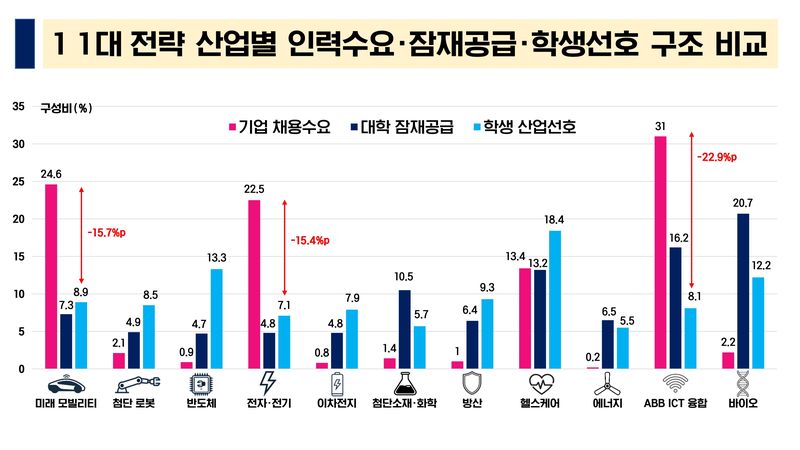
Gyeongbuk Province has confirmed a mismatch between business demand, university supply and student preferences across 11 strategic industries in the Daegu-Gyeongbuk region. Its move to a system in which universities directly train the talent businesses want has drawn attention.
Governor Lee Cheol-woo emphasized, “Universities will find it difficult to survive unless they change their education systems to focus on workforce needs at business sites. The province will actively provide funding to universities that train the talent businesses need.”
He added, “We will concentrate policy resources on training university talent in line with business demand so that university talent can be matched with local businesses and other workplaces across industry.”
The province previously commissioned a research project, starting last April, titled “Analysis of Local Businesses’ Workforce Needs and Mid- to Long-Term Hiring Outlook.” It surveyed workforce demand, supply and preferences in 11 strategic industries, including advanced robotics, semiconductors, electronics and electrical industries, and secondary batteries.
A total of 118 businesses, 28 anchor universities and 915 students participated. The business survey results were calculated using weights reflecting the composition of businesses in Gyeongbuk.
The survey projected hiring demand of 210,819 people in these industries over the next five years.
By industry, demand was highest in artificial intelligence (AI), blockchain, data and information and communications technology (ICT) convergence, at 65,295 people. This was followed by future mobility, at 51,765, and electronics and electrical industries, at 47,409.
By occupation, production and technical roles accounted for 41.1%, and research roles for 24.2%. Businesses sought both hands-on workers for operational roles and research and development personnel.
Majors were concentrated in engineering and health fields, including mechanical engineering, automotive, aviation and robotics at 27.8%, and nursing at 25.8%.
The university supply analysis classified 155,971 students enrolled at 28 universities as potential talent. Of these, 97,423—or 62.5%—were in majors directly related to the 11 strategic industries.
Students’ preferred occupations differed from business demand: office work ranked first at 25.8%, followed by production and technical roles at 21.7% and research roles at 14.8%. Gyeongbuk was the top preferred employment location for 55.7%, followed by the Seoul metropolitan area at 23.7% and Daegu at 12.2%.
Meanwhile, based on its survey of business demand, the province is building a joint talent-development system involving businesses, universities and local governments, linking university education and joint practical training with business recruitment and local government support for settling in the area.
[email protected] Kim Jang-wook Reporter