"Trump’s plan to revive U.S. manufacturing faces a test ... hurdles for Philly Shipyard and others"
- Input
- 2026-10-13 08:02:58
- Updated
- 2026-10-13 08:02:58
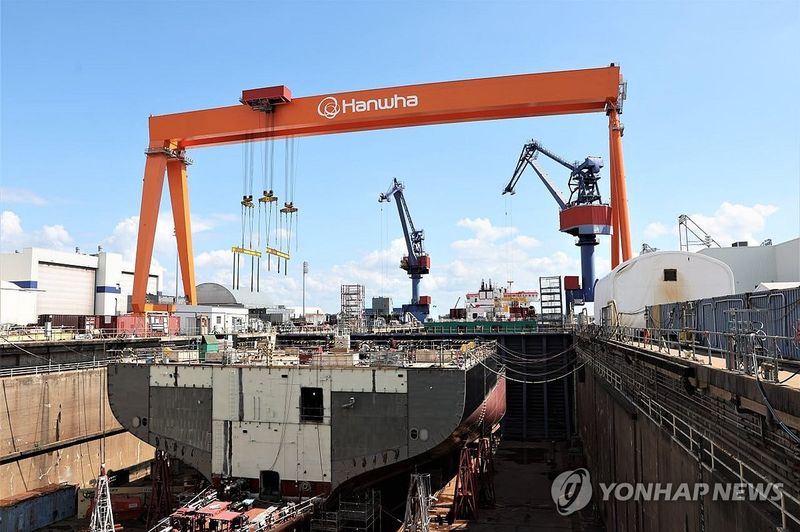
[Financial News] A project touted by U.S. President Donald Trump to revive manufacturing is being put to the test by high wages, labor shortages and a lack of price competitiveness.
The Wall Street Journal (WSJ) reported this on the 12th (local time), saying skepticism is emerging over whether the plan can be realized, given the difficulty of securing skilled workers, high production costs, and the challenge of finding additional customers and market demand.
The Trump administration is pursuing major projects worth billions of dollars in Pennsylvania and Iowa to revive traditional U.S. industries.
WSJ cited Hanwha Philly Shipyard in Philadelphia, which Hanwha acquired, as an example. The shipyard is pursuing a plan to increase its commercial shipbuilding output from about two vessels to 20.
Hanwha Philly Shipyard faces difficulties ... struggling to attract customers
Hanwha plans to invest $5 billion to expand the shipyard and has doubled its workforce over the past two years, hiring about 2,500 people in preparation for increased production.
WSJ reported that Hanwha Philly Shipyard needs to secure additional space for shipbuilding and is also struggling to attract customers other than its owner, Hanwha.
Hanwha Philly Shipyard builds vessels that operate along the U.S. coast. Under the federal Jones Act, those vessels must be built in the United States, crewed by U.S. sailors, registered under the U.S. flag, and insured in the United States. These requirements also drive up shipbuilding costs.
Excluding orders from Hanwha, the shipyard’s main current orders are for three container ships ordered by Hawaii-based shipping company Matson. Each is priced at $330 million, about twice the price of large container ships built in Korea or China.
The investment in Hanwha Philly Shipyard is part of MASGA (Make American Shipbuilding Great Again), a $150 billion investment package dedicated to the shipbuilding industry that South Korea pledged during trade negotiations with the United States.
However, WSJ reported that none of South Korea’s other shipbuilders, which build about 40 vessels a year on average, have shown interest in investing in the U.S. shipbuilding industry.
A representative of maritime consulting firm Karatzas Marine Advisors noted that, judged solely on economic viability, it would be difficult for foreign investors to assign a high valuation to U.S. shipyards such as Hanwha Philly Shipyard.
In Iowa, Mesabi Metallics is building a large steel mill with a $15 billion investment. Its goal is to begin initial production in 2030 and supply up to 10 million metric tons of additional steel annually to the U.S. market.
Mesabi Metallics: concerns over weakening profitability as competition among steel mills intensifies
Whether that will translate into demand is another matter. WSJ reported that, as U.S. steel production rises, established steelmakers have been surprised by the scale of Mesabi’s planned production increase.
Steel market analysis firm CRU noted that excessive growth in production capacity could intensify competition among steel mills, pushing prices down and weakening profitability.
Another concern is that while its parent company, India’s Essar Group, has experience building and operating steel mills in India, Mesabi itself has yet to establish a track record in the U.S. steel industry.
Mesabi previously took about 20 years to complete an iron ore mine in Minnesota, encountering construction delays and bankruptcy along the way.
The Trump administration is touting the two projects as major successes in attracting investment.
The White House emphasized that President Trump had made progress in bringing manufacturing to the United States, citing an LG Electronics home appliance factory in Tennessee and the expansion of a Japanese Denso auto parts factory, both carried out during Trump’s first administration.
However, WSJ raised doubts about the plans for Hanwha Philly Shipyard and the Iowa steel mill, and cited the case of Taiwanese company Foxconn’s display factory in Wisconsin, whose plans were significantly scaled back because of supply-chain problems and high costs. Part of the factory site was later converted into a data center.
[email protected] Lee Seok-woo, International Affairs Correspondent Reporter