Foreign capital spends 53 trillion won acquiring Japanese companies, surpassing last year’s total in just nine months
- Input
- 2026-10-13 09:45:12
- Updated
- 2026-10-13 09:45:12
【Financial News, Tokyo—Correspondent Seo Hye-jin】 The value of foreign capital’s acquisitions of Japanese companies has surpassed last year’s full-year total in just the first nine months of this year. A weak yen and business restructuring by Japanese companies have fueled major acquisitions, while sales by founders and business owners have also increased ahead of next year’s tax hikes on high-income earners.
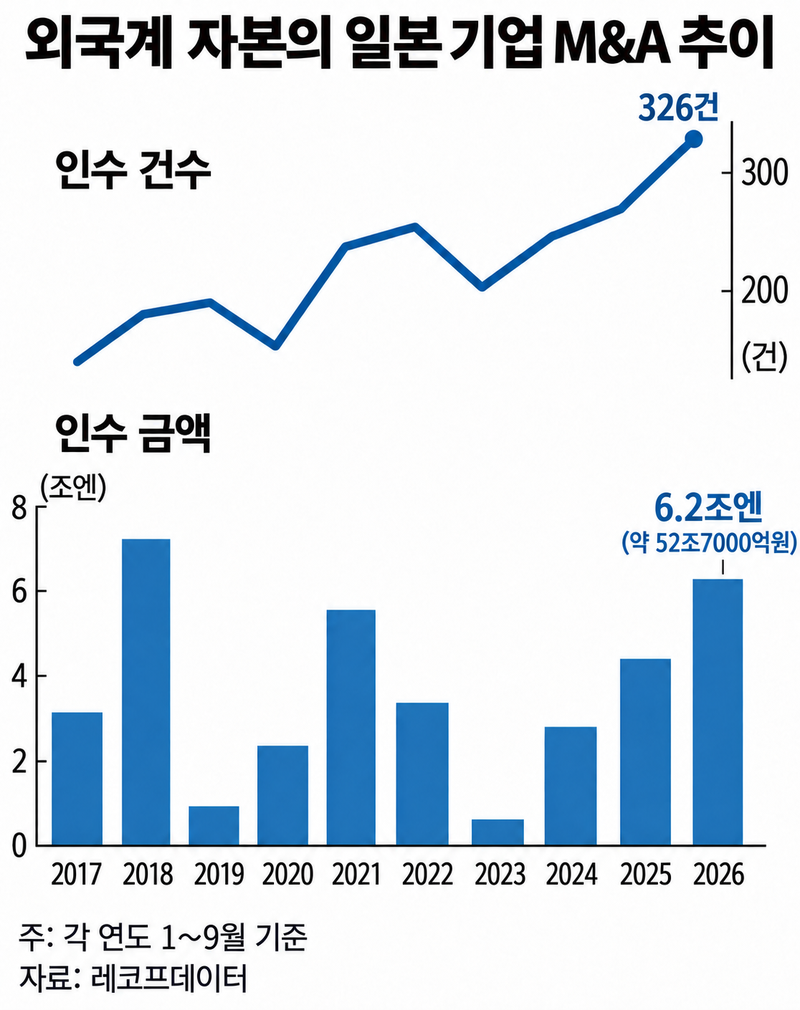
According to the Nikkei newspaper on the 13th, there were 3,883 M&A deals involving Japanese companies from January to September this year, as tallied by M&A research firm Recof Data—the highest figure ever for the same period. Overseas investors made 326 acquisitions of Japanese companies, an increase of at least 20% from the same period a year earlier.
The value of acquisitions by foreign capital rose 40% to about 6.2 trillion yen (about 52.7 trillion won). It exceeded last year’s full-year total and was the third-largest annual figure on record.
By contrast, the total value of M&A deals involving Japanese companies fell 20% from the same period a year earlier to 22 trillion yen (about 187 trillion won). This reflects a base effect from the concentration of large-scale restructurings last year, including Nippon Telegraph and Telephone Corporation’s (NTT’s) move to make NTT DATA Group a wholly owned subsidiary.
Large acquisitions by foreign private equity firms stood out. U.S. firm Apollo Global Management acquired Nippon Sheet Glass for about 590 billion yen (about 5.015 trillion won) and took it private. KKR and others agreed to acquire major chemical company Taiyo Holdings for about 500 billion yen (about 4.25 trillion won).
A takeover battle is underway for Kakaku.com, which operates the restaurant information service Tabelog. European firm EQT AB launched a tender offer (TOB), while LY Corporation joined forces with U.S. firm Bain Capital to make a rival proposal, triggering a bidding war that drove up the price.
Overseas funds are also increasing the capital available for investment in Japan. In April, EQT AB established a $15.6 billion Asia-Pacific-focused fund (about 20.84 trillion won). It is expected to have the capacity to invest several hundred billion yen in Japan. Bain Capital also announced in May that it would raise a $10.5 billion Asia fund (about 14 trillion won), saying it planned to allocate roughly half of it to Japan.
Spin-offs and sales by major Japanese companies are also boosting deal activity. Renesas Electronics sold its timing components business, which is essential to the operation of electronic circuits, to U.S.-based SiTime. It expects to recognize a gain on the sale of about 443.3 billion yen (about 3.7681 trillion won) in the July–September quarter this year.
U.S. firm Warburg Pincus acquired student housing company JSB for about 200 billion yen (about 1.7 trillion won). It was the firm’s first take-private acquisition since re-entering Japan last year.
The weak yen has lowered the cost of acquisitions for overseas investors. Meanwhile, after the Tokyo Stock Exchange called on listed companies to improve their price-to-book ratios (PBRs) in 2023, more companies have moved to sell non-core businesses and improve capital efficiency.
Ryo Kiyota, co-head of investment banking at Citigroup Securities, said that the corporate acquisition guidelines announced by Japan’s Ministry of Economy, Trade and Industry in 2023 had brought the country’s M&A market closer to international practices, and predicted that the market could become even more active.
The strengthening next year of the “minimum tax,” an additional tax system for high-income earners, is also prompting companies to bring sales forward. As the threshold for applying the tax is lowered and the rate rises, founders and business owners are looking to sell stakes or businesses before their tax burden increases. Several investment funds said they had received more inquiries from business owners about selling.
There were 833 M&A deals aimed at business succession from January to September this year, an increase of at least 10% from the same period a year earlier. That was the highest figure since records began in 2007.
Rising interest rates and the resulting increase in financing costs are a potential headwind. However, some expect the impact on the acquisition market to be limited, as Japanese interest rates remain lower than those in other countries.
[email protected] Seo Hye-jin Reporter