South Korean Ambassador to the U.S. Kang Kyung-wha: “Noting Trump’s willingness to engage in U.S.-North Korea dialogue ... explained the controversy over the ‘Kusong remarks’ to the U.S.”
- Input
- 2026-10-13 00:56:23
- Updated
- 2026-10-13 00:56:23
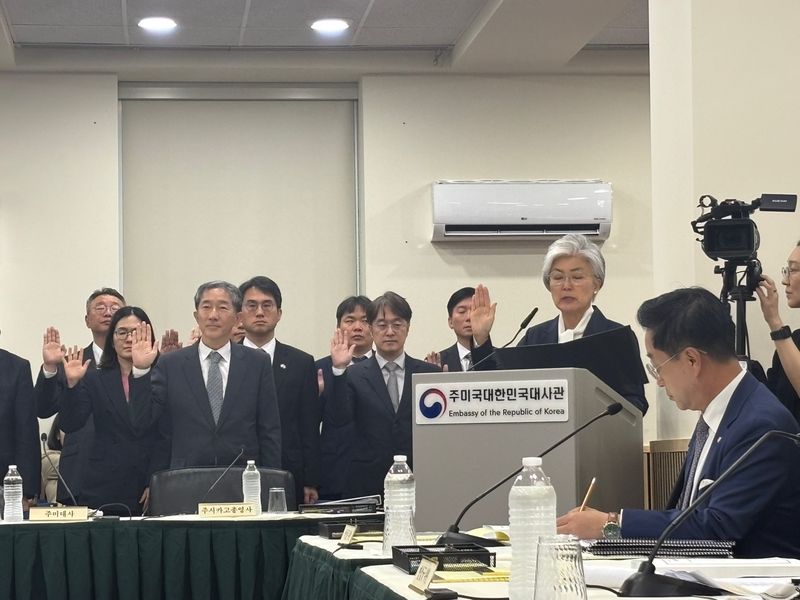
[Financial News] South Korean Ambassador to the U.S. Kang Kyung-wha spoke positively on the 12th of U.S. President Donald Trump’s willingness to engage in dialogue with North Korea, and said South Korea and the U.S. would continue close coordination on North Korea as “peacemakers” and “pacemakers.”
At a work briefing during the National Assembly Foreign Affairs and Unification Committee’s parliamentary audit at the embassy in Washington, D.C., that day, Kang said, “South Korea and the U.S. reaffirmed their shared position on North Korea’s complete denuclearization and peace and stability on the Korean Peninsula, as well as their shared understanding on resuming dialogue.” She also emphasized that the two countries would seek further cooperation, both bilaterally and with Japan, on occasions such as the Group of 20 (G20) summit to be held in Miami, U.S., this coming December.
Regarding the recent controversy over Unification Minister Chung Dong-young’s remarks about “North Korea’s Kusong nuclear facilities,” she said, “After speaking with Minister Chung, I conveyed an explanation of the matter to the U.S. through the usual consultation channels.” Responding to concerns about signs of strain in the South Korea-U.S. alliance, Kang added, “Support for the alliance and the bonds surrounding it run deep across U.S. political circles and society,” and, “We need to carefully analyze the direction of U.S. foreign policy and manage the relationship.”
Kang also reported that South Korea would deliver tangible results in strategic industries such as nuclear energy, nuclear-powered submarines and advanced technology as follow-up measures to agreements between the two countries’ leaders, including the South Korea-U.S. Joint Fact Sheet. In particular, she cited three recently announced plans to pursue strategic investments in the U.S., including Texas natural gas power-generation facilities and the Alaska LNG project, and said active efforts were also being made to address concerns raised by some members of the U.S. Congress about “South Korea discriminating against U.S. companies (in connection with Coupang),” as well as the Trump administration’s moves to impose tariffs.
Kang also proposed rebuilding the aging embassy building and increasing the budget for inviting U.S. congressional officials to South Korea. However, when the work briefing ran long during the audit that day, some lawmakers expressed regret, saying, “At a time when public concern about relations with the U.S. is high, the briefing lacked a sense of urgency.”
[email protected] Park Ji-hyun Reporter