Samsung Electronics hits a ‘107 trillion won jackpot’—so why are its shares heading the other way?
- Input
- 2026-10-13 05:30:00
- Updated
- 2026-10-13 05:30:00
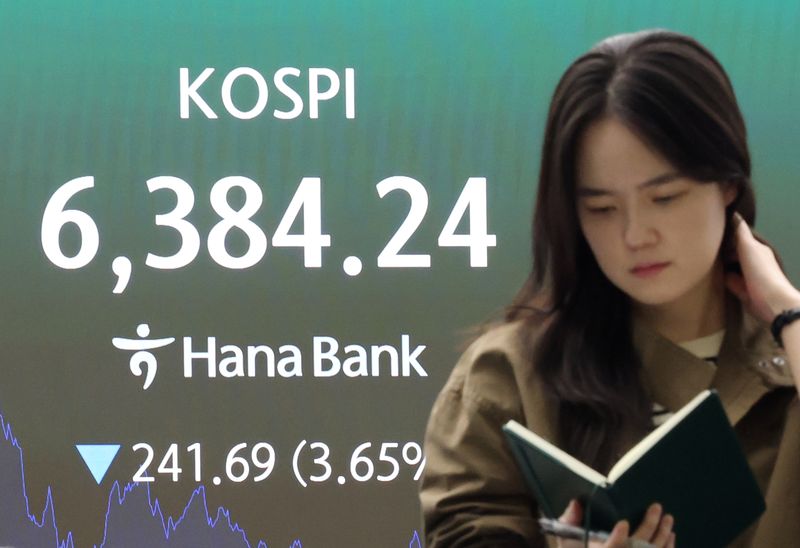
[Financial News] The KOSPI has crumbled despite a run of record earnings at Korean-listed companies. A massive sell-off by foreign investors, which overshadowed even Samsung Electronics’ surprise earnings announcement, sent the index tumbling below the 6,400 mark in a single stroke. The market’s valuation (share prices relative to earnings) has plunged to historic lows as stock prices fall and profits rise, but fears of a “peak-out” and a lack of investor inflows have left the market unable to find a catalyst for a rebound.
The KOSPI closed at 6,384.24 on the 12th, down 241.69 points (3.65%) from the previous trading day. After topping 7,000 on the 2nd, the index fell 8.85% in just four trading days, dropping below 6,500 and even 6,400. The KOSDAQ also slid 3.46% to 861.41.
A surge of foreign selling targeting the two leading semiconductor stocks drove the index’s steep decline. On the main board that day, Samsung Electronics closed down 4.39% at 250,500 won, while SK hynix fell 4.28% to 1,605,000 won.
The market’s response was cool even though Samsung Electronics announced on the 8th record preliminary third-quarter operating profit of 107.4 trillion won. Foreign ownership of Samsung Electronics common shares fell to 46.38%, its lowest level since January 2008. Foreign investors continued their net selling for five consecutive trading days, including that day, and their net sales of KOSPI shares over the most recent 100 days since July alone exceeded 50 trillion won. Meanwhile, individual investors’ purchases made near the market peak—about 83.6 trillion won in the KOSPI 7,000–9,000 range—could become a potential supply overhang if the market rebounds, analysts say.
The sharp divergence between earnings and share prices has sent valuation indicators to rock-bottom levels. According to FnGuide, the KOSPI’s 12-month forward price-to-earnings ratio (PER) stood at 5.11 times as of the 8th. That was a 54.8% plunge from 11.30 times at the end of October last year. Although net profit at 634 KOSPI-listed companies surged 333.3% year on year in the first half of this year, share prices failed to keep pace, effectively halving their valuations.
Brokerages see the decline as the result of mounting doubts about the durability of the semiconductor supercycle and global macroeconomic uncertainty. The market is dominated by concerns that earnings growth, led by Korea’s semiconductor sector, could slow amid debate over the profitability of AI infrastructure sparked by OpenAI, geopolitical tensions in the Middle East, and the burden of U.S. Treasury yields and high oil prices. Eugene Investment & Securities forecast that the growth rate of domestic companies’ earnings per share (EPS) would slow from 237% this year to 33% next year and 6.3% in 2028.
Market experts cite a turnaround in foreign investor flows and confirmation of global indicators as the key to reversing sentiment. They expect a sustained return by foreign investors to be possible only once the sustainability of AI demand and stability in inflation and interest rates are confirmed through the U.S. September consumer price index (CPI) and ASML’s earnings announcement on the 14th, TSMC’s earnings on the 15th, and earnings briefings (IR) by SK hynix and Samsung Electronics scheduled for the end of this month.
Some argue that the market’s extreme undervaluation presents a long-term buying opportunity. Daishin Securities and others have analyzed that the KOSPI could gain enough momentum to recover to the 7,700 level even if its forward PER merely returned to around six times. In the short term, however, a cautious approach is warranted, with investors advised to prepare for volatility until foreign net buying in spot shares and external macroeconomic factors become clearer.
[email protected] Moon Young-jin Reporter