[Editorial] Europe's spreading fiscal crisis: Pay down debt while coffers are overflowing
- Input
- 2026-10-12 18:18:16
- Updated
- 2026-10-12 18:18:16
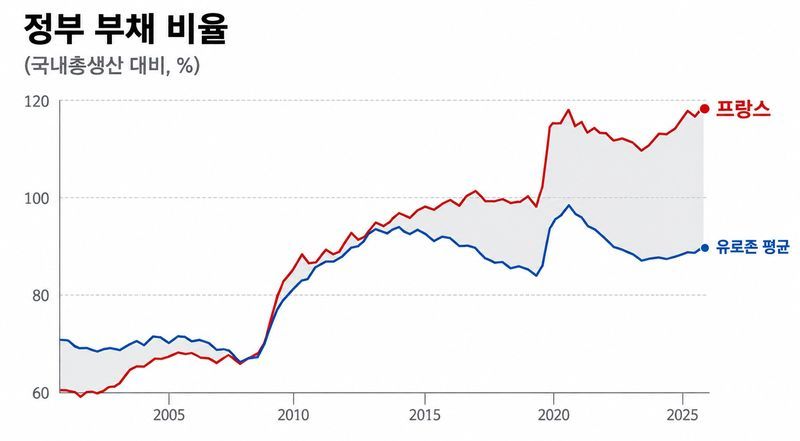
France, one of the Eurozone's two economic pillars alongside Germany, is sliding into a fiscal crisis after years of excessive government spending. Yields on French 10-year government bonds have neared 5%, reaching their highest level since 2002—higher than the level in Greece when it was previously pushed into a fiscal crisis. France's fiscal deficit is the second-largest among major economies, after that of the United States.
Rising welfare spending and tax-cutting policies are said to be behind France's fiscal crisis. Government policies in recent years, described as populist, are said to have sharply increased spending. Looking further back, France was already taking advantage of low interest rates and borrowing excessively in the 1990s, when its debt-to-GDP ratio was around 60%, pushing itself toward crisis. As fears of a fiscal crisis mount, foreign investors are shifting to bonds issued by safer countries, driving yields even higher.
France's fiscal deficit currently stands at 5.1% of GDP, and interest payments on government bonds are said to account for two-thirds of it. The sell-off in French government bonds is spreading across Europe, including to Italy. Italy's economy teetered on the brink of default more than a decade ago and only narrowly recovered; now, following France, its national debt is once again coming under scrutiny. As the crisis that began in France spreads to neighboring countries, the euro appears to be wavering as well.
The fiscal crises in European countries have much to teach South Korea. The government's forecast for South Korea's national debt-to-GDP ratio this year is 51.6%. That is relatively low compared with European countries, but debt is surging year after year. The situation in the government bond market, which had even prompted concern, has changed thanks to recent growth and increased tax revenue. The national debt ratio, which had seemed destined to keep rising, is expected to fall as GDP—the denominator—grows. The government projects a national debt ratio of 48.3% for next year.
But this is no reason for complacency. The recent rise in growth and increase in tax revenue have depended entirely on a boom in semiconductors. In other words, if the semiconductor market cools, growth will slow again, and the country could return to the days when it worried about low growth.
The government plans to use tax revenue collected in excess of expectations to establish a future response fund and direct spending to young people, growth engines, local areas, education and talent. The aim is to channel funding into areas where investment is essential while tax revenues are plentiful. Such funds have precedents abroad, and if investment from the fund boosts growth, it could create a virtuous cycle in which tax revenue continues to increase.
However, there are lessons to heed as we take a close look at the realities facing countries such as France. The more abundant tax revenues are, the more important it is to repay debt and prevent national debt from surging. France ignored this and managed its finances recklessly, leading to the crisis it faces today. We should learn from its example.
An increase in tax revenue should not mean spending it all; at least a certain share should also go toward repaying government bonds and reducing the scale of bond issuance. In particular, we must not forget that populism among politicians who disregard the state of public finances is always a chief culprit behind crises.