“An A grade despite anticipating controversy over ‘Assassin(s)’” vs. “Business viability, not historical perspective” ... Dispute over KOCCA’s valuation report [2026 Parliamentary Inspection of the Administration]
- Input
- 2026-10-12 17:19:39
- Updated
- 2026-10-12 17:19:39
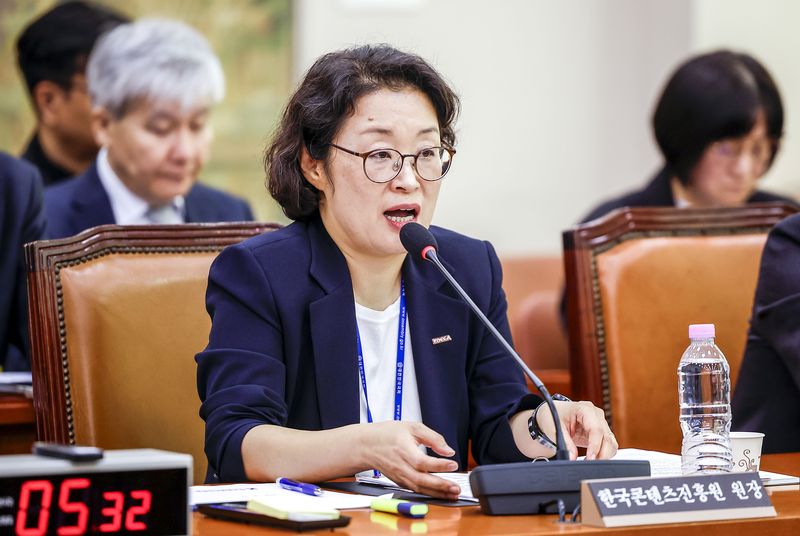
[Financial News] The ruling and opposition parties clashed over the Korea Creative Content Agency’s (KOCCA) content valuation report, which gave the film ‘Assassin(s)’ an A grade.
At the National Assembly Culture, Sports and Tourism Committee’s Parliamentary Inspection of the Administration on the 12th, Yoon Yong-geun of the People Power Party and Cho Gye-won of the Democratic Party of Korea clashed over KOCCA’s valuation criteria for ‘Assassin(s)’ and the responsibilities of public institutions.
Yoon Yong-geun: “An A grade despite saying it was hard to gauge its quality... The basis for the assessment is unconvincing”
Rep. Yoon Yong-geun asked whether the possibility of controversy over historical distortion had been considered during the assessment. KOCCA President Kim Yun-ji replied that she understood the evaluators had been aware of the issue and checked whether the production company was preparing for it.
Rep. Yoon first took issue with the report’s assessment of the “appropriateness of the planning.” He said the report described the shooting of Yuk Young-soo and Moon Se-gwang’s confession and execution as “things only vaguely known,” and concluded that a project delving into the background could come across as fresh.
He asked, “Were the shooting of Yuk Young-soo, Moon Se-gwang’s confession, and his execution historical facts or things only vaguely known?” He pointed out that “the problem is treating historical facts as things only vaguely known.”
He also questioned the assessment of the director’s capabilities. Rep. Yoon noted that the report’s SWOT analysis said it was “difficult to gauge the director’s filmmaking quality in the political espionage thriller genre,” yet gave the director’s capabilities an A grade.
Rep. Yoon argued that the assessment results could give companies investing in or providing loans for content a misleading impression, and called for KOCCA to submit its current content valuation criteria and proposed improvements before the comprehensive audit.
Cho Gye-won: “Economic viability, not political leanings... Support without interference”
Rep. Cho Gye-won countered by emphasizing the purpose of KOCCA’s valuation. He asked, “Isn’t content valuation a system for assessing a work’s economic value and business potential, rather than a film’s historical perspective or political leanings?” President Kim replied, “That’s right.”
Rep. Cho also expressed concern that criticism of a work could turn into attacks on individual creators. Referring to concerns raised by members of the film industry, including the Korean Film Directors’ Guild, he asked, “People’s homes, personal information, livelihoods, and safety shouldn’t be threatened because they took part in a work, right?” President Kim agreed.
He also sought her views on cinematic imagination. President Kim replied, “Film is a space where imagination can fully unfold, so I think it can contain all kinds of stories.” She also agreed with Rep. Cho’s remark that evaluating and interpreting a work is up to the audience.
Rep. Cho stressed, “We must never return to an era when culture and the arts were censored and blacklists were created,” adding, “It is unacceptable for politics to interfere in filmmaking and threaten creative freedom.”
He went on to invoke the principle of “support without interference,” saying, “What is right is right regardless of whether one is in the ruling or opposition camp, and what must be protected must be protected,” and called on KOCCA to make its position clear.
[email protected] Shin Jin-a Reporter