Pay disclosure in job postings: job seekers’ rights vs. a hiring slowdown...Labor Ministry: “We agree on the need”
- Input
- 2026-10-12 16:15:42
- Updated
- 2026-10-12 16:15:42

According to data submitted by Saramin, JobKorea and Incruit—the three job-information service providers—to Rep. Lee Yong-woo of the Democratic Party of Korea, a member of the National Assembly’s Climate, Energy, Environment and Labor Committee, pay was specified in 40.9% (2,099,039) of the 5,124,371 recruitment ads posted by companies last year. The figures point to three out of every five job ads failing to disclose pay information in advance.
Rep. Lee said that if job seekers, especially young people, repeatedly apply without knowing the pay level and then withdraw from the hiring process or leave their jobs early, “it is a waste for the country,” adding that he believes legislation is needed to establish a system for advance disclosure of pay information.
Whether employers should be required to disclose pay levels to job seekers in advance of interviews or hiring has been a recurring debate in past governments and the National Assembly. In 2018, the Anti-Corruption and Civil Rights Commission also recommended drawing up a plan to require disclosure of pay conditions in job postings to protect job seekers’ right to choose and their right to know.
Multiple amendments to the Fair Hiring Procedure Act with this goal have been introduced in the National Assembly, mainly by the Democratic Party of Korea and the Justice Party. They include requiring companies to disclose salary ranges in advance in recruitment ads and other materials, incorporating the principle of equal pay for equal work, and requiring employers to notify successful candidates of specific working conditions—including pay and personnel matters—within three days of confirming their hire. The bills aim to support job seekers’ decision-making rights, narrow pay gaps linked to employment type, and reduce frequent resignations and re-employment.
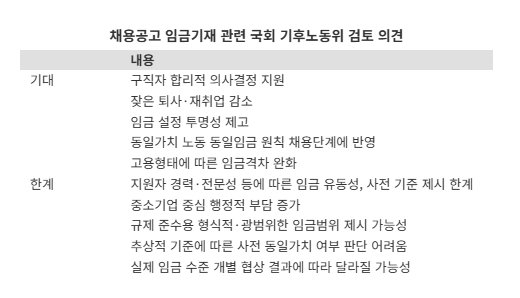
In its review report on the relevant bills, an expert adviser to the National Assembly’s Climate and Labor Committee also said several issues warranted consideration: the possibility of increased administrative burdens on small and medium-sized enterprises with inadequate HR and compensation systems; questions about effectiveness, such as companies setting excessively broad salary ranges to comply with the rules; and the difficulty of determining equal work of equal value using abstract criteria.
The Ministry of Employment and Labor, which oversees the Fair Hiring Procedure Act, says it will work to improve the transparency and accessibility of pay information overall by introducing a system for disclosing pay distributions by company and industry, while also considering a requirement to specify pay in recruitment ads.
A Ministry of Employment and Labor official explained, “Requiring pay disclosure in recruitment ads is related to the pay-distribution disclosure system we are currently working to introduce, but it is a separate policy matter. We agree on the need to provide pay information at the hiring stage, and will support the legislative discussions so that reasonable improvements can be made, taking into account the system’s effectiveness and acceptance in the workplace.”
[email protected] Kim Jun-hyeok Reporter