Foreign Investors’ 2 Trillion Won Sell-Off Sends KOSPI Below 6,400 [fn Closing Market Wrap]
- Input
- 2026-10-12 16:10:10
- Updated
- 2026-10-12 16:10:10
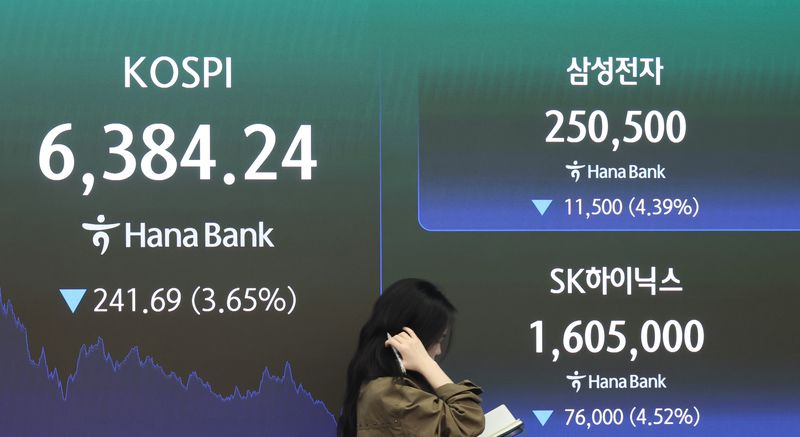
[Financial News] The KOSPI fell below the 6,400 mark for the first time in a little over two months amid aggressive foreign selling. The pressure on investor sentiment is believed to have grown as concerns mounted over the profitability of the artificial intelligence (AI) industry, on top of external headwinds such as rising oil prices and U.S. Treasury yields. With domestic stocks held back by supply-and-demand pressures, market analysts see an inflow of foreign buying as key to a rebound.
According to the Korea Exchange on the 12th, the KOSPI closed at 6,384.24, down 241.69 points (3.65%) from the previous trading day. Opening down 0.72% at 6,578.17, the index showed little sign of a rebound and fell below the 6,500 and 6,400 marks in succession in a single day. It has declined for four consecutive trading days since the 6th, and recorded its biggest drop in about a month since falling 3.99% on the 2nd of last month. The KOSDAQ, which had topped 900 last week, also closed at 849.19, down 43.08 points (4.83%), amid selling by institutional and foreign investors.
By investor group, foreign investors were net sellers of 2.0194 trillion won on the main board, while institutions sold a net 110.9 billion won. Foreign investors have been net sellers for five consecutive trading days. Individual investors and institutions bought a net 1.4792 trillion won and 662.1 billion won, respectively, but failed to limit the losses.
Although industry conditions remain solid, with Samsung Electronics posting quarterly operating profit in the 107 trillion won range, a global-leading level, semiconductor stocks saw steep declines as foreign-led selling flooded the market. Samsung Electronics fell 2.42% on the day it announced its results and plunged a further 4.39% today, closing at 250,500 won. SK Hynix has also fallen for four consecutive trading days, with its closing price dropping to 1,605,000 won (down 4.52%) that day.
Among the KOSDAQ’s largest companies by market capitalization, Alteogen closed at 299,500 won, down 4.77%. EcoPro ended at 84,200 won (down 8.38%), while Jusung Engineering fell 5.61% to 252,500 won.
The securities industry identified foreign investor flows as the biggest source of pressure on the domestic stock market. Lee Jae-won, a researcher at Yuanta Securities, said, “The biggest concern for the domestic stock market right now is not semiconductor earnings but foreign investor flows. Samsung Electronics’ third-quarter operating profit exceeded market expectations, and memory prices and investment in AI infrastructure remain solid, but the KOSPI continues to underperform amid sustained foreign selling.”
The gap in demand following the completion of share buybacks is also a factor. Yuanta Securities noted that the end of share buybacks by major semiconductor companies, which have supported the index amid foreign selling, is heightening concerns about investor flows. It also pointed to whether additional shareholder-return policies will be announced in earnings reports at the end of this month as something to watch.
Hana Securities cited a shift by foreign investors to net buying in the cash market as a condition for a rebound. Kim Du-eon, a researcher at Hana Securities, said, “Even record earnings could not overcome foreign investors’ selling pressure. For improved earnings to lead to gains in the index, buying to support it is needed; in the current market environment, we see an easing of foreign selling pressure as the starting point.”
Meanwhile, analysts have also suggested that South Korea’s stock market is diverging from global markets benefiting from AI because of its heavy reliance on earnings growth centered on memory chips. Lee said, “High interest rates, high oil prices and geopolitical uncertainty have intensified selling recently, but there are limits to explaining foreign investors’ outflows since the start of the year solely by macroeconomic factors. Even among countries benefiting from AI, differences are emerging in share-price resilience and the sustainability of growth that investors are pricing in.”
[email protected] Joo Won-gyu Reporter