Samjin Pharmaceutical-Supported Study Finds Differences in Treatment After Cardiac Stent Procedures
- Input
- 2026-10-12 14:31:41
- Updated
- 2026-10-12 14:31:41
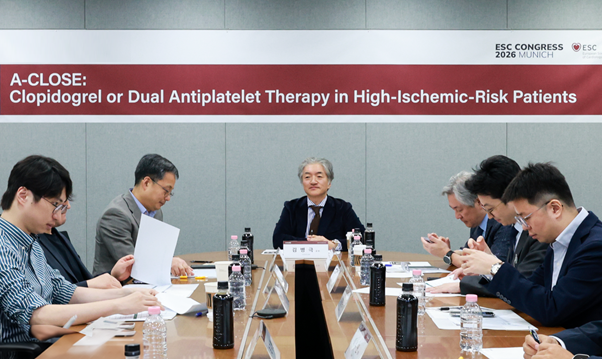
Samjin Pharmaceutical said on the 12th that it had held an A-CLOSE Wrap-up Meeting on the 6th at a research center in Magok, Gangseo-gu, Seoul, to share the findings of the A-CLOSE study and discuss its clinical significance and how it could be applied in real-world practice. Attendees included the study’s principal investigator, Professor Kim Byeong-geuk of the Department of Cardiology at Yonsei University Severance Hospital, as well as medical staff from Myongji Hospital, Gachon University Gil Medical Center and Severance Hospital.
The A-CLOSE study enrolled 3,203 high ischemic-risk patients about 12 months after receiving drug-eluting stents. The researchers randomly assigned 1,601 patients to clopidogrel monotherapy and 1,602 to extended dual antiplatelet therapy (DAPT), in which they continued combination treatment with clopidogrel and aspirin, and followed them for 24 months.
The rate of total clinical events, the primary endpoint that included death, myocardial infarction, stent thrombosis, stroke and bleeding, was 5.0% in the monotherapy group and 5.1% in the extended DAPT group. The study confirmed that monotherapy was noninferior to extended DAPT.
However, the rates of ischemic events and bleeding differed. The ischemic event rate was lower in the extended DAPT group, at 1.6%, than in the monotherapy group (3.7%). By contrast, the bleeding rate was lower in the monotherapy group, at 1.8%, than in the extended DAPT group (4.1%). Both differences were statistically significant.
The researchers explained that the findings provide evidence that treatment decisions for high ischemic-risk patients should be based on an assessment of both ischemic and bleeding risks, rather than on uniformly lowering or raising treatment intensity. It was also suggested that real-world care should take into account not only patients’ clinical characteristics but also lesion complexity and procedural characteristics. The fact that the study largely included relatively young patients was also noted as something to consider when applying the results.
Professor Kim Byeong-geuk said, “The A-CLOSE study provides direct comparative evidence on long-term antiplatelet treatment strategies for patients at high risk of ischemia one year after stent procedures,” adding, “Samjin Pharmaceutical supported the study so that Korean medical professionals could directly investigate questions arising in clinical practice, enabling us to produce meaningful results.”
Kim Sang-jin, president of Samjin Pharmaceutical, said, “It is meaningful that a Korean study was presented at the ESC Hot Line session and published in NEJM,” adding, “We will support Korean medical professionals in generating evidence and advancing academic research in long-term antiplatelet treatment, where both the prevention of ischemic events and the risk of bleeding must be considered.”
[email protected] Jeong Sang-hui Reporter