"EU to cap imports of Chinese hybrids at 350,000 a year"... Takes effect Dec. 1 [Lee Seok-woo's Global 24]
- Input
- 2026-10-12 14:45:04
- Updated
- 2026-10-12 14:45:04
[Financial News] The European Union (EU) will introduce a safeguard measure on Dec. 1, limiting imports of Chinese hybrid electric vehicles (HEVs) to 350,000 a year. The two sides agreed to set the cap at 350,000 vehicles in the first year and raise it by 6% annually thereafter. The measure will apply for four years.
According to the Financial Times (FT) and other foreign media on the 11th, local time, the EU and China have agreed to set quotas for imports of Chinese hybrid vehicles and impose additional tariffs on shipments exceeding the quotas.
The two sides have decided, for now, to prevent the trade conflict from escalating by having the EU impose import quotas on Chinese hybrid vehicles and China accept them.
Next year, exports of Chinese hybrid vehicles to the EU are expected to be reduced by as much as more than 700,000 vehicles compared with previous forecasts. Through August this year, exports of Chinese hybrid vehicles to the EU had reached 760,000. The EU’s trade deficit with China is also expected to shrink by around €10 billion to €14 billion (approximately 15 trillion to 21 trillion won). However, the joint statement issued by China’s Ministry of Commerce did not specify the scale of the reduction.
The agreement applies to both hybrid vehicles and plug-in hybrid vehicles (PHEVs). It covers vehicles of all origins imported into the EU, including from countries with which the EU has free trade agreements (FTAs).
The agreement will somewhat ease the competitive pressure South Korean automakers face from Chinese hybrid vehicles in the EU. However, under World Trade Organization (WTO) rules, the quotas apply to all exporting countries, so hybrid vehicles made in South Korea and exported to Europe will also be affected by the quotas.
EU imposes tariffs of up to 45% on Chinese electric vehicles, but only 10% on hybrids
In 2024, the EU imposed tariffs of up to 45% on Chinese battery electric vehicles, while applying only the standard 10% tariff to hybrid vehicles.
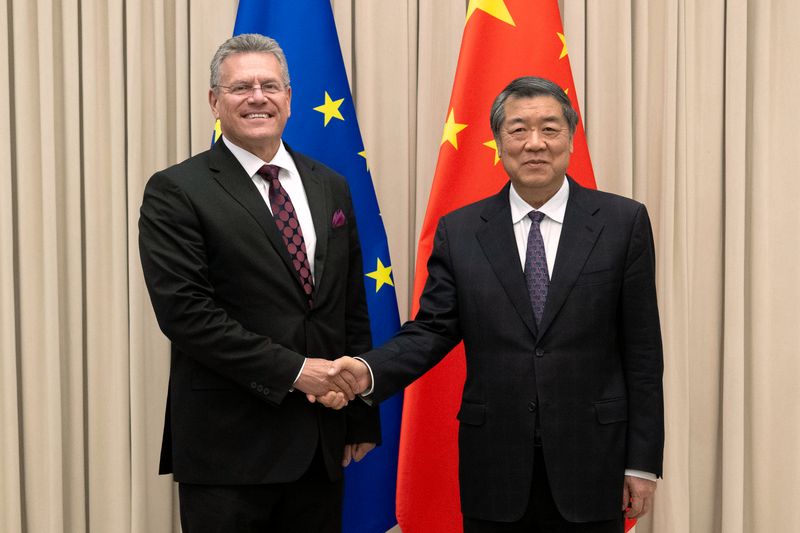
The agreement followed negotiations in Beijing on the 8th and 9th between EU Trade Commissioner Maroš Šefčovič and Wang Wentao, China’s Minister of Commerce. Šefčovič described the agreement as a “first step” toward future trade negotiations.
According to the joint statement released on the 9th, the two sides reached an understanding on trade in hybrid vehicles in a manner consistent with WTO rules.
At a press conference, Šefčovič said, “We reached a common understanding on regulating exports of Chinese-made hybrid and plug-in hybrid vehicles to the EU. This opens up the possibility of reducing China’s exports by more than half.”
He added that China had agreed to lower tariffs on some goods, including EU-made auto parts and olive oil, which would result in savings of at least €225 million (approximately 338 billion won).
However, the measure requires approval from EU member states before it can be finally implemented. The EU moved to restrict imports because low-priced Chinese hybrid vehicles are rapidly gaining ground in the European market. Imports of Chinese hybrid vehicles surged more than tenfold, from 3,800 in October 2024 to about 50,000 in July this year alone.
Through August this year, China exported a total of 1.56 million finished vehicles to the EU, including 760,000 hybrid vehicles.
[email protected] Lee Seok-woo, International Affairs Specialist Reporter