AI to Detect Warning Signs Early ... Sixth Basic Plan for Suicide Prevention Finalized
- Input
- 2026-10-12 16:18:09
- Updated
- 2026-10-12 16:18:09
On the 12th, the government held the 11th Suicide Prevention Policy Committee meeting at the Government Complex Seoul, chaired by Prime Minister Han Seong-suk. It appointed the committee’s fourth cohort of civilian members and deliberated on and finalized the “Sixth Basic Plan for Suicide Prevention.”
The plan integrates and supplements the “2025 National Suicide Prevention Strategy,” drawn up last September, and measures in nine areas announced from June to September this year by the Pan-Governmental Life Guardianship Promotion Headquarters, which was launched in December that year. The nine areas are students and adolescents; people facing financial hardship; emergency suicide response; management of suicide sites; media and online environments; isolated people and families in crisis; caregiving burdens; specialized occupations; and support for the recovery of crime victims. New tasks, including mental health treatment and the use of AI and data, were also added, elevating the plan to a statutory basic plan under the Suicide Prevention Act.
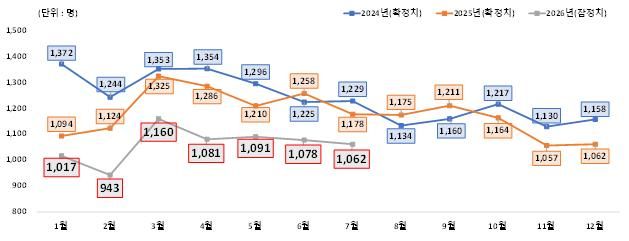
According to the Ministry of Health and Welfare, the suicide rate in 2024 was 29.1 deaths per 100,000 people, the highest since 2012, but fell to 27.8 last year. Monthly suicide rates have declined year on year since October last year. Provisional statistics from the National Data Agency show that 7,432 people died by suicide from January to July this year, down 1,043, or 12.3%, from 8,475 in the same period last year.
Vision: “A Strong Foundation (B.A.S.I.C.)” ... Five Key Strategies Set Out
The plan’s vision is “A Korea that honors life, built on a strong foundation (B.A.S.I.C.) in a society where protecting life is the norm.” Five strategies have been developed to address the shortcomings of previous plans, including their focus on a single ministry, reliance on applications, inadequate action on root causes, insufficient use of data, and lack of cooperation between local governments and the private sector. The plan also sets a target of reducing the suicide rate from 29.1 in 2024 to 18.9 or lower by 2030, a 33.3% reduction.
First, under the “Life-Saving Safety Net (Basic Safety Net)” strategy, a National Suicide Response Office will be established to monitor suicide attempts at the national level and support local responses. Staffing at suicide prevention centers will increase from 5.0 to 7.1 people per center next year, and temporary protection services for up to 24 hours will also be provided to people who attempt suicide but are not hospitalized. The number of Regional Psychiatric Emergency Medical Centers will rise from 14 currently to 17 by 2030, while Life and Love Crisis Response Centers will increase from 93 last year to 103 next year. The treatment-cost support limit for people who attempt suicide will be raised in stages from 1 million won to 1.5 million won, and the cap on support for emergency hospitalization fees will rise from 4.5 million won to 6 million won.
Second, the “Active Outreach” strategy aims to move away from waiting for people to apply and toward a system in which relevant agencies identify risks first. It will expand links between mental health care institutions and suicide prevention centers for high-risk groups, and identify people at risk using tools such as the integrated platform for identifying households in crisis. The current simplified classification of suicide motives, which has seven categories, will be broken down into 27 subcategories, with a foundation established for combining and analyzing the data alongside health insurance and social security benefit data. The government will pursue AI-based suicide-risk prediction and analysis of trends by region, and introduce AI for repetitive tasks, including writing counseling logs for the 109 helpline, so that specialists can focus on their core work.
Third, the “Structural Support” strategy addresses socioeconomic factors such as debt, poverty, isolation and caregiving burdens. To provide people strained by excessive debt with one-stop information and connections to relevant relief and support programs, a nationwide debt counseling hotline for all citizens (1375) will begin operating in October. Support for financially vulnerable people will also be expanded, including through specialized financial products. Other measures include raising the standard median income by 6.7% next year, providing emergency living-cost assistance to people at high risk of suicide, and expanding family caregiving leave.
Fourth, under the “Integrated Care” strategy, lead agencies will be designated for each group or issue: the Ministry of Education for adolescents, the Ministry of Justice for crime victims, the Ministry of National Defense for military personnel, and the Financial Services Commission (FSC) for debt. Measures for students and adolescents include fostering a classroom culture centered on questions and discussion and conducting a “Student Mental Health Survey.” The government will also pursue an amendment to the Act on Special Cases Concerning the Punishment, etc. of Child Abuse Crimes to define cases in which parents die after killing their children as “child murder,” not “accompanied suicide.” One-stop support for families bereaved by suicide has been expanded nationwide since June this year, and a “bereaved family protection officer” system, a tentative name, will also be introduced to intervene immediately after an incident.
Fifth, the “Community Accountability” strategy aims to build a locally led system in which local governments and the private sector share responsibility. Suicide rates and prevention efforts will be evaluated for each local government, with results made public after a set grace period. High-performing local governments will receive awards and financial incentives.
2030 Performance Targets ... Implementation Made Mandatory for Ministries and Local Governments
With the plan elevated to a statutory plan, heads of central government ministries and city and provincial governors are required to draw up and implement action plans based on it, and the Minister of Health and Welfare will evaluate them each year. The Office for Government Policy Coordination will oversee implementation, with the goal of delivering substantial results by 2030.
“Protecting the lives of the people is one of the state’s most important duties,” Prime Minister Han said. “Suicide is not the responsibility of any one ministry; it is a problem that the entire government must take responsibility for and resolve.” Han added, “We will closely review each local government’s performance, spread practices that have proved effective on the ground, and strengthen support for outstanding local governments through evaluations and financial assistance.”
[email protected] Jung Myeong-jin, Medical Correspondent Reporter