Chey Tae-won: “A transition to a ‘new capitalism’ that rewards social value is needed”
- Input
- 2026-10-12 14:59:59
- Updated
- 2026-10-12 14:59:59
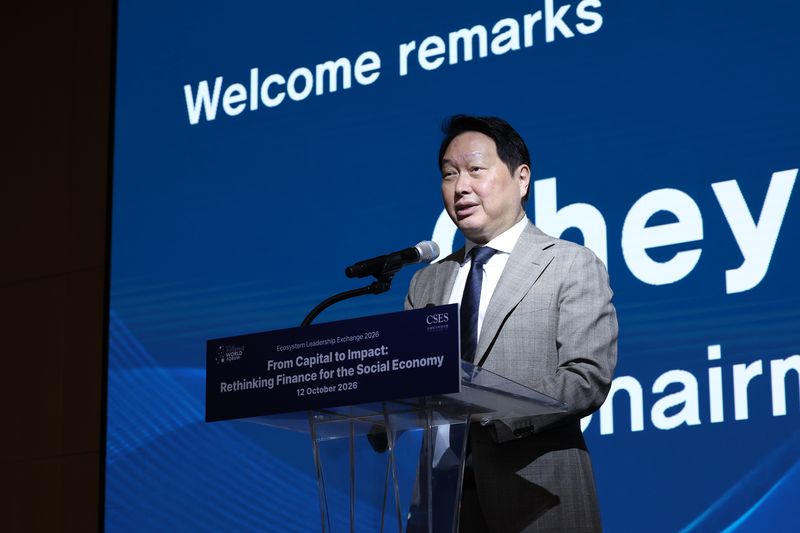
[Financial News] Chey Tae-won, chairman of SK Group, said on the 12th, “Just as capitalism and democracy operate together, we must accelerate the transition beyond the pursuit of profit to a ‘New Capitalism’ in which the creation of social value is rewarded.”
In his keynote address at the first Ecosystem Leadership Exchange (ELE), hosted by the Social Enterprise World Forum (SEWF) in Seoul that day, Chairman Chey said, “Relying solely on altruism cannot achieve the scale needed to address growing social problems. A sophisticated, performance-based incentive system that stimulates voluntary motivation is essential.”
In a joint foreword to the report ‘The Impact Economy,’ published on the 8th by the World Economic Forum, the Schwab Foundation and the Center for Social Value Enhancement Studies, Chairman Chey also proposed that “market rules and mechanisms that recognize and reward social value are needed for it to lead to actual economic value and resource allocation.” Chey believes that a system is needed to measure social value accurately and substantively, rather than through existing CSR assessment methods, and that recent advances in AI technology can help address this need.
Chairman Chey has now put on the global economic system’s agenda the social value he spent more than a decade testing with social enterprises in Korea.
At the World Economic Forum’s Davos meeting in 2013, he proposed the concept of the Social Performance Incentive (SPC), which would measure the results of efforts to solve social problems and provide compensation commensurate with those results. In response, SK launched the SPC project in 2015, measuring the social performance generated by social enterprises in monetary terms and paying cash incentives in proportion to it. SK and the Center for Social Value Enhancement Studies later expanded their discussions beyond measuring and rewarding social value to include ways to trade it in the market. In other words, Chairman Chey’s SPC is not an experiment for social enterprises, but a methodology for fundamentally changing how the market operates.
In the joint foreword, Chairman Chey said that an experiment had demonstrated “that social value can be measured and linked to financial incentives,” and explained that “the system that determines economic value itself must change to recognize and reward social value, scale it up, and change the rules of the market.” He also stressed that “when multiple actors create social value together, it is unclear who contributed how much,” adding that “regulations, investment, financial linkages and multilateral cooperation frameworks are needed to stimulate demand for purchasing and investing in social value.”
ELE is a new global leadership program established by SEWF to examine a country’s social economy ecosystem on the ground and exchange experiences among countries. SEWF selected Korea as the host of the first ELE and as a place for participants to learn.
Participants in this ELE will discuss the following topics through the 15th: social value reward systems; policies and legislation related to the social economy; private-sector participation and investment; and the development of social economy ecosystems at the national level. They will also visit the National Assembly, public institutions, companies and foundations to examine the policies and institutions, as well as financial and market structures, through which the government, businesses and civil society in Korea have supported social innovation.
[email protected] Park So-hyun Reporter