“They said earnings were strong, yet stocks are flashing blue again” ... Samsung Electronics and SK Hynix fall in tandem as foreign investors sell 1 trillion won
- Input
- 2026-10-12 13:38:15
- Updated
- 2026-10-12 13:38:15
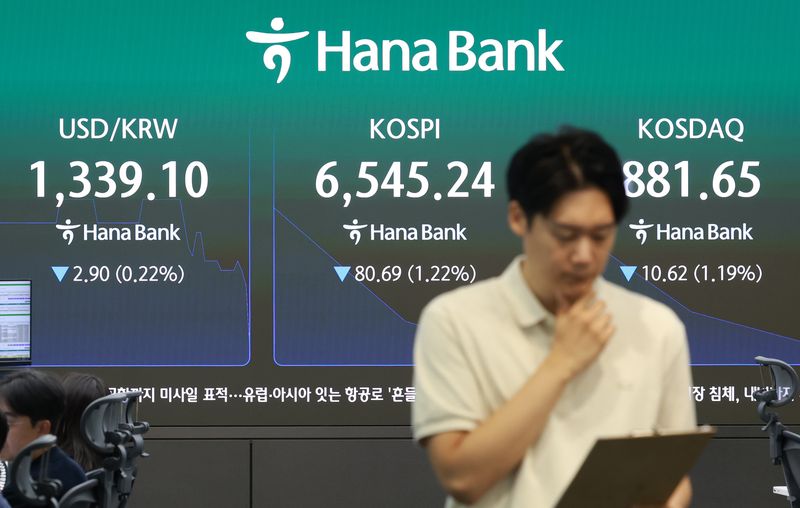
[Financial News] Domestic stocks are falling intraday amid heavy selling by foreign investors. The KOSPI has dropped more than 2%, while the KOSDAQ is down 4%. Despite positive prospects for the semiconductor industry, Samsung Electronics and SK Hynix are both weakening, prolonging the divergence between earnings and share-price performance.
As of 12:30 p.m. on the 12th, the KOSPI was trading at 6,461.80, down 164.13 points (2.48%) from the previous trading day. After opening at 6,578.17, down 0.72% from the previous trading day, the index fell as low as 6,417.13 intraday. The KOSPI has declined for four consecutive trading days since the 6th.
The KOSDAQ was down 35.71 points (4.00%) at 856.56. After opening at 885.53, it fell as low as 855.16 intraday.
At the same time, foreign investors were net sellers of 1.0406 trillion won in the securities market, while institutions were net sellers of 59.7 billion won. Individual investors were net buyers of 699.7 billion won, and other corporations were net buyers of 399.4 billion won.
Large-cap semiconductor stocks were also weak. Samsung Electronics was trading at 255,000 won, down 2.67% from the previous trading day, while SK Hynix was at 1,628,000 won, down 3.15%.
The securities industry identified foreign investor flows, rather than semiconductor earnings, as the biggest burden on the domestic stock market. Analysts said that although Samsung Electronics’ quarterly operating profit exceeded market expectations and memory prices and investment in AI infrastructure remained robust, continued foreign selling was keeping the KOSPI relatively weak.
With foreign selling concentrated in large-cap semiconductor stocks, the end of share buybacks by Samsung Electronics and SK Hynix was also cited as a factor heightening concerns about a gap in buying support. However, analysts expected that additional shareholder-return policies unveiled at the two companies’ earnings announcements and conference calls later this month could ease pressure on investor flows.
Analysts said it would be difficult to expect a rebound in the domestic stock market based solely on stable oil prices and interest rates. Robust U.S. growth, a widening fiscal deficit, and the supply of Treasury bonds and corporate bonds from AI companies are supporting high long-term interest rates, they said, making it important to also watch for changes in corporate earnings forecasts and global capital flows.
Lee Jae-won, a researcher at Yuanta Securities, said, “Rather than trying to predict when foreign investors will return, we should monitor the intensity of spot and futures selling and the trend in non-arbitrage program selling,” adding, “We should maintain the core investment thesis for semiconductors, while adjusting the pace of further increases in portfolio weight in line with the earnings outlook and actual changes in investor flows.”
[email protected] Choi Doo-sun Reporter