KCUE moves to prevent repeat of early-admissions application outage... revises manual and applicant number system
- Input
- 2026-10-12 11:41:46
- Updated
- 2026-10-12 11:41:46
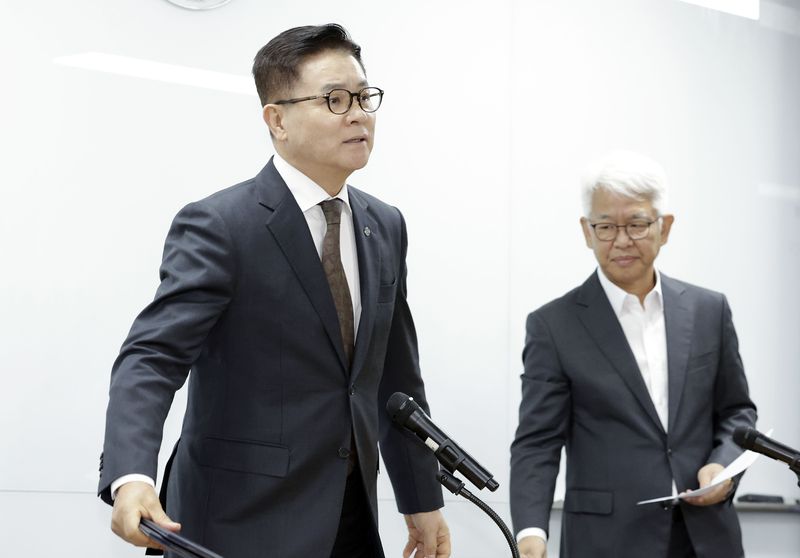
[Financial News] Lee Ki-jeong, chairman of the Korean Council for University Education (KCUE), said the council would comprehensively improve its outage response manual, guidelines for disclosing application rates and applicant number system in response to the system failure during applications for the 2027 academic year’s early admissions, which occurred last month. KCUE plans to conduct a special investigation with the Ministry of Education and other organizations and operate a dedicated task force (TF) ahead of regular admissions to develop measures to prevent a recurrence.
At a parliamentary audit by the National Assembly’s Education Committee on the 12th, Lee said, “As an organization responsible for university admissions procedures, we take this matter very seriously,” adding, “We will work to strengthen the stability of the application system and its management framework so that this does not happen again.”
KCUE is currently conducting a special investigation into the early-admissions system outage with the Ministry of Education and the Korea Advancing Schools Foundation. Based on the findings, it plans to review and improve the entire process, from advance system checks and response procedures in the event of an outage to guidelines on disclosing application rates at individual universities and the applicant number system. It is also operating a dedicated TF to prevent similar outages during regular admissions.
The outage occurred on the 11th of last month, the deadline for early-admissions applications. Connectivity problems began around 5:50 p.m. on the system of Uway Apply, a private application-processing service provider, preventing some applicants from completing their applications and payments normally. The deadline, initially set for 6 p.m., was extended to 7 p.m., but confusion continued, with some applicants failing to see the notice of the extension.
After the deadline was extended, controversy also arose over fairness in the disclosure of application rates by universities. Seventeen universities, including Gyeongin National University of Education, Pukyong National University, Dong-A University, Silla University and Handong Global University, released their application rates shortly after the original 6 p.m. deadline. Calls were made to improve not only follow-up measures for application-system outages but also the timing and criteria for universities’ disclosure of application rates.
KCUE handled relief requests from affected applicants based on electronic records. Lee explained, “We reported the situation to the Ministry of Education as soon as the outage occurred and extended the application deadline to protect applicants’ opportunity to apply,” adding, “We developed relief measures based on objective electronic records, and 354 of the 414 cases confirmed as eligible for relief ultimately completed their applications.” A total of 1,588 relief requests were received, of which 414 were deemed eligible.
The incident also highlighted the need to make the outage response system more effective. KCUE’s outage response manual for the 2027 academic year’s standardized common application system classifies application-service outages at the highest level, “High (Grade 1),” but concerns were raised that it does not provide sufficiently detailed response criteria for after an outage occurs. The fact that mock outage-response drills did not include training on the application provider’s own systems, which handle university selection and payment, was also cited as a problem. The application numbers issued during the application process can also be used to estimate the number of applicants, and this was identified as an area requiring improvement.
Lee also asked the National Assembly that day to expand financial support for universities. “Public expenditure per higher education student in Korea is 72% of the Organization for Economic Co-operation and Development (OECD) average,” he said, stressing that “bold and stable government investment is needed to enhance universities’ international competitiveness and cultivate future talent.”
He also called for support at the national level for universities’ transition to artificial intelligence (AI). “AI is not simply a change in educational tools; it is an important challenge for universities that affects education, research and administration across the board,” he said. “Support is needed to build AI infrastructure and promote sharing and cooperation among universities.”
He also proposed introducing a system that would provide a full tax credit for university donations of 100,000 won, in order to encourage small donations from individuals. “We will fulfill our role with even greater responsibility in building trust in university admissions, strengthening universities’ competitiveness and preparing for the future of higher education in Korea,” he said.
[email protected] Kim Man-ki Reporter