Controversy over audit of Supreme Court justices’ “encouragement” payments... BAI chief: “Investigation has limits... we’ll check whether improvements have been made”
- Input
- 2026-10-12 15:10:03
- Updated
- 2026-10-12 15:10:03
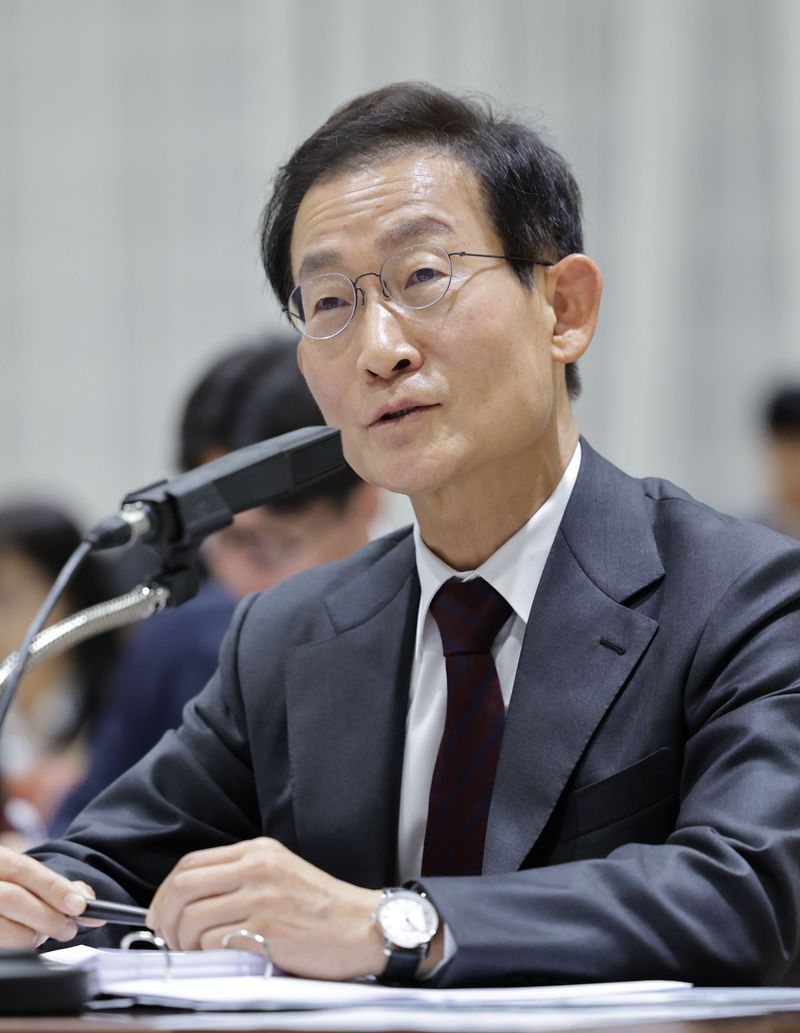
[Financial News] BAI chief Kim Ho-cheol said on the 12th, responding to criticism that the BAI had not sufficiently investigated how Supreme Court justices’ encouragement payments were used, that “there are limits to the investigation.” He said the BAI had confirmed that cash was paid to the justices but had been unable to determine specifically how it was spent, and that it would check whether the caution issued to the Supreme Court was being followed and whether improvements were made going forward.
At the National Assembly Legislation and Judiciary Committee’s audit of the BAI in Jongno-gu, Seoul, that day, Kim said, “We confirmed that the cash payment records showed the money was paid to Supreme Court justices.” He explained that although the BAI had requested the spending records, no such records were kept, and there were also limits on conducting additional in-person interviews or investigations during the financial audit.
Last month, the BAI announced its audit findings that the Supreme Court had paid about 1.3 billion won in cash, without a legal basis, to Supreme Court justices, including the head of the National Court Administration, over just over three years. Chief Justice Cho Hee-dae recently explained at the Supreme Court’s parliamentary audit that he had not been involved in the payments.
At the audit that day, some questioned whether the BAI should have investigated how the money was used after confirming that the payments had been made. Kim Han-gyu, a lawmaker from the Democratic Party of Korea, criticized the BAI’s caution, calling it “an act of letting them off lightly that doesn’t even amount to a slap on the wrist.”
“We were unable to establish the facts regarding the specific spending details,” Kim said, adding, “There may be differences of opinion over whether we need to examine every item of spending individually.”
It also became an issue whether the BAI had agreed with the Supreme Court on its change in payment methods after the audit. When lawmaker Kim asked, “Did you ever agree on how the Supreme Court could pay the encouragement payments going forward?”, Kim replied, “There was no such agreement.”
In response to criticism that the Supreme Court continued to pay the encouragement payments even after the caution was issued, Kim said, “We will check whether the caution is being properly followed and will also see whether there have been improvements in the next audit.”
Responding to calls to refer Chief Justice Cho’s use of a corporate credit card for investigation, Kim said, “I understand that the BAI considered whether the matter could warrant a formal complaint, but concluded that it did not reach that threshold.”
Regarding the use of special activity funds, when People Power Party lawmaker Joo Jin-woo asked, “If a Supreme Court justice played golf with family using special activity funds, would that violate the rules on their use?”, Kim replied, “It would appear to be a violation.”
However, regarding the hypothetical of a president using special activity funds for a family golf outing, he explained, “I do not speak on the assumption that news reports are true or that allegations against any particular person are true. The term ‘Supreme Court justice’ does not identify a specific person, but the president can be identified, so it would not be appropriate for me as BAI chief to comment.”
Kim also reaffirmed his position that those responsible would be held accountable for the controversy over targeted and coercive audits. In his opening remarks that day, he said the BAI was pursuing institutional reforms, including abolishing the Special Investigation Bureau and strengthening internal controls, adding, “Procedures are under way to hold those involved strictly accountable.”
Asked whether there would be a shake-up involving officials who led past audits, he also said, “Through the Operational Reform Task Force and the Parliamentary Investigation Follow-up Task Force, we are holding those responsible fully accountable for coercive and illegal audits.”
Explaining why the findings changed in the reconsiderations of the West Sea civil servant shooting incident and the audit into statistical manipulation, he said, “New facts that our audit had not uncovered emerged during the parliamentary investigation.” He added, “The conclusions are reached by considering the assessment of evidence, the discovery of new facts, the omission of important facts, and other factors.”
Questions were also raised about the political impartiality of audit commissioners appointed under the current administration. Responding to a question about whether the Blue House had intervened in the process of nominating audit commissioners, Kim rejected the suggestion, saying, “There was no pressure from the Presidential Office.”
[email protected] Seong Seok-woo Reporter