Presidential Committee for the Era of Local Autonomy Chair Park Jeong-hyeon: “Future Response Fund Must Not Squeeze Local Governments’ Discretionary Funds”
- Input
- 2026-10-12 12:51:35
- Updated
- 2026-10-12 12:51:35
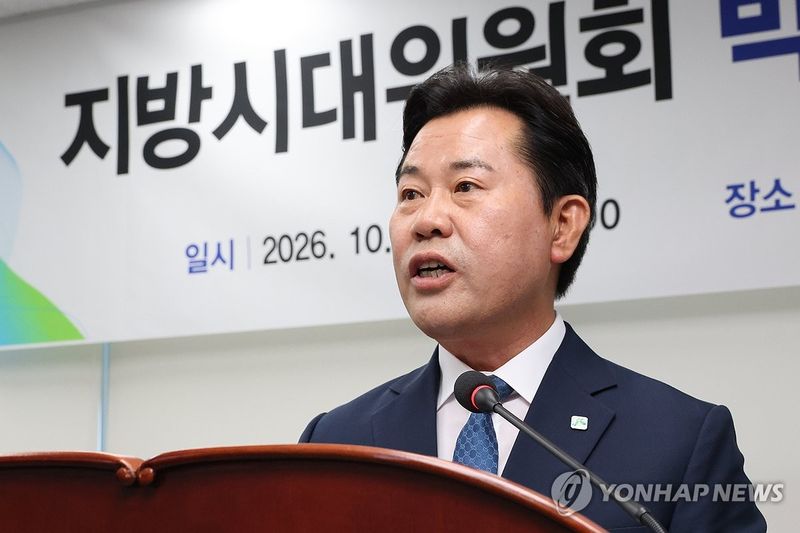
[Financial News] On the 12th, Park Jeong-hyeon, chair of the Presidential Committee for the Era of Local Autonomy under the president, said of the government’s plans to establish the Future Response Fund, “The committee will speak up to ensure that the fund does not squeeze local governments’ discretionary resources, but instead contributes to regional growth and job creation.”
Park, who began his term that day as the committee’s third chair, said concerns that the increase in ordinary local allocation tax available for local governments to use freely could shrink during the fund’s creation process needed to be carefully considered.
The Future Response Fund is a new funding source the government is seeking to establish to focus investment on four areas: the future, youth, local regions and education. Local governments are concerned that if the increase in local allocation tax shrinks as the fund is built up, the resources available for their own projects could be constrained by the same amount.
Park said, “The Future Response Fund itself is not a system designed to reduce local government finances,” but added, “The fund’s overall project size and its impact on local allocation tax need to be considered separately.” He said he would continue consulting with relevant ministries, taking local fiscal conditions and regional views into account.
Park said he would expand the Special Account for Balanced Regional Development and block grants to increase local governments’ fiscal autonomy. Block grants allow local governments to select projects suited to local conditions and allocate budgets within parameters set by the central government.
According to the Presidential Committee for the Era of Local Autonomy, block grants under the Special Account for Balanced Regional Development increased from 3.8 trillion won last year to 10.6 trillion won this year. The government’s budget proposal for next year includes 11.9 trillion won, up 1.3 trillion won from this year. The number of eligible projects also grew from 47 last year to around 121 this year, and the proposal calls for increasing it to 150 next year.
Park said, “Investment in the future and expanding local government finances are not mutually exclusive choices,” adding, “We will continue to expand the resources that regions can decide how to use for themselves through measures such as increasing the Special Account for Balanced Regional Development and block grants.”
Park said he would also strengthen the committee’s role in coordinating policies and budgets. Responding to the view that its status as an advisory committee under the president was a limitation, he said, “The committee does not directly implement projects or execute budgets, but it is not merely an advisory body.”
The committee regularly reports matters it has deliberated on and decided to the president, while relevant ministries must draw up implementation plans and take the necessary measures. The committee can also review progress, report to Cabinet meetings and recommend action to relevant ministries.
Park said, “We will make active use of these legal powers to link and coordinate the policies and budgets of the Budget Ministry, the Ministry of the Interior and Safety, the Ministry of Land, Infrastructure and Transport, and the Ministry of Trade, Industry and Energy, with the five mega-regions, three special provinces and regional growth engines at the center.” He added, “We will make the committee a control tower for balanced growth that delivers results, going beyond deliberation and decision-making.”
He identified balanced growth across the five mega-regions and three special provinces, the second relocation of public institutions to local areas, and the completion of Sejong City as the administrative capital as key priorities after taking office. The plan is to increase corporate investment and jobs in connection with each region’s strategic industries, and to expand local governments’ authority and finances so they can decide for themselves which policies their regions need.
Park previously served as a special policy adviser to former South Chungcheong Province Governor Ahn Hee-jung, vice governor for political affairs of South Chungcheong Province, and mayor of Buyeo County during the seventh and eighth popularly elected terms. He also served as spokesperson and vice chair of the Basic Income Local Government Association.
[email protected] Lee Bo-mi Reporter